Lithariapteryx jubarella
Jubarella Lithariapteryx
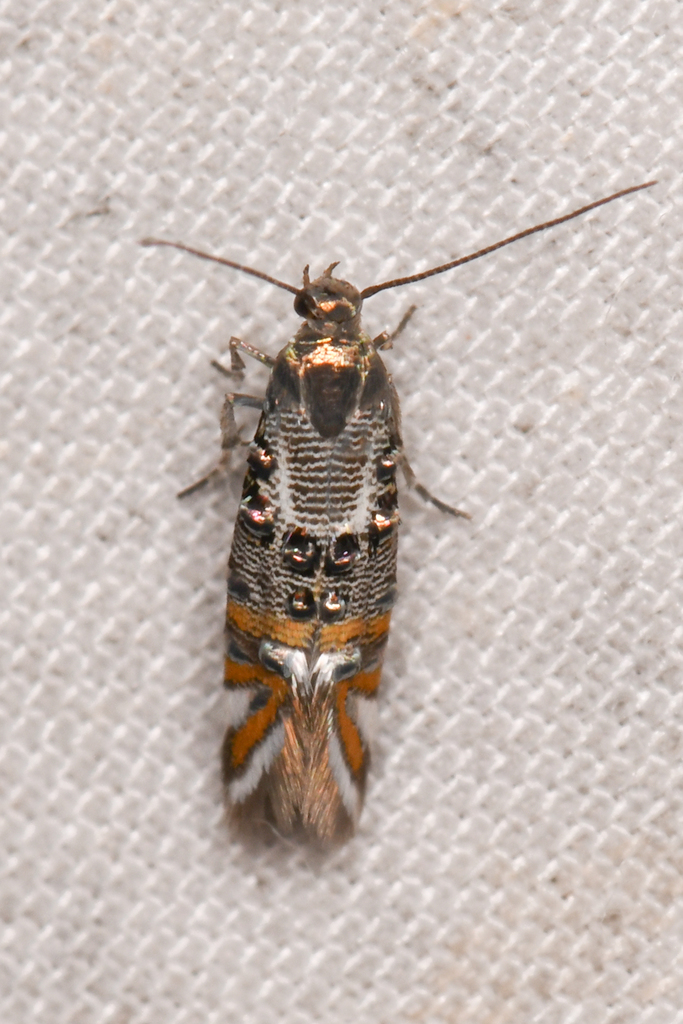
(c) Trevor Van Loon, some rights reserved (CC BY) · licence
Family: Heliodinidae · Class: Insecta · Order: Lepidoptera
Lithariapteryx jubarella (Jubarella Lithariapteryx) is a California animal in the Heliodinidae family.
Lithariapteryx jubarella is a small heliodinid moth in the family Heliodinidae, commonly known as sun moths. Adults have forewings measuring 4.5 to 6.5 millimeters in length (Powell 1991). The species exhibits the typical characteristics of its genus, with narrow forewings and relatively small size compared to other lepidopteran families. Like other members of Heliodinidae, the moths have metallic-scaled wings that may reflect light, contributing to their common name as sun moths. This species is endemic to California's coastal region, with documented occurrences along the Pacific coast. Lithariapteryx jubarella has been recorded in coastal sand dune habitats, particularly in areas supporting native dune vegetation (Powell 1991). The species appears to have a restricted distribution tied to these specialized coastal environments, which are increasingly fragmented along the California coastline. Lithariapteryx jubarella inhabits coastal strand and sand dune ecosystems, environments characterized by sparse vegetation adapted to salt spray, shifting sands, and intense solar exposure. These habitats typically support specialized plant communities including native grasses, herbs, and low shrubs that have evolved to tolerate the harsh coastal conditions. The moth's association with this habitat type suggests adaptation to the unique microclimatic conditions of coastal dunes, including temperature fluctuations, wind exposure, and substrate instability. As a member of the Heliodinidae, Lithariapteryx jubarella likely exhibits diurnal or crepuscular activity patterns, as suggested by the family's common name of sun moths. Many heliodinid species are associated with specific host plants during their larval stage, though the particular host plant relationships for L. jubarella have not been well documented in the available literature. The species was described by Comstock in 1940 and has been assigned Hodges number 2511 in the standardized classification system for North American Lepidoptera. Lithariapteryx jubarella is part of a genus that includes several other California endemic species, including L. elegans and L. mirabilinella, suggesting a pattern of regional speciation within coastal habitats (Powell 1991). The species faces potential conservation challenges common to coastal dune-obligate species, including habitat loss due to coastal development, recreation pressure, and invasive plant species that alter native plant communities. Coastal sand dune ecosystems in California have experienced significant reduction and fragmentation since European settlement, with many remaining patches existing as isolated fragments. The limited distribution and specialized habitat requirements of Lithariapteryx jubarella make it potentially vulnerable to environmental changes, though formal conservation status assessments have not been completed. Like many small moth species with restricted ranges, L. jubarella may face population pressures from climate change effects on coastal ecosystems, including altered precipitation patterns, increased storm intensity, and sea level rise impacts on low-lying dune systems.
Classification
Class: Insecta · Order: Lepidoptera · Family: Heliodinidae
Frequently asked questions
How is Lithariapteryx jubarella classified?
Lithariapteryx jubarella belongs to class Insecta, order Lepidoptera, family Heliodinidae.
What family does Lithariapteryx jubarella belong to?
Lithariapteryx jubarella is in the Heliodinidae family.
What is Lithariapteryx jubarella?
Lithariapteryx jubarella is a small heliodinid moth in the family Heliodinidae, commonly known as sun moths.
Is Lithariapteryx jubarella found in California?
Yes. Lithariapteryx jubarella is recorded in California in The California Species Project's catalogue.
Related species
Other California species in the same genus, family, or bioregion.
Data from The California Species Project — 14,000+ California species with verified data from CNPS, CDFW, USFWS, and more.