Lithobates catesbeianus
American Bullfrog
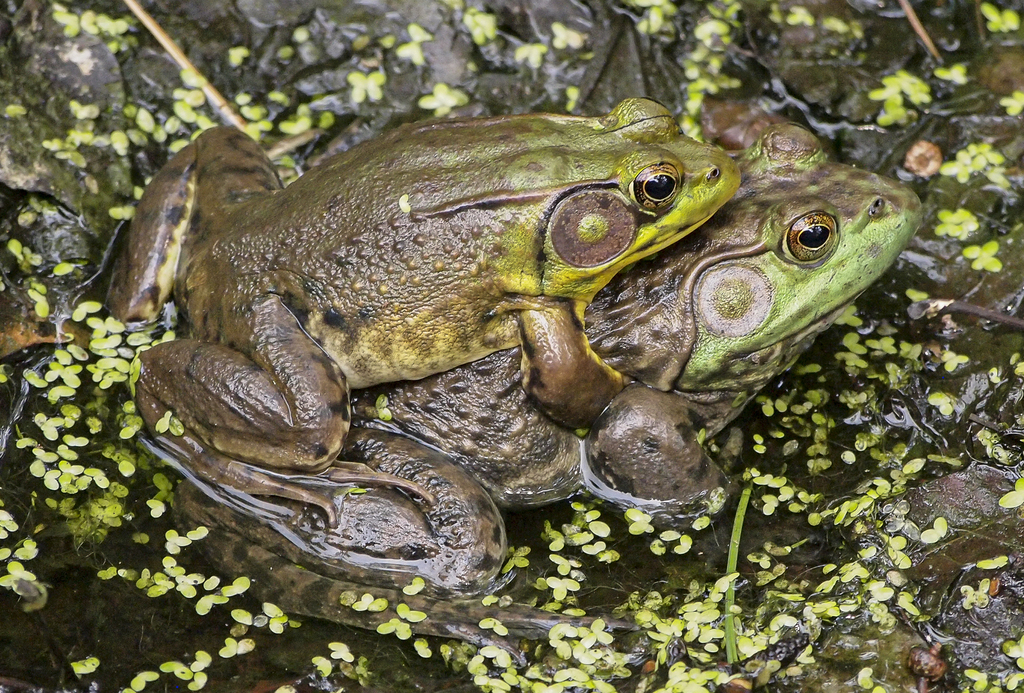
(c) Nell Cant, some rights reserved (CC BY) · licence
Family: Ranidae · Class: Amphibia · Order: Anura
Lithobates catesbeianus (American Bullfrog) is a California animal in the Ranidae family.
The American bullfrog (Lithobates catesbeianus) is the largest native frog species in North America, with adults measuring 90 to 200 mm (3.5 to 7.9 inches) in snout-vent length and weighing up to 750 grams (1.7 pounds). Males are typically larger than females and develop enlarged thumbs during breeding season. The dorsal coloration ranges from olive green to brown, often with darker mottling or spots. The ventral surface is cream to white, frequently with gray mottling on the throat and chest. Adults lack dorsolateral folds, a key distinguishing feature from other ranid frogs. The tympanum (eardrum) is conspicuous and larger than the eye in males, while in females it approximates eye diameter. Originally native to eastern North America from Nova Scotia to central Florida and west to the Rocky Mountains, American bullfrogs have been widely introduced beyond their historic range. In California, established populations occur throughout the Central Valley, coastal regions, and many inland areas below 1,500 meters (4,900 feet) elevation. The species was first introduced to California in the early 1900s for commercial frog farming and has since colonized most suitable aquatic habitats statewide. According to AmphibiaWeb, populations are documented from sea level to approximately 2,100 meters (6,900 feet) elevation in the state. American bullfrogs inhabit permanent or semi-permanent freshwater environments including ponds, lakes, slow-moving streams, reservoirs, and irrigation canals. Adults require water bodies deeper than one meter with emergent vegetation for cover and shallow areas for basking. Tadpoles develop in warm, shallow waters with abundant vegetation and organic substrates. The species tolerates a wide range of water chemistry conditions and can survive in moderately polluted environments. Breeding occurs from late spring through summer, typically May through August in California. Males establish territories in shallow water and produce loud, low-pitched calls described as resembling a bull's bellow. Females deposit 6,000 to 20,000 eggs in floating surface films attached to vegetation. Tadpoles require 4 months to 2 years for metamorphosis, depending on water temperature and food availability. Adults are opportunistic predators consuming insects, crayfish, small fish, frogs, small mammals, birds, and reptiles. Their diet shifts ontogenetically, with smaller individuals feeding primarily on invertebrates and larger adults capable of consuming vertebrate prey. The American bullfrog is not federally listed and maintains stable populations throughout its introduced California range. However, the species is considered an invasive species that negatively impacts native amphibian communities through predation, competition, and disease transmission. Bullfrogs are vectors for chytrid fungus (Batrachochytrium dendrobatidis), which has caused significant declines in native frog species. According to the California Department of Fish and Wildlife, bullfrog control is recommended in areas supporting sensitive native amphibian populations. The species' tolerance for habitat modification and broad dietary requirements have facilitated its successful establishment across diverse California ecosystems.
Classification
Class: Amphibia · Order: Anura · Family: Ranidae
Frequently asked questions
How is Lithobates catesbeianus classified?
Lithobates catesbeianus belongs to class Amphibia, order Anura, family Ranidae.
What family does Lithobates catesbeianus belong to?
Lithobates catesbeianus is in the Ranidae family.
What is Lithobates catesbeianus?
The American bullfrog (Lithobates catesbeianus) is the largest native frog species in North America, with adults measuring 90 to 200 mm (3.5 to 7.9 inches) in snout-vent length and weighing up to 750 grams (1.7 pounds).
Is Lithobates catesbeianus found in California?
Yes. Lithobates catesbeianus is recorded in California in The California Species Project's catalogue.
Related species
Other California species in the same genus, family, or bioregion.
Data from The California Species Project — 14,000+ California species with verified data from CNPS, CDFW, USFWS, and more.