Littorina subrotundata
Newcomb's Littorine Snail
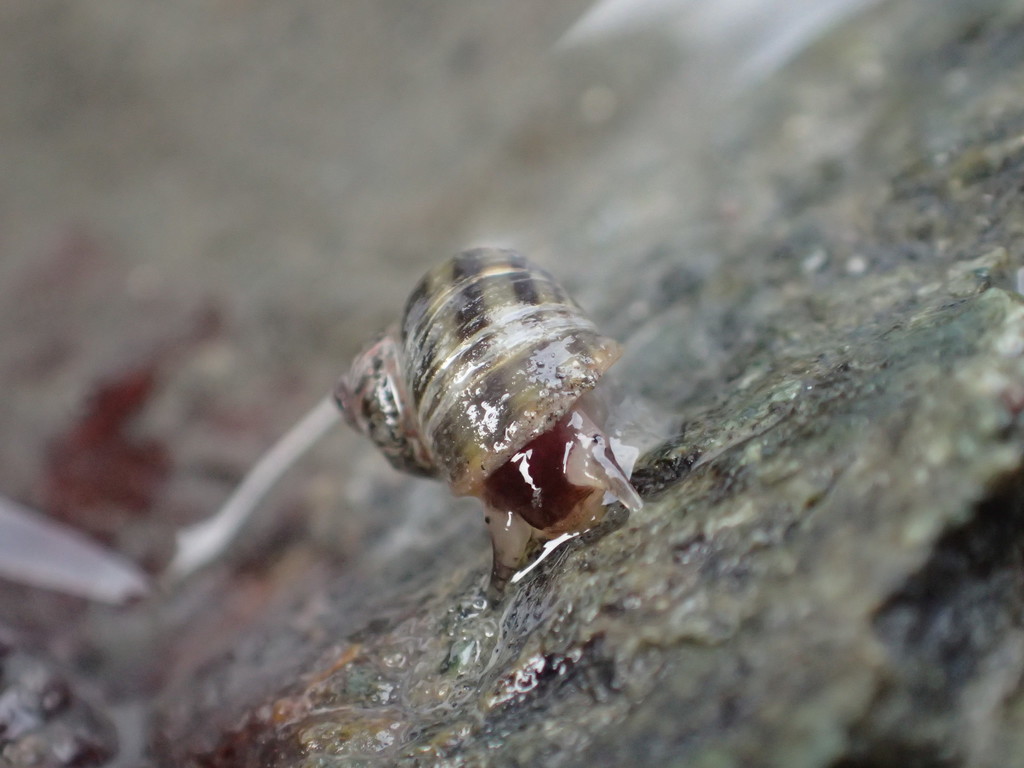
(c) Matt Bowser, some rights reserved (CC BY) · licence
Family: Littorinidae · Class: Gastropoda · Order: Littorinimorpha
Conservation status: G5 S1S2
Littorina subrotundata (Newcomb's Littorine Snail) is a California animal in the Littorinidae family.
Newcomb's littorine snail is a small marine gastropod mollusk in the family Littorinidae. The shell is higher than wide with a fairly globose body whorl and spire composed of approximately four whorls that taper to an acute apex (Invertebrates of the Salish Sea). The species exhibits the thin-shelled morphology characteristic of many littorinid snails, which makes it more vulnerable to predation compared to thicker-shelled relatives such as Littorina sitkana (ScienceDirect). Littorina subrotundata has a broad Pacific coast distribution, ranging from Humboldt Bay in California north to Alaska and extending west to Russia (Encyclopedia of Puget Sound). This extensive range reflects the species' adaptation to North Pacific coastal environments and suggests historical dispersal patterns across the Bering land bridge region. The species inhabits intertidal zones, particularly salt marshes and brackish water environments. In San Francisco Bay, Littorina subrotundata has been documented as one of the dominant species in the middle elevation zone of tidal brackish marshes (USGS San Francisco Bay Study). The species occupies microhabitats within the intertidal zone where it experiences extreme environmental fluctuations, including high temperatures and low humidity during periods of emersion. These challenging conditions represent significant deviations from submerged marine conditions and require physiological adaptations for survival. As an intertidal gastropod, Newcomb's littorine snail likely feeds on algae, detritus, and organic matter typical of littoral zone grazers, though specific dietary studies have not been well documented. The species' ecology involves navigating the complex dynamics of tidal cycles, where individuals must balance feeding opportunities during submersion with desiccation avoidance during low tide exposure. Reproductive behavior follows typical gastropod patterns, though detailed breeding ecology remains understudied. The global conservation rank of G5 indicates that Littorina subrotundata is secure globally, while the California state rank of S1S2 suggests the species is critically imperiled to imperiled within the state. This ranking disparity reflects the species' peripheral occurrence in California at the southern edge of its range, where populations may be naturally limited or face increased environmental pressures. The species faces potential threats common to intertidal organisms, including habitat modification, pollution, and climate change impacts on coastal ecosystems. Sea level rise and altered precipitation patterns could affect the brackish marsh habitats where the species occurs, particularly in California where coastal development pressure is intense. The thin shell morphology that characterizes this species may represent both an adaptation to specific environmental conditions and a vulnerability to predation pressure. Research has demonstrated that thin-shelled littorinids like L. subrotundata suffer significantly higher predation rates compared to species with more robust shell architecture, suggesting that population dynamics may be strongly influenced by predator-prey interactions in intertidal communities.
Classification
Class: Gastropoda · Order: Littorinimorpha · Family: Littorinidae
Conservation status
G5 S1S2
Frequently asked questions
How is Littorina subrotundata classified?
Littorina subrotundata belongs to class Gastropoda, order Littorinimorpha, family Littorinidae.
What family does Littorina subrotundata belong to?
Littorina subrotundata is in the Littorinidae family.
Is Littorina subrotundata protected or of conservation concern?
Littorina subrotundata carries the following status: G5 S1S2.
What is Littorina subrotundata?
Newcomb's littorine snail is a small marine gastropod mollusk in the family Littorinidae.
Is Littorina subrotundata found in California?
Yes. Littorina subrotundata is recorded in California in The California Species Project's catalogue.
Related species
Other California species in the same genus, family, or bioregion.
Data from The California Species Project — 14,000+ California species with verified data from CNPS, CDFW, USFWS, and more.