Lonchura punctulata
Scaly-breasted Munia
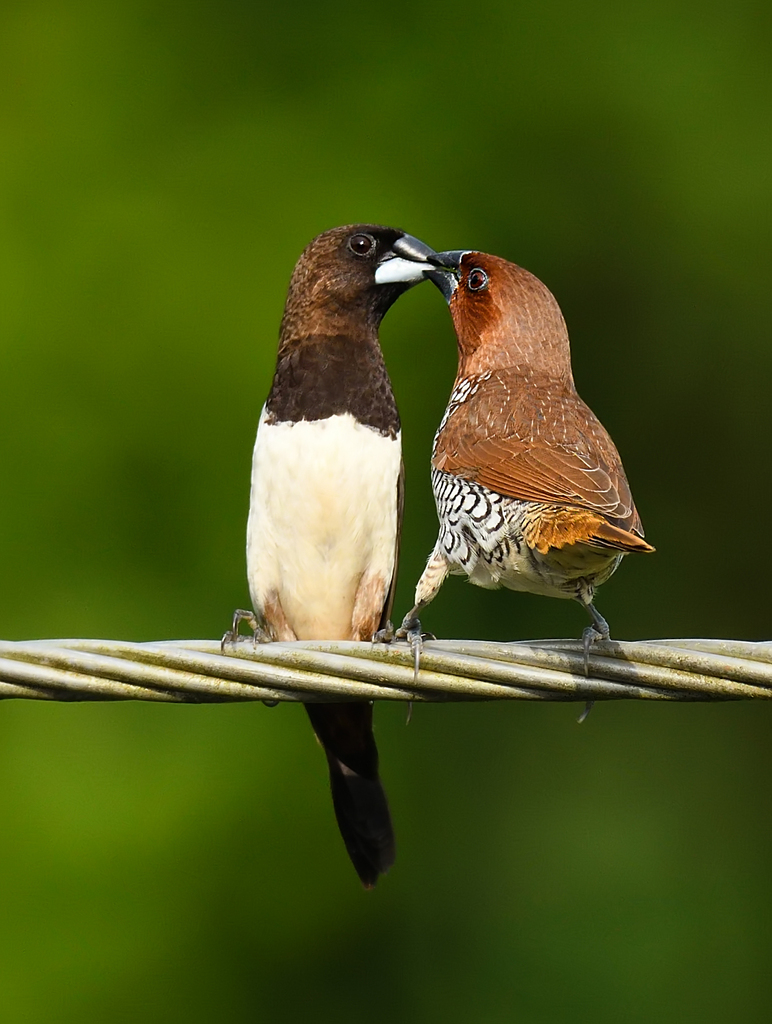
(c) sunnyjosef, some rights reserved (CC BY) · licence
Family: Estrildidae · Class: Aves · Order: Passeriformes
Lonchura punctulata (Scaly-breasted Munia) is a California animal in the Estrildidae family.
The Scaly-breasted Munia, also known as the Nutmeg Mannikin, is a small finch-like bird in the family Estrildidae. Adults measure 11 to 12 centimeters (4.3 to 4.7 inches) in length and weigh approximately 12 to 16 grams. The species exhibits distinct plumage patterns with brown upperparts and a characteristic scaly or spotted appearance on the breast and flanks, created by dark-edged white to buff feathers. The head and throat are chestnut-brown, while the belly is white to pale yellow. Males and females appear similar, though breeding males may show slightly more intense coloration. Juveniles display uniform brown plumage with a pale bill that darkens with age. Native to tropical Asia, the Scaly-breasted Munia has established populations in California through introduction. The species occurs primarily in the Central Valley, coastal areas of Southern California, and parts of the San Francisco Bay Area. Introduced populations have been documented in Los Angeles, Orange, Riverside, San Bernardino, and Ventura counties. The species was first recorded breeding in California in the 1960s, with populations becoming established through escapes and releases from the cage bird trade. Scaly-breasted Munias inhabit open grasslands, agricultural areas, suburban parks, and gardens. They show preference for areas with tall grasses and scattered shrubs or trees for nesting and roosting. The species adapts well to human-modified environments, including rice fields, weedy lots, and residential areas with appropriate vegetation. They typically occur from sea level to approximately 1,500 meters (4,900 feet) elevation in California. The species feeds primarily on grass seeds, particularly favoring small seeds from grasses in the Poaceae family. Foraging occurs on the ground or by clinging to seed heads, often in small flocks outside the breeding season. Breeding occurs from March through September in California, with peak activity during spring and early summer. Pairs construct dome-shaped nests with side entrances, built in dense shrubs, trees, or tall grasses. Females lay three to seven white eggs, which are incubated for 13 to 15 days. Both parents care for nestlings, which fledge after 18 to 21 days. The species may produce multiple broods per season under favorable conditions. The Scaly-breasted Munia is not federally listed and lacks special conservation status in California. As a non-native species, it is not protected under state wildlife regulations. Population trends in California appear stable, with established breeding populations persisting in suitable habitat. The species benefits from agricultural practices that provide seed sources and suburban development that creates edge habitats. Unlike many introduced species, Scaly-breasted Munias have not been identified as significant ecological threats to native bird communities, though they may compete locally with native seed-eating species for food resources.
Classification
Class: Aves · Order: Passeriformes · Family: Estrildidae
Frequently asked questions
How is Lonchura punctulata classified?
Lonchura punctulata belongs to class Aves, order Passeriformes, family Estrildidae.
What family does Lonchura punctulata belong to?
Lonchura punctulata is in the Estrildidae family.
What is Lonchura punctulata?
The Scaly-breasted Munia, also known as the Nutmeg Mannikin, is a small finch-like bird in the family Estrildidae.
Is Lonchura punctulata found in California?
Yes. Lonchura punctulata is recorded in California in The California Species Project's catalogue.
More California species
This species has no close relatives in our California data — here are other species to explore.
Data from The California Species Project — 14,000+ California species with verified data from CNPS, CDFW, USFWS, and more.