Lophocampa maculata
Spotted Tussock Moth
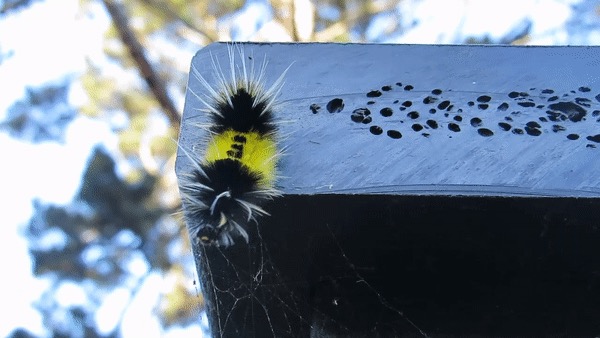
(c) Linzy L., some rights reserved (CC BY-SA) · licence
Family: Erebidae · Class: Insecta · Order: Lepidoptera
Lophocampa maculata (Spotted Tussock Moth) is a California animal in the Erebidae family.
The spotted tussock moth (Lophocampa maculata), also known as the spotted Halisidota or yellow-spotted tiger moth, is a medium-sized moth in the family Erebidae. Adult moths have a wingspan of 35 to 50 mm (1.4 to 2.0 inches). The forewings are cream to pale yellow with distinctive translucent spots scattered across the wing surface, giving the species its common name. The hindwings are typically paler and less marked. Males are generally smaller than females and have more feathery antennae. The larvae are more conspicuous than adults, measuring up to 35 mm (1.4 inches) when fully grown. Caterpillars display dense tufts of hair in various colors including black, white, yellow, and orange. The head is typically black or dark brown, and the body features both short dense setae and longer pencil-like hair tufts that extend from specific segments. These defensive hairs can cause skin irritation in sensitive individuals. Lophocampa maculata occurs across much of North America, including California. The species is distributed from southern Canada south to Georgia and west to the Pacific Coast. In California, populations are found primarily in the northern and central regions, including the Sierra Nevada foothills and coastal ranges. The species extends from sea level to elevations of approximately 2,000 meters (6,600 feet). This moth inhabits deciduous and mixed forests where its host plants occur. Larvae feed on a diverse range of deciduous trees including birches, maples, oaks, poplars, and willows. Adults are typically found in woodland edges, riparian areas, and suburban environments with mature trees. The species shows preference for areas with moderate moisture and partial shade. Spotted tussock moths are univoltine, producing one generation per year. Adults emerge from late spring through early summer, typically from May to July depending on elevation and latitude. Females deposit clusters of 100 to 300 eggs on the undersides of host plant leaves. Eggs hatch after 10 to 14 days, and larvae feed throughout summer, passing through five to six instars before pupating. Caterpillars create cocoons incorporating their body hairs within bark crevices or leaf litter. The species overwinters as pupae. Larvae are gregarious in early instars, feeding in groups that can defoliate small branches. As they mature, caterpillars become more solitary and disperse throughout the host tree. Despite their feeding behavior, spotted tussock moth populations rarely reach levels that cause significant tree damage in natural settings. The spotted tussock moth is not listed under federal or California endangered species legislation. Populations appear stable throughout most of the species' range, though localized declines may occur due to habitat loss from urban development and forest management practices. The species' broad host plant range and adaptability to various forest types provide some resilience against environmental changes. Climate change may affect distribution patterns, particularly at higher elevations where temperature increases could alter suitable habitat.
Classification
Class: Insecta · Order: Lepidoptera · Family: Erebidae
Frequently asked questions
How is Lophocampa maculata classified?
Lophocampa maculata belongs to class Insecta, order Lepidoptera, family Erebidae.
What family does Lophocampa maculata belong to?
Lophocampa maculata is in the Erebidae family.
What is Lophocampa maculata?
The spotted tussock moth (Lophocampa maculata), also known as the spotted Halisidota or yellow-spotted tiger moth, is a medium-sized moth in the family Erebidae.
Is Lophocampa maculata found in California?
Yes. Lophocampa maculata is recorded in California in The California Species Project's catalogue.
Related species
Other California species in the same genus, family, or bioregion.
Data from The California Species Project — 14,000+ California species with verified data from CNPS, CDFW, USFWS, and more.