Lottia gigantea
Owl Limpet
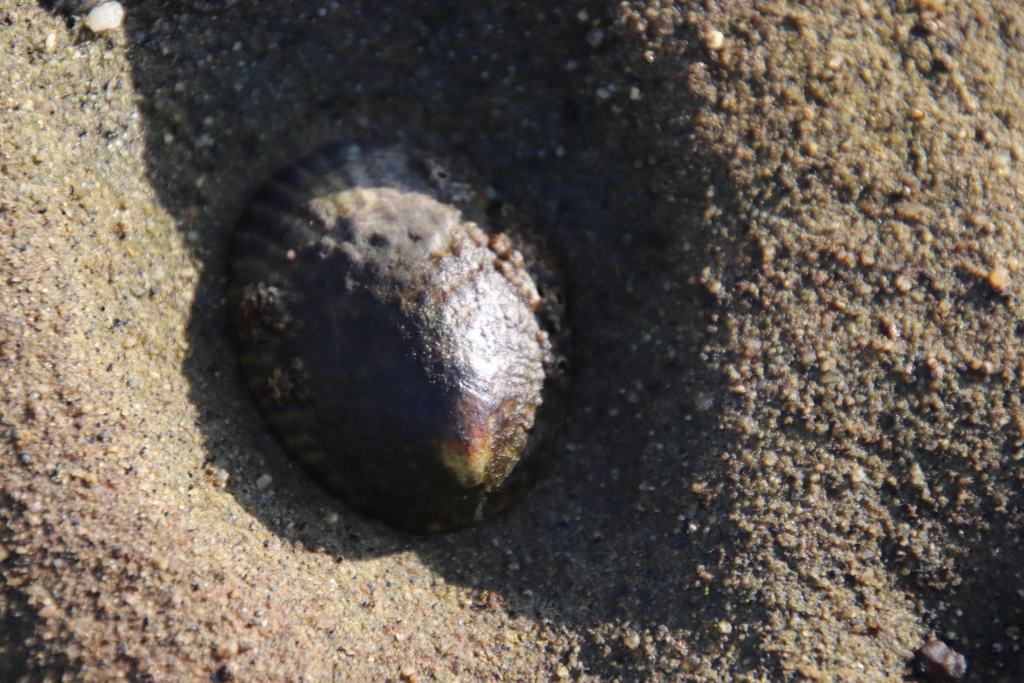
(c) Millie Basden, some rights reserved (CC BY) · licence
Family: Lottiidae · Class: Gastropoda · Order: Patellogastropoda
Lottia gigantea (Owl Limpet) is a California animal in the Lottiidae family.
The owl limpet is the largest limpet species found along the Pacific coast, with shells reaching up to 100 millimeters (3.9 inches) in length. The conical shell is typically brown to gray in coloration with radiating ridges extending from the apex to the margins. The muscular foot, which can be nearly as large as the shell when extended, allows the animal to maintain a powerful grip on rocky surfaces. Adult owl limpets are distinguished from other limpet species by their substantial size and robust, dome-shaped shell profile. Owl limpets occur along the Pacific coast from British Columbia, Canada, to Baja California, Mexico. Within California, the species is distributed along the entire coastline, inhabiting rocky intertidal zones from Humboldt County south to San Diego County. According to the California Department of Fish and Wildlife, owl limpets are found at numerous monitoring sites including locations around the Channel Islands and mainland coast (CDFW 2025). The species exclusively inhabits rocky intertidal zones, typically occurring in the high to mid-intertidal areas where wave action is moderate to heavy. Owl limpets require hard substrate for attachment and are commonly found on exposed rock faces, in crevices, and around tidepools. They demonstrate strong site fidelity, often returning to the same specific location or "home scar" on the rock surface during low tide periods. The species tolerates exposure to air during low tide and can withstand significant wave action during high tide cycles. Owl limpets are herbivorous grazers that feed primarily on algae and diatoms scraped from rock surfaces using their radula, a rasping feeding organ. They exhibit territorial behavior, with larger individuals maintaining and defending feeding territories that can exceed one meter in diameter. Smaller limpets and other herbivorous mollusks are actively excluded from these territories through aggressive interactions. Reproduction occurs through broadcast spawning, with eggs and sperm released into the water column during spring and summer months. The species demonstrates protandric hermaphroditism, functioning as males when smaller and transitioning to females as they grow larger, typically when shell length exceeds 25 to 30 millimeters. Owl limpets currently have no federal or state conservation listing status. The species is monitored as part of the Multi-Agency Rocky Intertidal Network, with standardized protocols established for tracking population density and size distribution at 43 permanent monitoring sites along the California coast (MARINe 2011). These monitoring efforts focus on individuals with shell lengths of 15 millimeters or greater to ensure consistent data collection. While not listed as threatened or endangered, owl limpet populations face ongoing pressures from coastal development, pollution, and climate change impacts including ocean acidification and rising sea levels. The species serves as an important indicator organism for rocky intertidal ecosystem health and is included in California's Marine Life Management Act monitoring protocols for invertebrate species.
Classification
Class: Gastropoda · Order: Patellogastropoda · Family: Lottiidae
Frequently asked questions
How is Lottia gigantea classified?
Lottia gigantea belongs to class Gastropoda, order Patellogastropoda, family Lottiidae.
What family does Lottia gigantea belong to?
Lottia gigantea is in the Lottiidae family.
What is Lottia gigantea?
The owl limpet is the largest limpet species found along the Pacific coast, with shells reaching up to 100 millimeters (3.9 inches) in length.
Is Lottia gigantea found in California?
Yes. Lottia gigantea is recorded in California in The California Species Project's catalogue.
Related species
Other California species in the same genus, family, or bioregion.
Data from The California Species Project — 14,000+ California species with verified data from CNPS, CDFW, USFWS, and more.