Lottia scabra
Rough Limpet
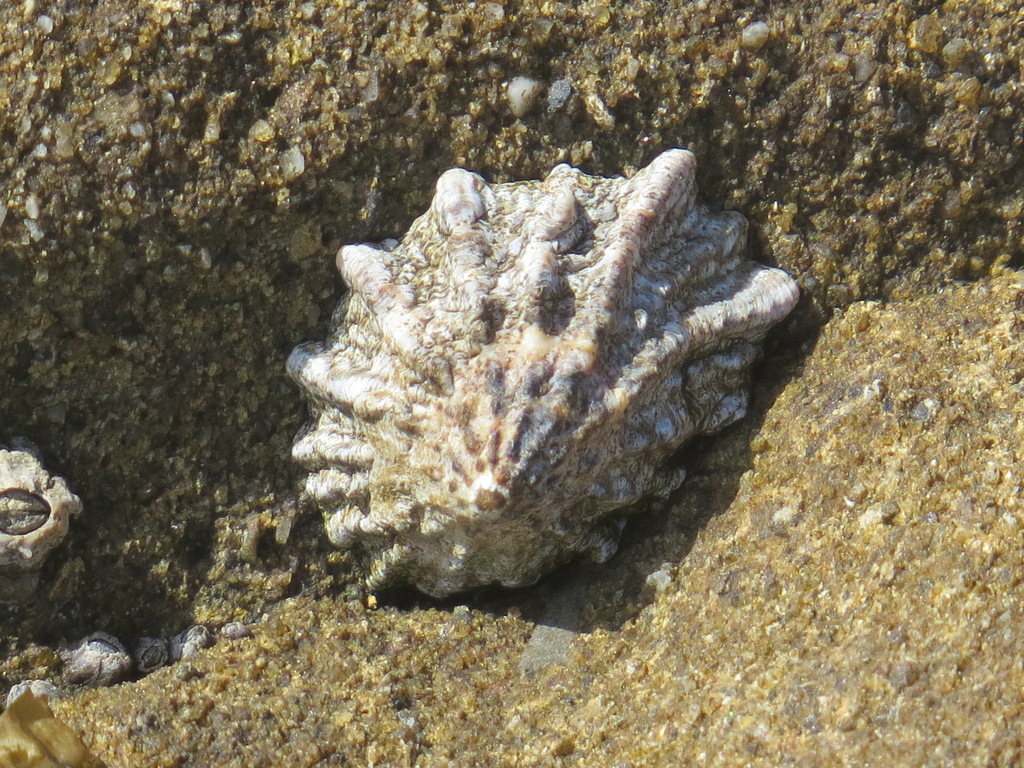
(c) Garth Harwood, some rights reserved (CC BY) · licence
Family: Lottiidae · Class: Gastropoda · Order: Patellogastropoda
Lottia scabra (Rough Limpet) is a California animal in the Lottiidae family.
The rough limpet (Lottia scabra) is a small marine gastropod mollusk belonging to the family Lottiidae. This conical-shelled species exhibits the characteristic limpet form, with a tent-like shell that provides protection while allowing the animal to maintain a tight seal against rocky surfaces. The shell typically measures 15 to 25 mm (0.6 to 1.0 inches) in diameter and displays a rough, ridged exterior surface that gives the species its common name. The shell coloration ranges from grayish-brown to dark brown, often with radiating patterns that help camouflage the animal against rocky substrates. Rough limpets occur along the Pacific Coast from central California to Baja California, Mexico. In California, the species is found from Monterey County southward, inhabiting rocky intertidal zones and shallow subtidal areas. Populations are documented at various marine protected areas including Point Lobos State Marine Reserve and other rocky coastal sites throughout the species' range. The distribution appears to be closely tied to the availability of suitable rocky habitat along exposed coastlines. This species inhabits rocky intertidal and shallow subtidal environments, typically in areas exposed to moderate to heavy wave action. Rough limpets are commonly found attached to exposed rock surfaces, in crevices, and on boulder fields from the mid-intertidal zone to depths of approximately 20 meters (65 feet). They show a preference for hard substrate surfaces where they can maintain secure attachment against wave action. The species tolerates a range of salinity conditions typical of nearshore marine environments. Rough limpets are herbivorous grazers that feed primarily on microalgae, diatoms, and small macroalgal growth on rock surfaces. They use their radula, a rasping feeding organ, to scrape organic material from rocks during foraging activities. Like other limpets, this species exhibits strong site fidelity, often returning to the same home scar on the rock surface after foraging excursions. Reproduction involves external fertilization, with larvae developing in the plankton before settling and metamorphosing into juvenile limpets. The species plays an important ecological role in rocky intertidal communities as both grazer and prey item for various predators including sea stars, crabs, and shorebirds. Currently, Lottia scabra does not appear on federal or state endangered species lists, and specific population trend data are not readily available. However, like many intertidal species, rough limpets face potential threats from coastal development, pollution, ocean acidification, and sea level rise associated with climate change. Rocky intertidal habitats are particularly vulnerable to human impacts including trampling by recreational users, water quality degradation, and habitat modification. The species benefits from protection within marine protected areas along the California coast, where fishing and collection restrictions help maintain natural community structure. Continued monitoring of rocky intertidal communities is important for detecting population changes in this and other ecologically significant species.
Classification
Class: Gastropoda · Order: Patellogastropoda · Family: Lottiidae
Frequently asked questions
How is Lottia scabra classified?
Lottia scabra belongs to class Gastropoda, order Patellogastropoda, family Lottiidae.
What family does Lottia scabra belong to?
Lottia scabra is in the Lottiidae family.
What is Lottia scabra?
The rough limpet (Lottia scabra) is a small marine gastropod mollusk belonging to the family Lottiidae.
Is Lottia scabra found in California?
Yes. Lottia scabra is recorded in California in The California Species Project's catalogue.
Related species
Other California species in the same genus, family, or bioregion.
Data from The California Species Project — 14,000+ California species with verified data from CNPS, CDFW, USFWS, and more.