Loxia curvirostra
Red Crossbill
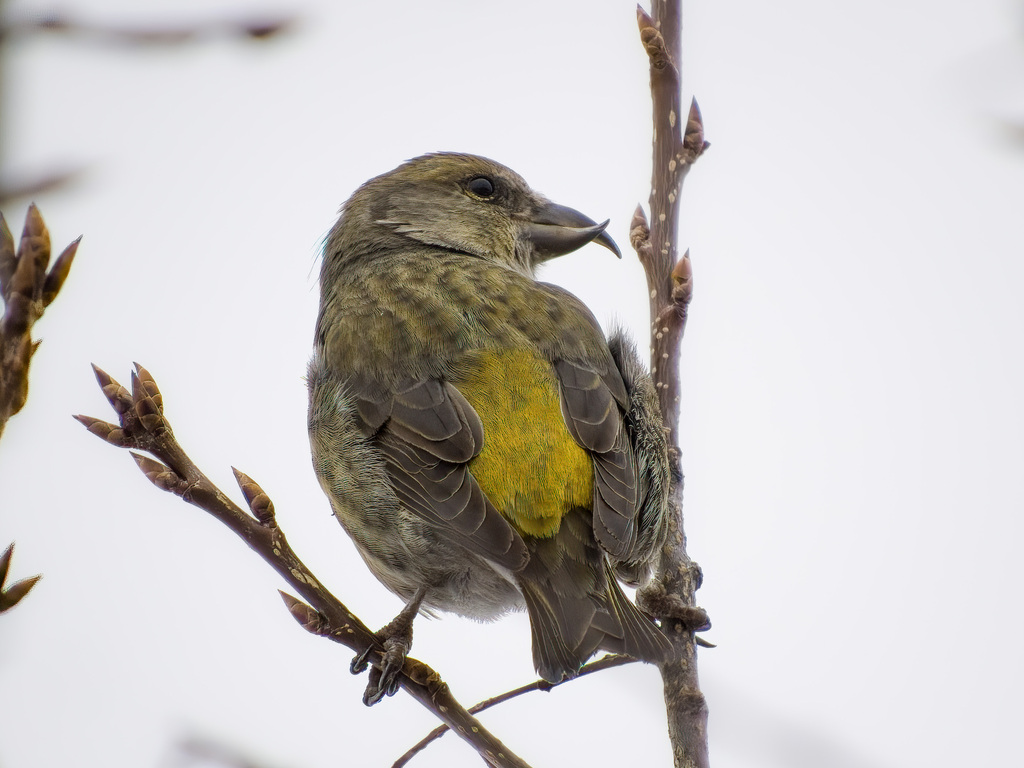
(c) Jason Alexander, some rights reserved (CC BY) · licence
Family: Fringillidae · Class: Aves · Order: Passeriformes
Loxia curvirostra (Red Crossbill) is a California animal in the Fringillidae family.
The Red Crossbill is a medium-sized finch measuring 14 to 18 cm (5.5 to 7.1 inches) in length with a wingspan of 27 to 30 cm (10.6 to 11.8 inches). The species exhibits pronounced sexual dimorphism in plumage. Adult males display brick-red to orange-red coloration on the head, breast, and rump, with darker brownish wings and tail. Females are predominantly olive-yellow to gray-green with darker streaking on the underparts. Both sexes possess the species' most distinctive feature: a crossed bill where the mandible tips curve in opposite directions, with the lower mandible curving either left or right past the upper mandible. Red Crossbills occur across much of California, primarily in mountainous regions. The species is found in the Sierra Nevada from Plumas County south to Tulare County, the Cascade Range, Coast Ranges from Mendocino County south to Santa Barbara County, and isolated populations in the San Bernardino and San Jacinto Mountains. Their distribution closely follows coniferous forest ecosystems throughout the state. The species inhabits coniferous forests dominated by pines, firs, spruces, and Douglas-fir, typically at elevations ranging from 900 to 3,400 meters (2,950 to 11,150 feet). Red Crossbills show strong associations with mature forest stands containing abundant cone-bearing trees. They prefer areas with diverse conifer species and age classes, which provide varied cone crops throughout different seasons. Red Crossbills are highly specialized seed predators, using their crossed bills to extract seeds from closed conifer cones. Their diet consists almost exclusively of conifer seeds, particularly from pines, firs, spruces, and hemlocks. The crossed bill structure allows them to pry open cone scales and access seeds that other birds cannot reach. Breeding timing varies considerably based on cone crop availability rather than season, with nesting recorded from January through September in California. Females construct cup-shaped nests on horizontal conifer branches, typically 4 to 18 meters above ground. Clutch size ranges from 3 to 5 eggs, with an incubation period of 12 to 18 days. Red Crossbills are highly nomadic, with populations moving extensively in response to cone crop failures and abundance patterns. The Red Crossbill is not federally or state-listed and maintains stable populations across most of its range. However, the species faces potential threats from climate change, which may alter coniferous forest composition and cone production patterns. Forest management practices that reduce mature conifer stands or create simplified forest structure can negatively impact local populations. The species' dependence on irregular cone crops makes population monitoring challenging, as numbers fluctuate dramatically between years and locations based on food availability.
Classification
Class: Aves · Order: Passeriformes · Family: Fringillidae
Frequently asked questions
How is Loxia curvirostra classified?
Loxia curvirostra belongs to class Aves, order Passeriformes, family Fringillidae.
What family does Loxia curvirostra belong to?
Loxia curvirostra is in the Fringillidae family.
What is Loxia curvirostra?
The Red Crossbill is a medium-sized finch measuring 14 to 18 cm (5.5 to 7.1 inches) in length with a wingspan of 27 to 30 cm (10.6 to 11.8 inches).
Is Loxia curvirostra found in California?
Yes. Loxia curvirostra is recorded in California in The California Species Project's catalogue.
Related species
Other California species in the same genus, family, or bioregion.
Data from The California Species Project — 14,000+ California species with verified data from CNPS, CDFW, USFWS, and more.