Loxia leucoptera
White-winged Crossbill
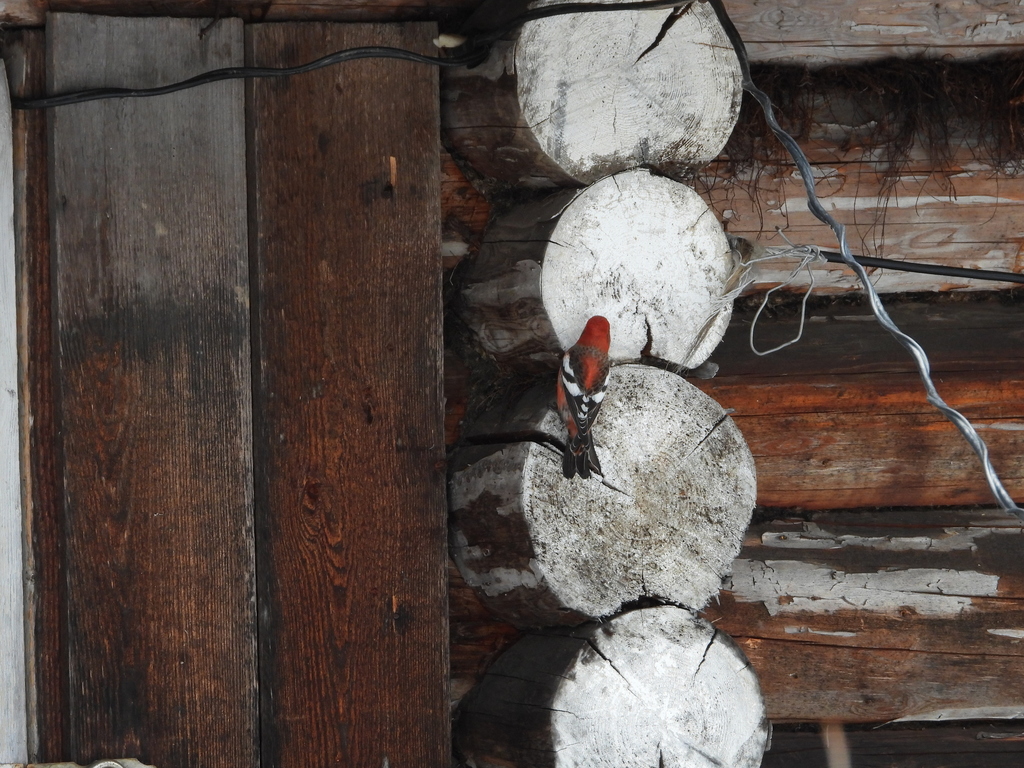
(c) Aleksey Shumkov, some rights reserved (CC BY) · licence
Family: Fringillidae · Class: Aves · Order: Passeriformes
Loxia leucoptera (White-winged Crossbill) is a California animal in the Fringillidae family.
The White-winged Crossbill is a medium-sized finch measuring 14 to 17 cm (5.5 to 6.7 inches) in length with a wingspan of 26 to 29 cm (10.2 to 11.4 inches). Males display bright rose-red to pinkish plumage with prominent white wing bars and black wings and tail. Females are olive-yellow to grayish with duller white wing bars and streaked underparts. Both sexes possess the distinctive crossed bill structure characteristic of crossbills, with the mandible tips crossing to facilitate seed extraction from conifer cones. Juveniles resemble females but show more extensive streaking. White-winged Crossbills have an irregular distribution across northern California, occurring primarily in the Sierra Nevada, Cascade Range, and occasionally in the Coast Ranges during irruptive years. According to eBird records, the species has been documented in counties including Plumas, Sierra, Nevada, El Dorado, Alpine, Mono, and Inyo. Their presence in California varies dramatically between years depending on cone crop failures in northern breeding areas that trigger southward movements. This species inhabits coniferous forests dominated by spruce, fir, pine, and hemlock, typically at elevations between 1,200 and 3,000 meters (4,000 to 10,000 feet) in California. White-winged Crossbills show strong preference for mature forests with abundant cone production. During irruptive years, they may occupy lower elevation habitats and urban areas with suitable conifers. The species requires access to water sources and often forages in mixed coniferous stands. White-winged Crossbills are highly specialized seed predators, feeding primarily on conifer seeds extracted from unopened cones using their crossed bills. Their diet consists mainly of spruce seeds when available, supplemented by fir, pine, and hemlock seeds. According to Birds of the World, breeding timing is closely tied to cone availability rather than season, with nesting recorded from January through September. Females construct cup nests in conifer branches and typically lay 3 to 4 eggs. The species exhibits nomadic behavior, with populations moving vast distances in search of cone crops. White-winged Crossbills are not federally or state listed in California and are considered secure globally. The North American Breeding Bird Survey indicates stable long-term population trends across their range. Climate change poses potential long-term threats through shifts in coniferous forest composition and cone production patterns. Forest management practices that maintain diverse age classes of conifers support crossbill populations. The species' highly mobile nature and ability to exploit episodic food resources make them less vulnerable to localized habitat changes than sedentary species. Conservation efforts focus on maintaining large tracts of mature coniferous forests with natural disturbance regimes that promote diverse cone production cycles.
Classification
Class: Aves · Order: Passeriformes · Family: Fringillidae
Frequently asked questions
How is Loxia leucoptera classified?
Loxia leucoptera belongs to class Aves, order Passeriformes, family Fringillidae.
What family does Loxia leucoptera belong to?
Loxia leucoptera is in the Fringillidae family.
What is Loxia leucoptera?
The White-winged Crossbill is a medium-sized finch measuring 14 to 17 cm (5.5 to 6.7 inches) in length with a wingspan of 26 to 29 cm (10.2 to 11.4 inches).
Is Loxia leucoptera found in California?
Yes. Loxia leucoptera is recorded in California in The California Species Project's catalogue.
Related species
Other California species in the same genus, family, or bioregion.
Data from The California Species Project — 14,000+ California species with verified data from CNPS, CDFW, USFWS, and more.