Loxostege oberthuralis
Oberthür’s Loxostege
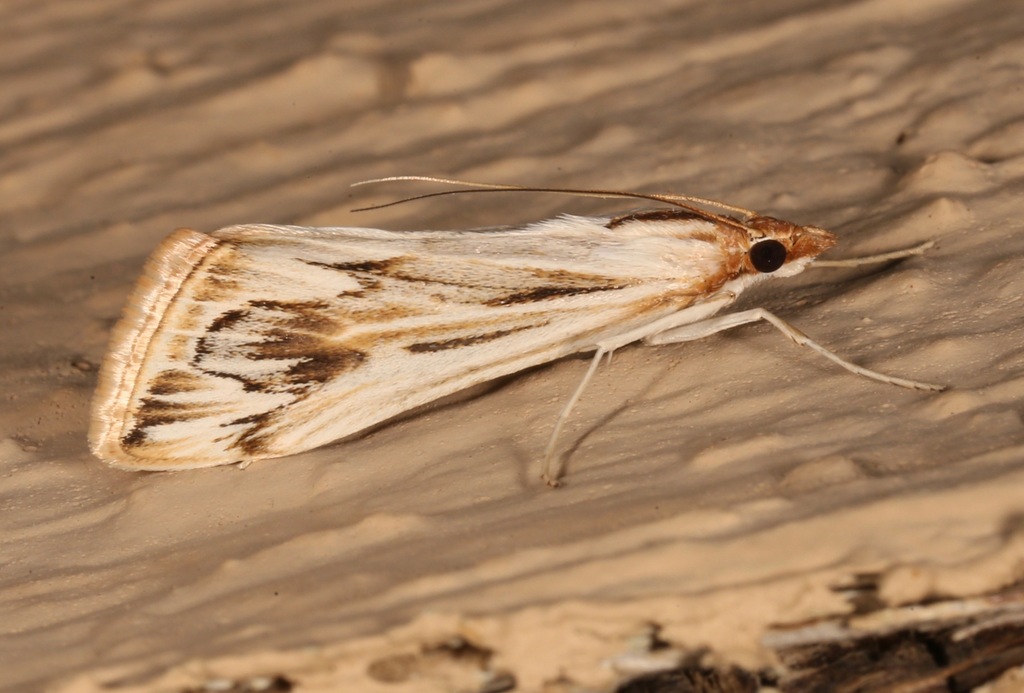
(c) Laura Gaudette, some rights reserved (CC BY) · licence
Family: Crambidae · Class: Insecta · Order: Lepidoptera
Loxostege oberthuralis (Oberthür’s Loxostege) is a California animal in the Crambidae family.
Oberthür's Loxostege is a small moth in the family Crambidae, subfamily Pyraustinae. Adults measure approximately 11.5 mm in forewing length (Moth Photographers Group). The forewings display an ash-colored ground with bold dark streaks that distinguish this species from the similar Loxostege egregialis, which exhibits a more yellowish coloration with weaker dark markings (BugGuide). The forewings show a somewhat powdery appearance with the characteristic pattern of many Loxostege species, including distinct transverse lines and markings typical of the pyraustine moths. Loxostege oberthuralis occurs in Arizona, southern California, and Nevada (Moth Photographers Group). The species was originally described by Fernald in 1894 from Morrison, Arizona, which serves as the type locality (Fernald 1894). In California, documented records include specimens from pinyon-juniper woodland habitats. The species appears to have a limited distribution within the southwestern United States, representing one of several Loxostege species adapted to arid environments. This moth inhabits pinyon-juniper woodland ecosystems at moderate to high elevations. A documented California specimen was collected at 7,200 feet elevation in pinyon-juniper habitat, indicating the species' association with these montane woodland communities (BugGuide). The pinyon-juniper ecosystem provides the specific environmental conditions and potential host plants required by this species during its larval development. Adults are attracted to ultraviolet light, as demonstrated by light trap collections (BugGuide). Flight activity has been documented in September, suggesting late summer or early fall emergence patterns. Like other pyraustine moths, larvae likely feed on herbaceous plants, though specific host plant relationships for L. oberthuralis have not been well documented in available literature. The species exhibits typical nocturnal behavior patterns common to most Crambidae moths. Loxostege oberthuralis faces taxonomic challenges that may impact conservation assessment. DNA barcoding studies indicate that L. oberthuralis and L. egregialis cannot currently be separated molecularly, with both species appearing in the same Barcode Index Number (BIN) group and showing random distribution in phylogenetic analyses (BugGuide). This molecular similarity, combined with morphological variation between the species, suggests the need for additional systematic research to clarify species boundaries and relationships within this complex. The species lacks formal conservation status at state or federal levels, reflecting limited knowledge of population trends and distribution. Documentation remains sparse, with few published records and limited photographic evidence of living specimens. A 2018 California record was noted as potentially the first image of a living adult (BugGuide). The restricted range, specialized habitat requirements, and apparent rarity suggest this species may be vulnerable to habitat loss from development, altered fire regimes, or climate change impacts on pinyon-juniper ecosystems. Additional field surveys and taxonomic research are needed to better understand the conservation needs of this poorly known southwestern moth species.
Classification
Class: Insecta · Order: Lepidoptera · Family: Crambidae
Frequently asked questions
How is Loxostege oberthuralis classified?
Loxostege oberthuralis belongs to class Insecta, order Lepidoptera, family Crambidae.
What family does Loxostege oberthuralis belong to?
Loxostege oberthuralis is in the Crambidae family.
What is Loxostege oberthuralis?
Oberthür's Loxostege is a small moth in the family Crambidae, subfamily Pyraustinae.
Is Loxostege oberthuralis found in California?
Yes. Loxostege oberthuralis is recorded in California in The California Species Project's catalogue.
Related species
Other California species in the same genus, family, or bioregion.
Data from The California Species Project — 14,000+ California species with verified data from CNPS, CDFW, USFWS, and more.