Lucania parvu
Rainwater killifish
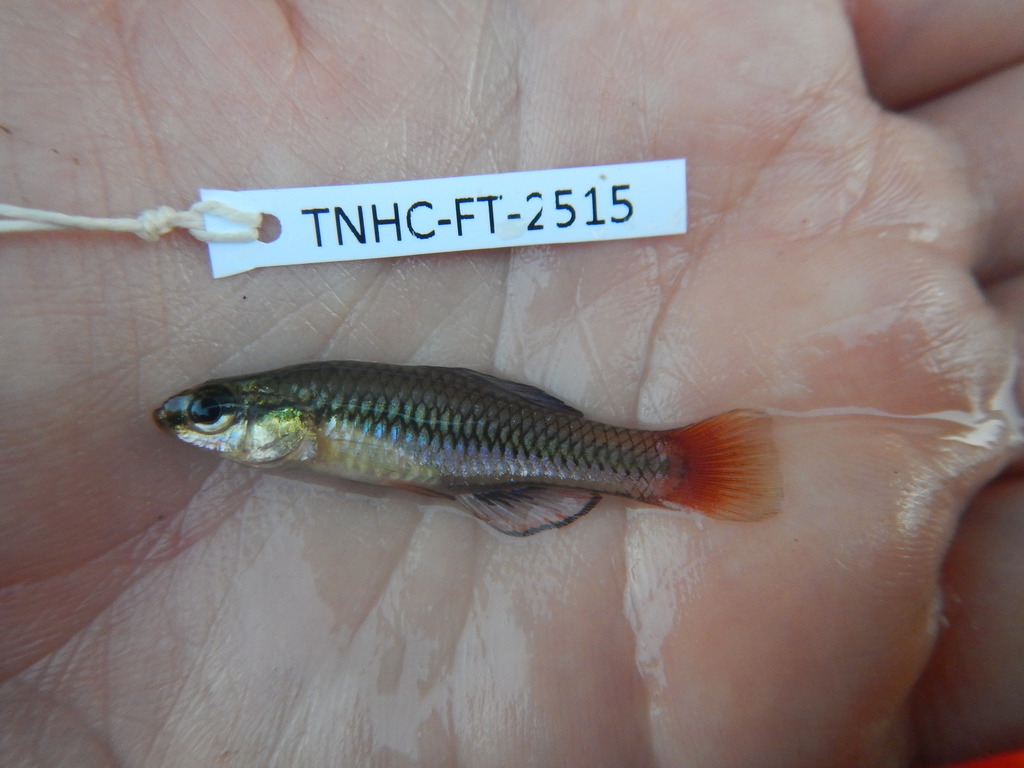
(c) Fishes of Texas team, some rights reserved (CC BY-SA) · licence
Family: Fundulidae · Class: Actinopterygii · Order: Cyprinodontiformes
Lucania parvu (Rainwater killifish) is a California animal in the Fundulidae family.
The rainwater killifish is a small freshwater and brackish water fish native to the Atlantic and Gulf coasts of North America. Adults typically measure 3.7 cm (1.5 inches) in total length, with a maximum recorded length of 6.2 cm (2.4 inches) (FishBase). The species exhibits sexual dimorphism, with males reaching maturity at approximately 2.5 cm (1.0 inch) in length. The body is elongated and laterally compressed, adapted for life in shallow coastal waters and vegetated areas. Natively, the rainwater killifish ranges from Massachusetts south to the Florida Keys and around the Gulf of Mexico to northeastern Mexico (FishBase). The species naturally ascends the Rio Grande and Pecos River systems in Texas and New Mexico. However, the species has been widely introduced outside its native range, including California, where it was first recorded as a contaminant in largemouth bass shipments during the 1940s and 1950s (USGS NAS Database). In California, populations have been documented in coastal areas including Ballona Creek and associated wetlands in Los Angeles County. Rainwater killifish inhabit a variety of aquatic environments, demonstrating broad salinity tolerance. The species occurs in marine, freshwater, and brackish waters, typically at depths ranging from 0 to 2 meters (FishBase). Preferred habitats include salt marshes, bays, lagoons, brackish stretches of coastal streams, and vegetated quiet waters. The species tolerates water temperatures from 10°C to 25°C and can survive in waters ranging from fresh to hypersaline conditions. In California waters, the species has been found in areas with salinities ranging from 27 to 30 parts per thousand. The species exhibits amphidromous behavior, with individuals capable of moving between freshwater and saltwater environments (FishBase). Reproduction may involve migration into freshwater for breeding, followed by movement back to brackish waters. The diet consists primarily of small invertebrates, including larval crustaceans such as cyclopoid and harpacticoid copepods, mosquito larvae, small worms, and mollusks (FishBase). This opportunistic feeding strategy allows the species to exploit various food resources across its diverse habitat range. The rainwater killifish is not federally or state-listed in California and carries no special conservation status. According to NatureServe, most occurrences have good viability and the population appears relatively stable, though the species faces threats from habitat loss, particularly seagrass decline due to water quality degradation from runoff, pollution, and freshwater diversion. In its introduced California range, the species appears to be established in suitable coastal habitats. The species' wide salinity tolerance and opportunistic feeding habits contribute to its persistence in both native and introduced environments, though it has proven difficult to maintain in aquarium settings.
Classification
Class: Actinopterygii · Order: Cyprinodontiformes · Family: Fundulidae
Frequently asked questions
How is Lucania parvu classified?
Lucania parvu belongs to class Actinopterygii, order Cyprinodontiformes, family Fundulidae.
What family does Lucania parvu belong to?
Lucania parvu is in the Fundulidae family.
What is Lucania parvu?
The rainwater killifish is a small freshwater and brackish water fish native to the Atlantic and Gulf coasts of North America.
Is Lucania parvu found in California?
Yes. Lucania parvu is recorded in California in The California Species Project's catalogue.
Related species
Other California species in the same genus, family, or bioregion.
Data from The California Species Project — 14,000+ California species with verified data from CNPS, CDFW, USFWS, and more.