Lucilia sericata
Common European Greenbottle Fly
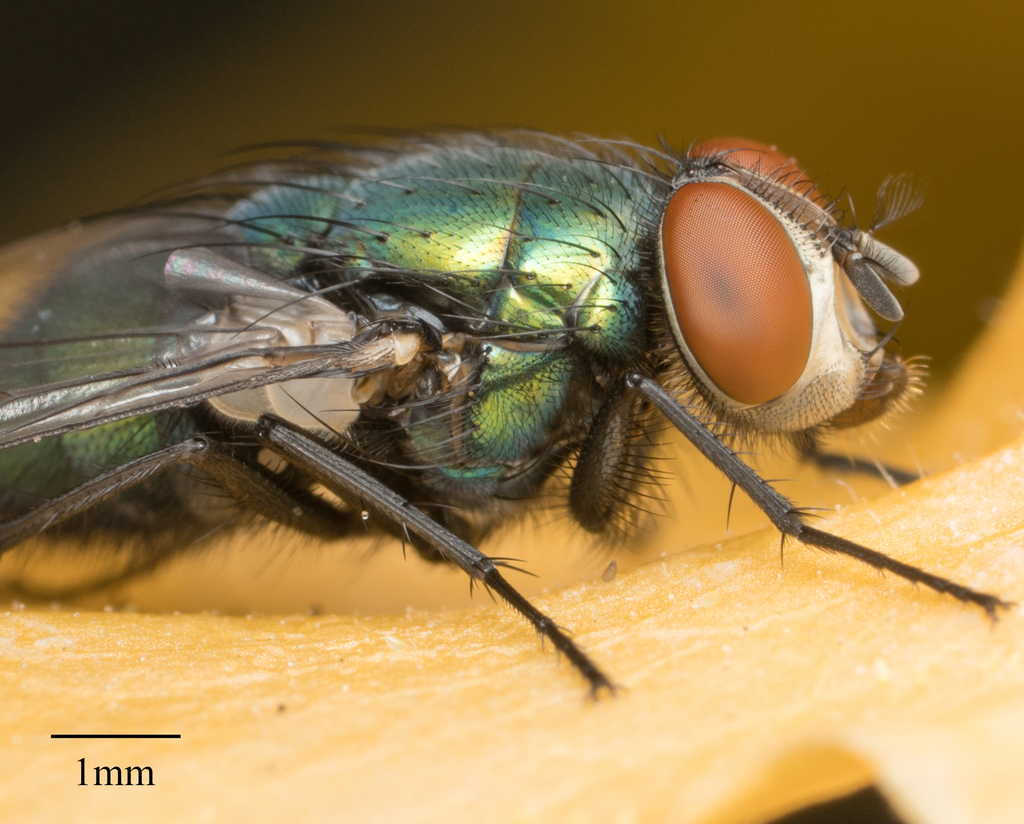
no rights reserved · CC0
Family: Calliphoridae · Class: Insecta · Order: Diptera
Lucilia sericata (Common European Greenbottle Fly) is a California animal in the Calliphoridae family.
The Common European Greenbottle Fly is a metallic green blow fly in the family Calliphoridae, measuring 6-10 mm in body length. Adults display a brilliant metallic green to blue-green coloration on the thorax and abdomen, with transparent wings and dark legs. The compound eyes are typically reddish-brown, and males can be distinguished from females by their closer-set eyes and different abdominal markings. This cosmopolitan species has established populations throughout North America, including California, following introduction from Europe. In California, Lucilia sericata occurs across diverse elevations and habitats, from coastal areas to inland valleys and mountainous regions. The species has adapted well to human-modified environments and is commonly found in urban, suburban, and agricultural areas throughout the state. Lucilia sericata occupies a wide range of habitats but shows particular association with areas where organic matter accumulates. Adults are frequently observed around garbage disposal sites, compost areas, animal facilities, and outdoor dining areas. The species thrives in warm temperatures and is most active during daylight hours. Larvae develop in various substrates including animal carcasses, organic waste, and decaying vegetation, though they also feed on living tissue in open wounds of animals (BugGuide). Adult flies are active foragers, feeding on nectar, sugary substances, and protein-rich materials. Mating typically occurs in warm, sunny conditions, with females seeking appropriate oviposition sites shortly after copulation. Females deposit clusters of 100-200 white, elongated eggs directly onto suitable larval food sources. The complete life cycle from egg to adult takes approximately 2-3 weeks under optimal conditions, with multiple generations per year in California's temperate climate. Larvae progress through three instars before pupating in soil or other dry substrates adjacent to their feeding sites. The species plays important ecological roles as both decomposer and pollinator. Larvae contribute to organic matter decomposition, while adults visit flowers and transfer pollen. However, Lucilia sericata can also function as a disease vector, potentially transmitting pathogens between hosts. In agricultural settings, the species may cause myiasis in livestock, where larvae feed on living tissue of wounded or weakened animals. Lucilia sericata is not listed under any conservation designation and maintains stable populations throughout its range. NatureServe ranks the species as G4 (apparently secure), reflecting its widespread distribution and abundant populations. The species benefits from human activities that create suitable breeding habitats, and climate change may expand its potential range northward. No specific conservation measures are needed for this adaptable and successful introduced species, though monitoring of its role as a potential disease vector continues in public health contexts.
Classification
Class: Insecta · Order: Diptera · Family: Calliphoridae
Frequently asked questions
How is Lucilia sericata classified?
Lucilia sericata belongs to class Insecta, order Diptera, family Calliphoridae.
What family does Lucilia sericata belong to?
Lucilia sericata is in the Calliphoridae family.
What is Lucilia sericata?
The Common European Greenbottle Fly is a metallic green blow fly in the family Calliphoridae, measuring 6-10 mm in body length.
Is Lucilia sericata found in California?
Yes. Lucilia sericata is recorded in California in The California Species Project's catalogue.
Related species
Other California species in the same genus, family, or bioregion.
Data from The California Species Project — 14,000+ California species with verified data from CNPS, CDFW, USFWS, and more.