Lumbricus terrestris
Common Earthworm
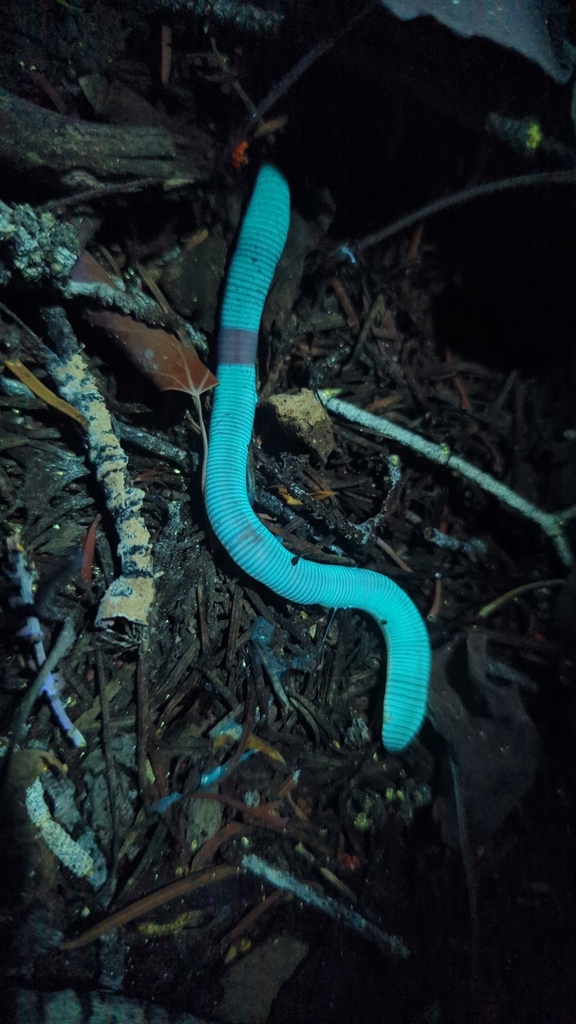
(c) Alan Rockefeller, some rights reserved (CC BY) · licence
Family: Lumbricidae · Class: Clitellata · Order: Opisthopora
Lumbricus terrestris (Common Earthworm) is a California animal in the Lumbricidae family.
The common earthworm is a large, segmented annelid measuring 90 to 300 mm (3.5 to 12 inches) in length, with some individuals reaching up to 350 mm. The body is cylindrical and soft, divided into numerous segments visible as grooved rings along its length. A distinctive feature is the clitellum, a smooth, thickened band located approximately one-third of the way back from the head end, which appears lighter in color than the rest of the body. The anterior end is more pointed than the posterior, and the body ranges from reddish-brown to grayish-pink in coloration. Each segment except the first and last bears four pairs of tiny bristles called setae that aid in locomotion. Native to Europe, Lumbricus terrestris has been widely introduced across North America, including California. The species now occurs throughout much of the continental United States and southern Canada, thriving in both urban and rural environments. In California, populations are established in gardens, agricultural areas, parks, and other disturbed soils from sea level to moderate elevations. Common earthworms inhabit deep, permanent burrow systems that can extend 1.8 to 3 meters (6 to 10 feet) below the surface. They prefer moist, organic-rich soils with pH levels between 6.0 and 7.4. The species shows strong preferences for soils with adequate moisture content and organic matter, avoiding both waterlogged and completely dry conditions. Burrows are typically vertical with horizontal branches and are lined with mucus secretions. This species exhibits both diurnal and seasonal behavioral patterns. During daylight hours and dry periods, individuals remain deep in their burrows, emerging at night or during rain to feed and mate. They are detritivores, feeding primarily on decomposing organic matter, leaf litter, and soil organic particles. The worms ingest soil and organic material, processing it through their digestive system and excreting nutrient-rich castings that significantly improve soil structure and fertility. Reproduction occurs through cross-fertilization between hermaphroditic individuals, typically during spring and fall when soil moisture levels are optimal. Cocoons containing 1 to 20 eggs are deposited in the upper soil layers, with young emerging after 60 to 90 days depending on temperature and moisture conditions. As an introduced species, Lumbricus terrestris is not listed under federal or state conservation programs. However, ecological research has documented both beneficial and potentially negative impacts of earthworm introductions in North American ecosystems (Xerces Society 2024). While commonly valued for their soil-improving properties in agricultural and garden settings, large earthworm populations can alter native soil communities and affect forest floor dynamics in previously earthworm-free ecosystems. The species has shown resilience to various environmental stressors, though populations can be affected by pesticide applications, particularly neonicotinoids applied as soil treatments (Xerces Society 2018). Current populations appear stable throughout their introduced range, with the species continuing to expand into new suitable habitats through both natural dispersal and human-mediated transport.
Classification
Class: Clitellata · Order: Opisthopora · Family: Lumbricidae
Frequently asked questions
How is Lumbricus terrestris classified?
Lumbricus terrestris belongs to class Clitellata, order Opisthopora, family Lumbricidae.
What family does Lumbricus terrestris belong to?
Lumbricus terrestris is in the Lumbricidae family.
What is Lumbricus terrestris?
The common earthworm is a large, segmented annelid measuring 90 to 300 mm (3.5 to 12 inches) in length, with some individuals reaching up to 350 mm.
Is Lumbricus terrestris found in California?
Yes. Lumbricus terrestris is recorded in California in The California Species Project's catalogue.
More California species
This species has no close relatives in our California data — here are other species to explore.
Data from The California Species Project — 14,000+ California species with verified data from CNPS, CDFW, USFWS, and more.