Luridiblatta trivittata
Three-lined Cockroach
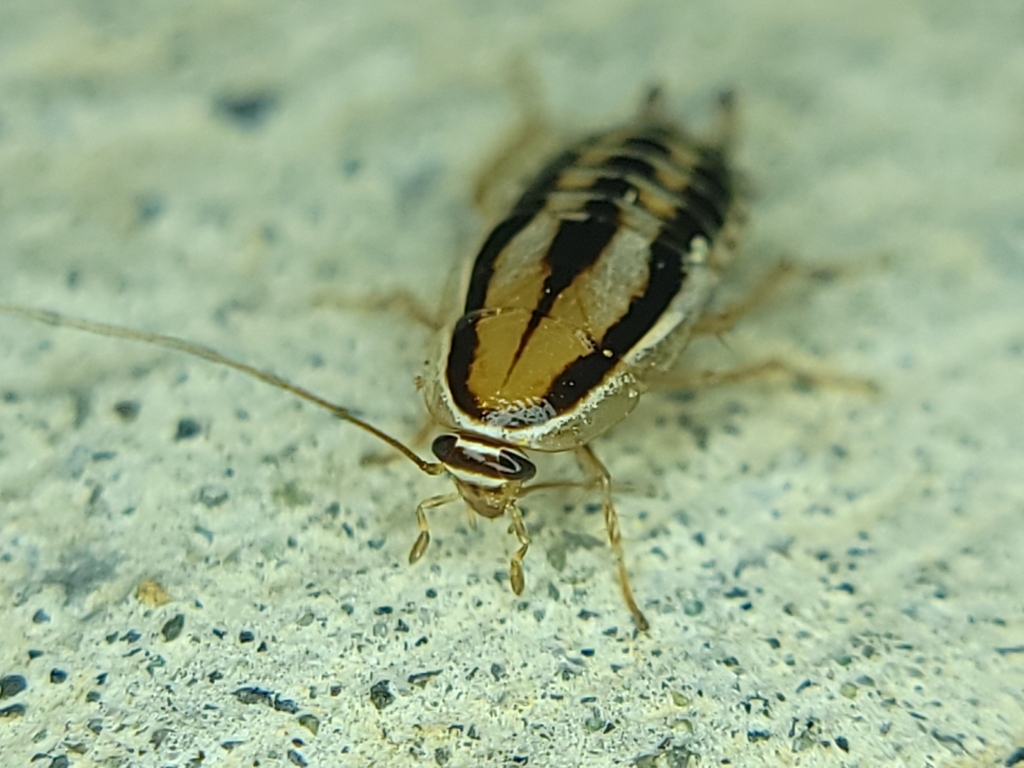
no rights reserved · CC0
Family: Ectobiidae · Class: Insecta · Order: Blattodea
Luridiblatta trivittata (Three-lined Cockroach) is a California animal in the Ectobiidae family.
The Three-lined Cockroach is a small, non-native cockroach species recently introduced to California. Adults measure approximately 7 mm in length and display distinctive sexual dimorphism in wing development. Females possess highly reduced wings that do not cover the abdomen, while males have somewhat short wings that also fail to cover the entire abdomen completely. The species appears to be flightless or have severely limited flight capability. Females are frequently observed carrying oothecae (egg cases), which is a characteristic reproductive behavior for this species (BugGuide 2023). Native to the Mediterranean region, Luridiblatta trivittata is adventive in California, representing a recent introduction to North America (BugGuide 2023). Documented occurrences include Santa Clara County at Long Ridge Open Space Preserve and Solano County in Benicia, indicating establishment in the San Francisco Bay Area. The species' current distribution in California appears limited but may be expanding as populations become established. Specific habitat preferences for this species in California have not been extensively documented. Mediterranean cockroaches typically inhabit areas with moderate moisture and organic debris. The Santa Clara County specimen was collected at night in October 2011, suggesting nocturnal activity patterns common among cockroach species (BugGuide 2023). The species may occupy leaf litter, under stones, or in other protected microhabitats typical of small ectobiid cockroaches. Like other members of the family Ectobiidae, the Three-lined Cockroach likely feeds on decaying organic matter, including plant debris and possibly fungal material. The species exhibits typical cockroach reproductive behavior, with females carrying protective egg cases until hatching. Seasonal activity patterns and specific breeding cycles in California have not been well studied. The October collection date suggests the species remains active into autumn months. Luridiblatta trivittata holds no federal or state conservation status, as it is a non-native species recently introduced to California. The species was formerly classified under the genus Phyllodromica but has been reclassified to Luridiblatta based on current taxonomic understanding. As an introduced Mediterranean species, its establishment in California raises questions about potential ecological impacts on native arthropod communities, though specific effects have not been documented. The limited distribution records suggest the species may still be in early stages of establishment. Continued monitoring of this non-native cockroach's distribution and abundance would help assess its potential for further range expansion in California. No specific management actions are currently directed toward this species, reflecting its recent introduction and unclear ecological significance in California ecosystems.
Classification
Class: Insecta · Order: Blattodea · Family: Ectobiidae
Frequently asked questions
How is Luridiblatta trivittata classified?
Luridiblatta trivittata belongs to class Insecta, order Blattodea, family Ectobiidae.
What family does Luridiblatta trivittata belong to?
Luridiblatta trivittata is in the Ectobiidae family.
What is Luridiblatta trivittata?
The Three-lined Cockroach is a small, non-native cockroach species recently introduced to California.
Is Luridiblatta trivittata found in California?
Yes. Luridiblatta trivittata is recorded in California in The California Species Project's catalogue.
More California species
This species has no close relatives in our California data — here are other species to explore.
Data from The California Species Project — 14,000+ California species with verified data from CNPS, CDFW, USFWS, and more.