Luscinia svecica
Bluethroat
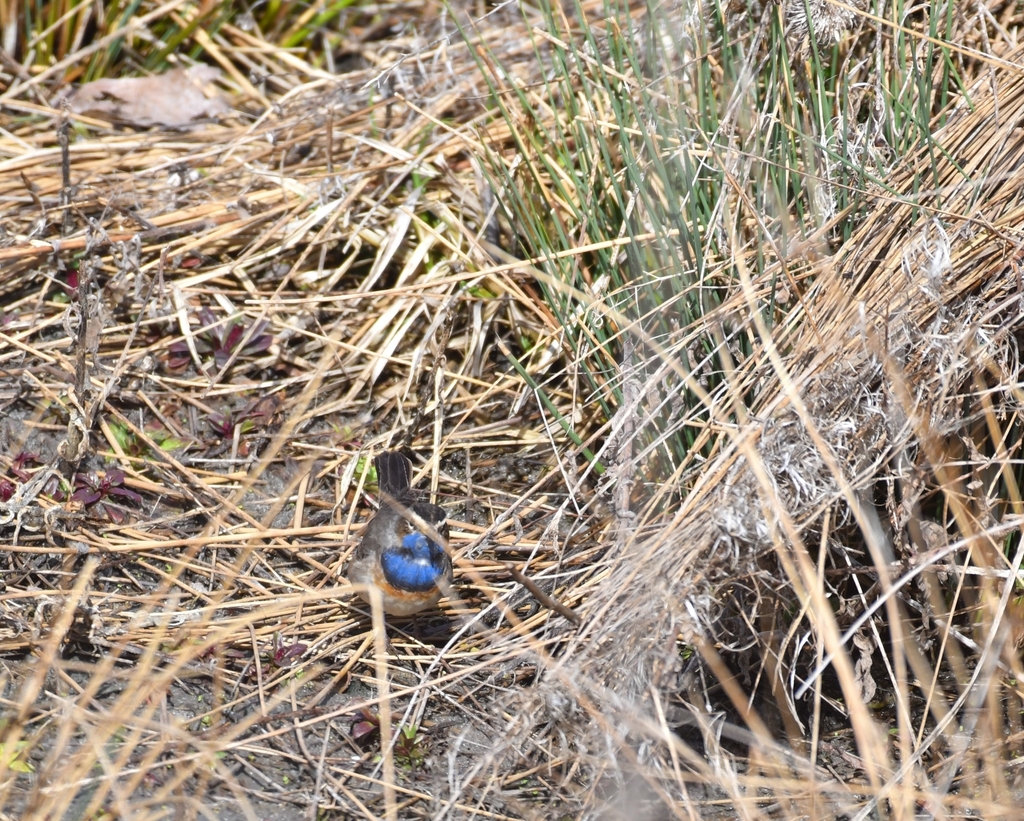
no rights reserved · CC0
Family: Muscicapidae · Class: Aves · Order: Passeriformes
Luscinia svecica (Bluethroat) is a California animal in the Muscicapidae family.
The Bluethroat is a small passerine bird measuring 13 to 14 cm (5.1 to 5.5 inches) in length with a wingspan of 20 to 22 cm (7.9 to 8.7 inches). Adult males during breeding season display a distinctive bright blue throat patch bordered by black and rufous bands, with a white or rufous central spot. The upperparts are brown with a prominent white supercilium extending from the bill to the nape. Females and non-breeding males lack the blue throat coloration, showing a pale throat with dark malar stripes and a necklace of dark spots across the upper breast. Both sexes exhibit a rufous tail base and outer tail feathers, particularly visible in flight. The Bluethroat has a vast global range across northern Eurasia, from Scandinavia east to Alaska and northern Canada. In North America, the species breeds primarily in Alaska, with the subspecies L. s. svecica occurring in western and northern regions. The Bluethroat is considered a casual vagrant to California, with very few documented records in the state. Most California sightings have occurred along the coast during migration periods, typically in fall months from September through November. Breeding habitat consists of dense, low vegetation in tundra, taiga, and montane regions, particularly areas with willow and birch scrub near water sources. The species favors wet meadows, marsh edges, and riparian thickets at elevations ranging from sea level to 2,400 meters (7,900 feet). During migration and winter, Bluethroats utilize similar dense cover habitats including reed beds, brushy areas, and scrubland. Bluethroats are primarily insectivorous, feeding on beetles, flies, caterpillars, and other arthropods during the breeding season. The diet expands to include berries and seeds during autumn migration and winter months. Males establish territories through song, delivered from prominent perches or during display flights. The species constructs cup-shaped nests in dense vegetation close to the ground, typically concealed under shrubs or grass tufts. Females lay 5 to 7 glossy blue-green eggs with fine reddish-brown spots. The incubation period lasts 13 to 15 days, with nestlings fledging after 13 to 14 days. The Bluethroat is not federally listed in the United States and maintains stable populations across most of its range. The International Union for Conservation of Nature classifies the species as Least Concern globally. Climate change may affect breeding distributions in Arctic regions, potentially shifting suitable habitat northward. In California, the species remains an extremely rare visitor with no established breeding populations. Conservation efforts focus primarily on habitat protection within the species' core breeding range in Alaska and northern Canada.
Classification
Class: Aves · Order: Passeriformes · Family: Muscicapidae
Frequently asked questions
How is Luscinia svecica classified?
Luscinia svecica belongs to class Aves, order Passeriformes, family Muscicapidae.
What family does Luscinia svecica belong to?
Luscinia svecica is in the Muscicapidae family.
What is Luscinia svecica?
The Bluethroat is a small passerine bird measuring 13 to 14 cm (5.1 to 5.5 inches) in length with a wingspan of 20 to 22 cm (7.9 to 8.7 inches).
Is Luscinia svecica found in California?
Yes. Luscinia svecica is recorded in California in The California Species Project's catalogue.
Related species
Other California species in the same genus, family, or bioregion.
Data from The California Species Project — 14,000+ California species with verified data from CNPS, CDFW, USFWS, and more.