Lycaena heteronea
Blue Copper
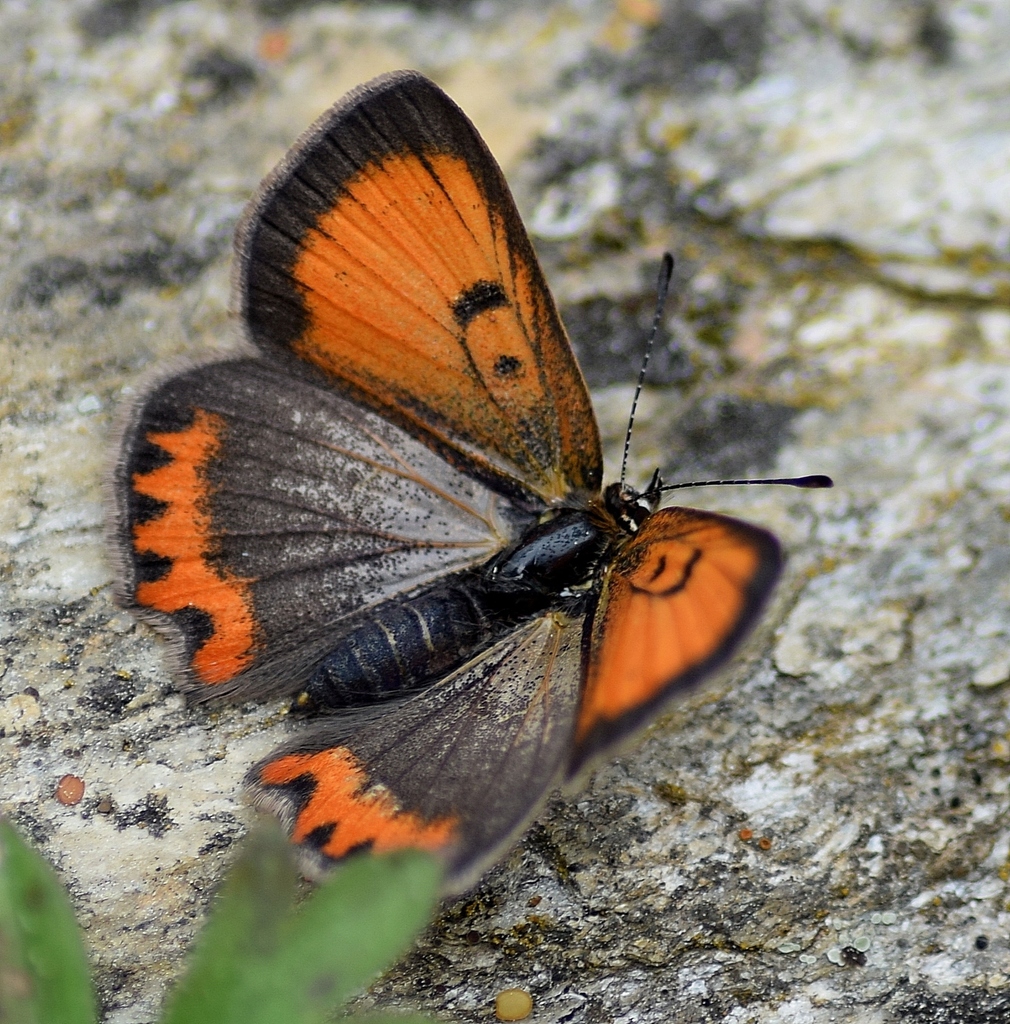
(c) Kostas Zontanos, some rights reserved (CC BY) · licence
Family: Lycaenidae · Class: Insecta · Order: Lepidoptera
Lycaena heteronea (Blue Copper) is a California animal in the Lycaenidae family.
The Blue Copper (Lycaena heteronea) is a small butterfly in the copper family Lycaenidae, characterized by distinct sexual dimorphism in wing coloration. Males display brilliant metallic blue dorsal wing surfaces with narrow black borders, while females are brown to grayish-brown with orange marginal spots along the hindwings. The undersides of both sexes are light gray to white with small black spots and orange submarginal bands on the hindwings. Adults measure 25 to 35 mm (1.0 to 1.4 inches) in wingspan, with females typically larger than males. The Blue Copper has an extensive range from British Columbia south and east through southcentral California, northern Arizona, and northern New Mexico. In California, populations are documented from the Sierra Nevada, Cascade Range, and montane regions of southern California. The species occurs at elevations ranging from approximately 1,200 to 3,400 meters (4,000 to 11,200 feet), with highest densities in mid-elevation zones. This species inhabits open areas within coniferous forests, mountain meadows, sagebrush scrub, and alpine zones where host plants are abundant. Blue Copper butterflies require proximity to wild buckwheat species (Eriogonum) in the buckwheat family (Polygonaceae), which serve as the exclusive larval host plants. Common host species include sulfur flower buckwheat (Eriogonum umbellatum), cushion buckwheat (Eriogonum ovalifolium), and naked buckwheat (Eriogonum nudum). Adults are frequently observed nectaring on various flowering plants including rabbitbrush, goldenrod, and asters. Blue Copper butterflies are univoltine, producing one generation per year. Adults emerge from mid-June through August, with peak flight periods varying by elevation and latitude. Males exhibit territorial behavior, perching on prominent rocks or vegetation near host plant patches to await females. After mating, females deposit single eggs on or near Eriogonum host plants. Larvae feed exclusively on buckwheat foliage through four instars before pupating. The species overwinters as eggs, which hatch in spring when host plants begin active growth. Larvae complete development by early summer, pupating for approximately three weeks before adult emergence. The Blue Copper is not federally or state listed and appears to maintain stable populations throughout most of its range. However, localized populations may face threats from habitat alteration, grazing pressure that affects host plant abundance, and climate change impacts on high-elevation ecosystems. The species' dependence on specific Eriogonum host plants makes it vulnerable to factors that reduce buckwheat populations, including invasive plant species and altered fire regimes. Conservation of intact montane ecosystems with diverse native plant communities is essential for maintaining viable Blue Copper populations across the species' range.
Classification
Class: Insecta · Order: Lepidoptera · Family: Lycaenidae
Frequently asked questions
How is Lycaena heteronea classified?
Lycaena heteronea belongs to class Insecta, order Lepidoptera, family Lycaenidae.
What family does Lycaena heteronea belong to?
Lycaena heteronea is in the Lycaenidae family.
What is Lycaena heteronea?
The Blue Copper (Lycaena heteronea) is a small butterfly in the copper family Lycaenidae, characterized by distinct sexual dimorphism in wing coloration.
Is Lycaena heteronea found in California?
Yes. Lycaena heteronea is recorded in California in The California Species Project's catalogue.
Related species
Other California species in the same genus, family, or bioregion.
Data from The California Species Project — 14,000+ California species with verified data from CNPS, CDFW, USFWS, and more.