Lycaena phlaeas
American Copper
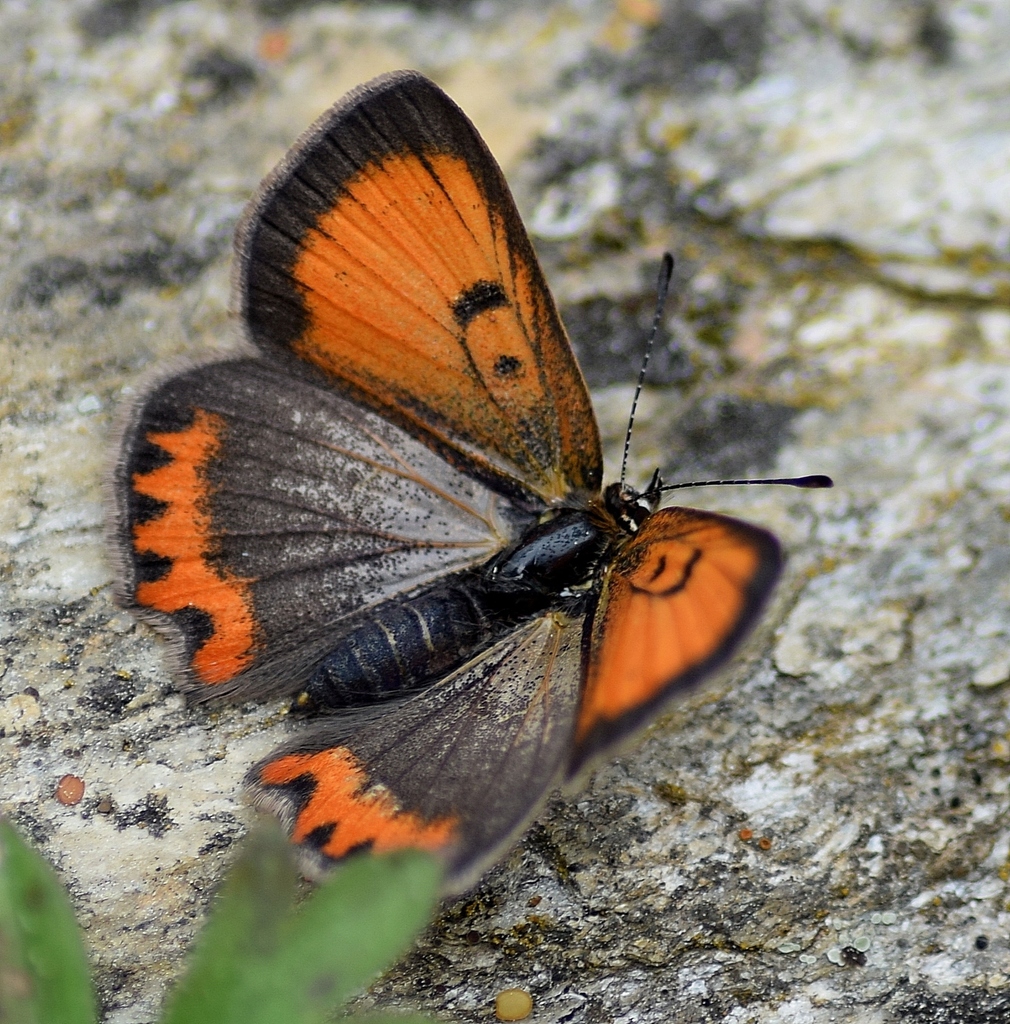
(c) Kostas Zontanos, some rights reserved (CC BY) · licence
Family: Lycaenidae · Class: Insecta · Order: Lepidoptera
Lycaena phlaeas (American Copper) is a California animal in the Lycaenidae family.
The American Copper is a small butterfly with forewings measuring 12-16 mm (0.5-0.6 inches) from base to tip. Males display bright orange forewings with black spots and a dark border, while the hindwings are gray-brown with an orange marginal band. Females are typically duller with more extensive dark markings. The undersides of both sexes show pale gray coloration with small black spots and an orange band along the hindwing margin. The species exhibits considerable geographic variation, with western mountain populations often showing reduced orange coloration compared to eastern forms. The American Copper has a complex distribution pattern across North America. Native populations occur in the Arctic regions and western mountains, extending from Alaska south through the Rocky Mountains to New Mexico and Arizona. However, the species' presence from Nova Scotia south to Georgia, Tennessee, and Arkansas, and west across Great Lakes states to North Dakota, likely results from introduction from Scandinavia during the colonial period. This introduced eastern population has become well-established across much of the northeastern and midwestern United States. This species inhabits diverse environments ranging from sea level to elevations exceeding 3,000 meters (9,800 feet) in mountainous regions. American Coppers occupy open areas including meadows, fields, roadsides, vacant lots, and disturbed ground where host plants are abundant. The species shows particular affinity for areas with patchy vegetation and exposed soil, often colonizing human-modified landscapes. In western regions, they frequent alpine meadows, while eastern populations thrive in agricultural areas and suburban environments. American Coppers are multivoltine, producing two to three generations annually in most regions, with northern populations typically having fewer broods. Adults are active from April through October, depending on location and elevation. Males exhibit territorial behavior, perching on low vegetation and pursuing potential mates or rivals. Females lay single eggs on host plant leaves, primarily members of the buckwheat family (Polygonaceae). Larvae feed on sheep sorrel (Rumex acetosella), curled dock (Rumex crispus), and mountain sorrel (Oxyria digyna). Caterpillars are green with purple markings and feed on leaf undersides, often attended by ants that receive honeydew in exchange for protection. Overwintering occurs in the larval stage, with pupation taking place in spring. The American Copper is not federally or state-listed and appears to maintain stable populations across most of its range. The species demonstrates considerable adaptability to human-modified environments, often benefiting from disturbance that creates suitable habitat. Eastern introduced populations continue to expand and persist, suggesting successful establishment. However, some western native populations may face localized pressures from habitat loss due to development and climate change impacts on high-elevation environments. The species' association with weedy host plants in disturbed areas contributes to its overall population stability.
Classification
Class: Insecta · Order: Lepidoptera · Family: Lycaenidae
Frequently asked questions
How is Lycaena phlaeas classified?
Lycaena phlaeas belongs to class Insecta, order Lepidoptera, family Lycaenidae.
What family does Lycaena phlaeas belong to?
Lycaena phlaeas is in the Lycaenidae family.
What is Lycaena phlaeas?
The American Copper is a small butterfly with forewings measuring 12-16 mm (0.5-0.6 inches) from base to tip.
Is Lycaena phlaeas found in California?
Yes. Lycaena phlaeas is recorded in California in The California Species Project's catalogue.
Related species
Other California species in the same genus, family, or bioregion.
Data from The California Species Project — 14,000+ California species with verified data from CNPS, CDFW, USFWS, and more.