Lycaena rubidus
Ruddy Copper
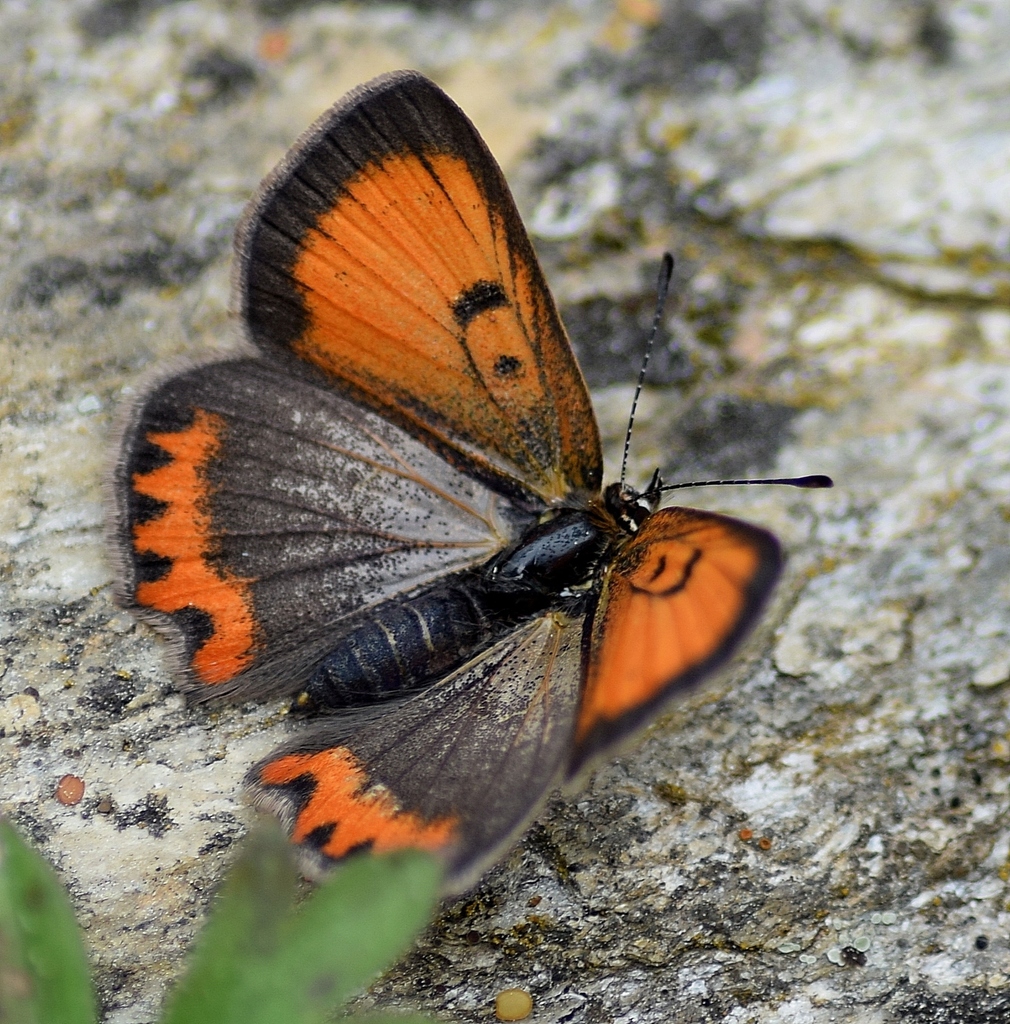
(c) Kostas Zontanos, some rights reserved (CC BY) · licence
Family: Lycaenidae · Class: Insecta · Order: Lepidoptera
Lycaena rubidus (Ruddy Copper) is a California animal in the Lycaenidae family.
The Ruddy Copper is a small butterfly with a wingspan of 25-32 mm (1.0-1.3 inches). Males display bright copper-orange dorsal wing surfaces with narrow dark borders and minimal black spotting. The forewings show a distinctive purple-red iridescence in direct sunlight. Females are considerably duller, with brown to gray-brown dorsal surfaces marked by orange submarginal bands and scattered black spots. Both sexes have gray undersides with white-ringed black spots and orange marginal bands on the hindwings. The species can be distinguished from similar coppers by its relatively small size and the male's intense reddish-copper coloration. The Ruddy Copper ranges from British Columbia east to North Dakota, extending south to central California and northern New Mexico. In California, populations occur primarily in the Sierra Nevada, Cascade Range, and northern Coast Ranges. The species is found at elevations from 1,200 to 3,400 meters (4,000-11,200 feet), with most populations occurring above 1,800 meters (6,000 feet). Historical records indicate the species was more widespread at lower elevations but has experienced range contraction in recent decades. This species inhabits mountain meadows, forest clearings, and alpine zones where its host plants are abundant. Preferred habitats include moist meadows near streams, boggy areas, and disturbed sites such as roadsides and logged areas. The butterfly requires areas with patchy sunlight and nearby nectar sources including wild mint, asters, and goldenrod. Adults are closely associated with stands of dock species, particularly curly dock (Rumex crispus) and sheep sorrel (Rumex acetosella), which serve as larval host plants in the buckwheat family (Polygonaceae). Ruddy Coppers are univoltine, producing one generation per year. Adults emerge from mid-June through August, with peak flight activity in July. Males establish territories on hilltops and ridge areas, engaging in aerial pursuits of passing females and other butterflies. Mating occurs during midday hours when temperatures are warmest. Females deposit single eggs on dock leaves, preferring young, tender growth. Larvae feed on host plant foliage through five instars before overwintering as pupae. The species shows strong site fidelity, with adults rarely dispersing more than 500 meters from emergence sites. The Ruddy Copper is not federally or state listed but faces population pressures from habitat modification and climate change. Mountain meadow habitats have declined due to grazing, water diversions, and conifer encroachment. Rising temperatures associated with climate change are pushing suitable habitat to higher elevations, potentially isolating populations. The species' dependence on specific moisture conditions and host plant availability makes it vulnerable to drought and altered precipitation patterns. Conservation efforts focus on maintaining meadow hydrology and managing invasive plant species that compete with native dock populations.
Classification
Class: Insecta · Order: Lepidoptera · Family: Lycaenidae
Frequently asked questions
How is Lycaena rubidus classified?
Lycaena rubidus belongs to class Insecta, order Lepidoptera, family Lycaenidae.
What family does Lycaena rubidus belong to?
Lycaena rubidus is in the Lycaenidae family.
What is Lycaena rubidus?
The Ruddy Copper is a small butterfly with a wingspan of 25-32 mm (1.0-1.3 inches).
Is Lycaena rubidus found in California?
Yes. Lycaena rubidus is recorded in California in The California Species Project's catalogue.
Related species
Other California species in the same genus, family, or bioregion.
Data from The California Species Project — 14,000+ California species with verified data from CNPS, CDFW, USFWS, and more.