Lycaena rubidus incana
White Mountains Copper
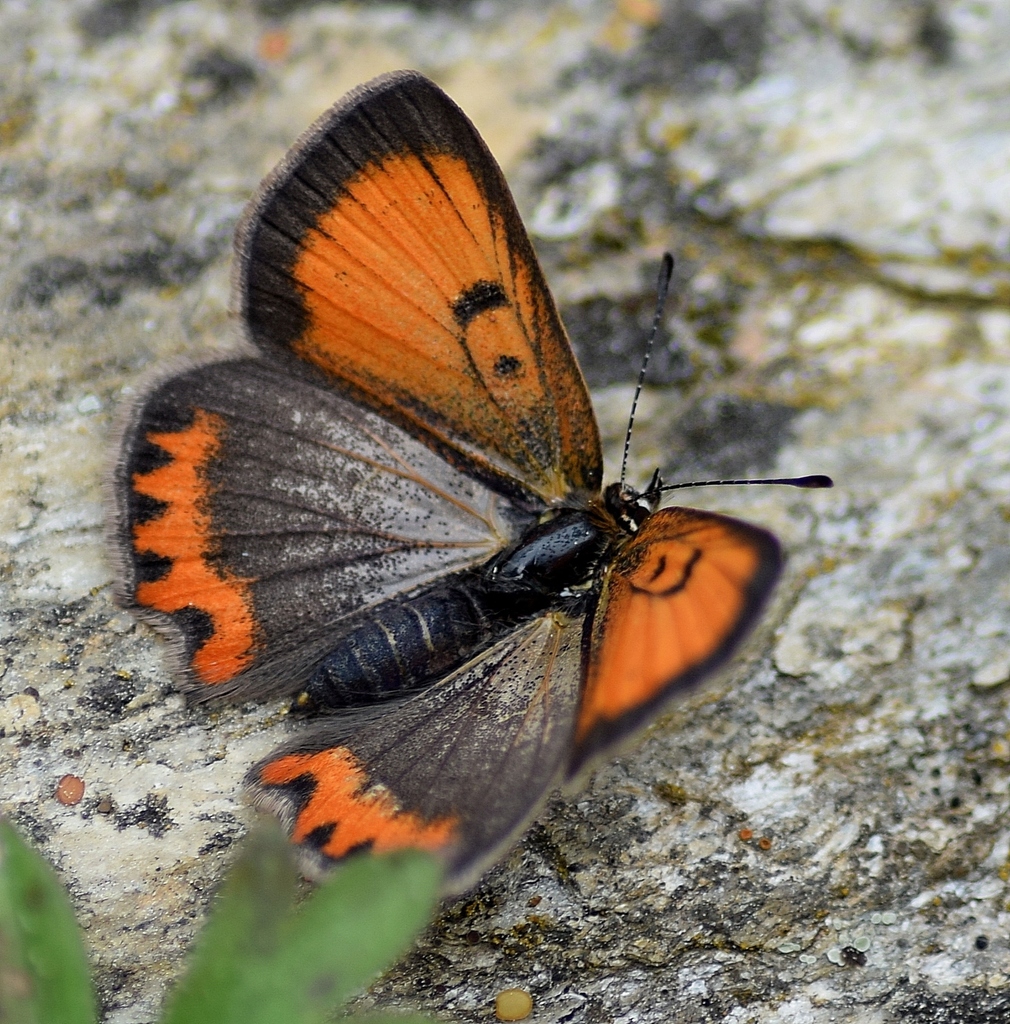
(c) Kostas Zontanos, some rights reserved (CC BY) · licence
Family: Lycaenidae · Class: Insecta · Order: Lepidoptera
Conservation status: G4?T2T3 S1
Lycaena rubidus incana (White Mountains Copper) is a California animal in the Lycaenidae family.
The White Mountains Copper (Lycaena rubidus incana) is a subspecies of the Ruddy Copper butterfly endemic to the White Mountains of eastern California and western Nevada. This small copper butterfly exhibits the typical lycaenid characteristics with a wingspan ranging from 22 to 28 mm (0.87 to 1.1 inches). Males display bright orange-red forewings with dark borders and scattered black spots, while the hindwings are grayish-brown with orange marginal bands. Females are generally duller, with more subdued orange coloration and heavier black spotting. The subspecies incana is distinguished from other Lycaena rubidus populations by its slightly paler coloration and reduced size, adaptations to the harsh high-elevation environment. The White Mountains Copper is restricted to the White Mountains range along the California-Nevada border, primarily occurring in Mono and Inyo Counties, California. This subspecies occupies one of the most geographically limited ranges of any North American butterfly, with populations documented at elevations between 2,440 and 3,660 meters (8,000 to 12,000 feet). The species demonstrates extreme habitat specificity within this alpine environment. The subspecies inhabits alpine and subalpine meadows, rocky slopes, and streamside areas within the Great Basin montane ecosystem. These high-elevation habitats are characterized by short growing seasons, intense solar radiation, and extreme temperature fluctuations. The butterfly occurs in areas dominated by sagebrush communities, alpine cushion plants, and scattered conifers including limber pine and bristlecone pine. Suitable habitat requires the presence of specific host plants and adequate moisture from snowmelt or springs. The White Mountains Copper has a univoltine life cycle, producing one generation per year due to the short alpine growing season. Adults typically emerge from mid-July through August, coinciding with peak wildflower blooms. Males establish territories on hilltops and ridges, engaging in aerial combat with intruders. Females deposit eggs singly on host plants, primarily wild buckwheat species (Eriogonum). The eggs overwinter, and larvae complete development the following spring and early summer, feeding on buckwheat leaves and flowers. The species demonstrates strong site fidelity, with adults rarely dispersing far from breeding areas. The White Mountains Copper holds a Global/State Rank of G4?T2T3 S1, indicating the subspecies is imperiled in California with very few occurrences. Climate change poses the primary long-term threat, as warming temperatures push suitable habitat to higher elevations with limited available terrain. The species' extremely restricted range makes it vulnerable to stochastic events including drought, severe weather, and habitat disturbance. Mining activities, recreational use, and potential infrastructure development represent additional anthropogenic threats. The subspecies' dependence on specific host plants and microhabitats compounds its vulnerability. Despite its precarious status, the White Mountains Copper currently lacks federal protection under the Endangered Species Act, though its conservation status warrants continued monitoring and habitat protection efforts.
Classification
Class: Insecta · Order: Lepidoptera · Family: Lycaenidae
Conservation status
G4?T2T3 S1
Frequently asked questions
How is Lycaena rubidus incana classified?
Lycaena rubidus incana belongs to class Insecta, order Lepidoptera, family Lycaenidae.
What family does Lycaena rubidus incana belong to?
Lycaena rubidus incana is in the Lycaenidae family.
Is Lycaena rubidus incana protected or of conservation concern?
Lycaena rubidus incana carries the following status: G4?T2T3 S1.
What is Lycaena rubidus incana?
The White Mountains Copper (Lycaena rubidus incana) is a subspecies of the Ruddy Copper butterfly endemic to the White Mountains of eastern California and western Nevada.
Is Lycaena rubidus incana found in California?
Yes. Lycaena rubidus incana is recorded in California in The California Species Project's catalogue.
Related species
Other California species in the same genus, family, or bioregion.
Data from The California Species Project — 14,000+ California species with verified data from CNPS, CDFW, USFWS, and more.