Lytta nuttalli
Nuttall's blister beetle
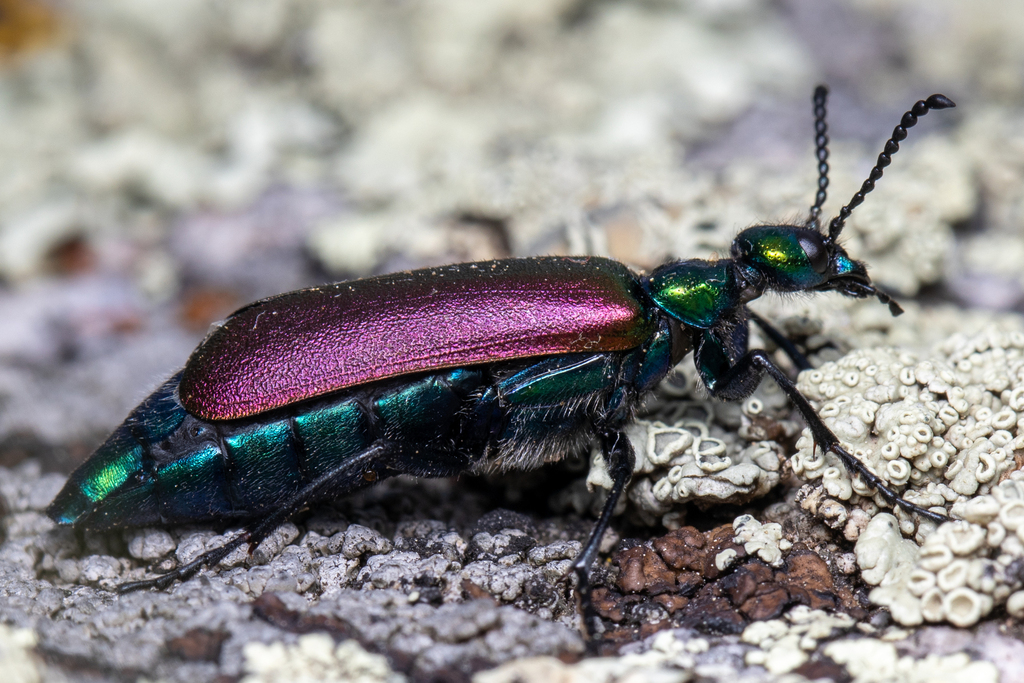
(c) Ben Smith, some rights reserved (CC BY) · licence
Family: Meloidae · Class: Insecta · Order: Coleoptera
Lytta nuttalli (Nuttall's blister beetle) is a California animal in the Meloidae family.
Nuttall's blister beetle is a medium-sized beetle in the family Meloidae, measuring approximately 19 mm (0.75 inches) in length. Like other blister beetles, this species produces cantharidin, a defensive compound that can cause blistering of skin upon contact. The body is typically elongated with a relatively narrow thorax compared to the head and abdomen, characteristic of the genus Lytta. This species occurs in western North America, with documented populations in California, Colorado, and Nevada. In California, Nuttall's blister beetle has been recorded in the high-elevation regions of the eastern Sierra Nevada, including locations in Mono County such as the White Mountains area near Mt. Barcroft (BugGuide 2015). The species appears to have a disjunct distribution across mountainous regions of the western United States. Nuttall's blister beetle inhabits high-elevation environments, with California records from alpine zones at approximately 3,566 meters (11,700 feet) elevation. Observations indicate the species occurs in subalpine and alpine habitats of the Great Basin and Sierra Nevada ecological transition zone (BugGuide 2015). Adults have been documented in areas around Sonora Pass in the Toiyabe National Forest, suggesting adaptation to harsh montane conditions with short growing seasons and extreme temperature fluctuations. Adults are active during summer months, with California observations recorded in July. Like other blister beetles, this species likely has a complex life cycle involving hypermetamorphosis, where larvae undergo multiple distinct developmental stages. Blister beetle larvae are typically parasitoid or predatory, often targeting grasshopper eggs or bee larvae in ground nests, though specific host relationships for L. nuttalli have not been well documented. Adults are generally herbivorous, feeding on flowers and foliage of various plants, though specific host plant associations for this species require further study. The conservation status of Nuttall's blister beetle has not been formally assessed by federal or state agencies. The species does not appear on the U.S. Fish and Wildlife Service's list of threatened or endangered species as of December 2025. NatureServe lists the global conservation rank as unranked (GNR), indicating insufficient data to assign a conservation status (NatureServe 2025). The apparently limited distribution and specialized high-elevation habitat requirements suggest the species may be naturally uncommon, though specific population data are lacking. Primary conservation concerns likely include habitat vulnerability to climate change, as high-elevation species face upslope range shifts and potential habitat loss with warming temperatures. The species' apparent restriction to isolated mountain ranges may limit population connectivity and genetic exchange. Additional research is needed to better understand the species' distribution, abundance, host plant relationships, and specific ecological requirements to properly assess conservation needs.
Classification
Class: Insecta · Order: Coleoptera · Family: Meloidae
Frequently asked questions
How is Lytta nuttalli classified?
Lytta nuttalli belongs to class Insecta, order Coleoptera, family Meloidae.
What family does Lytta nuttalli belong to?
Lytta nuttalli is in the Meloidae family.
What is Lytta nuttalli?
Nuttall's blister beetle is a medium-sized beetle in the family Meloidae, measuring approximately 19 mm (0.75 inches) in length.
Is Lytta nuttalli found in California?
Yes. Lytta nuttalli is recorded in California in The California Species Project's catalogue.
Related species
Other California species in the same genus, family, or bioregion.
Data from The California Species Project — 14,000+ California species with verified data from CNPS, CDFW, USFWS, and more.