Lytta stygica
Green Blister Beetle
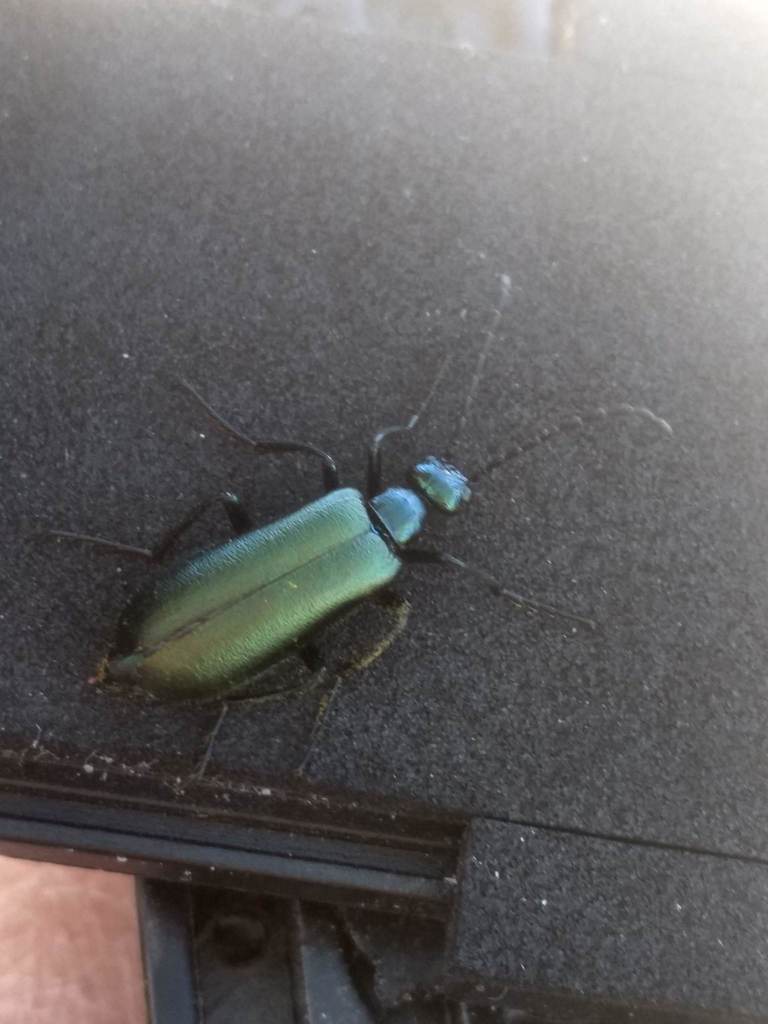
(c) Michele Jones, some rights reserved (CC BY) · licence
Family: Meloidae · Class: Insecta · Order: Coleoptera
Lytta stygica (Green Blister Beetle) is a California animal in the Meloidae family.
The Green Blister Beetle (Lytta stygica) is a member of the family Meloidae, belonging to the subgenus Poreospasta within the Stygica species group. This beetle is part of a taxonomically complex group of blister beetles found in western North America. Adults typically measure 10-20 mm in length and display the characteristic metallic green coloration that gives the species its common name, though specific morphological descriptions remain limited in the scientific literature. Lytta stygica occurs in California and other western states, though its precise distribution within California has not been comprehensively documented. The species appears to be part of the broader western North American blister beetle fauna, with records suggesting occurrence in areas with suitable host vegetation and ground-nesting bee populations. The habitat requirements of L. stygica are not well-documented in the available literature. Like other members of the genus Lytta, this species likely inhabits areas that support both its larval host requirements and adult feeding needs. Many blister beetles in this genus are associated with open habitats including grasslands, chaparral, and oak woodlands where ground-nesting bees are present. The ecology of Green Blister Beetles follows the typical meloidae life cycle pattern. Adults are phytophagous, feeding on various flowering plants, though specific host plants for L. stygica have not been well-documented. The larvae are hypermetamorphic, undergoing a complex development that includes a mobile first instar (triungulin) that seeks out ground-nesting bee larvae or provisions. This parasitic larval stage is characteristic of the family Meloidae. Adult blister beetles produce cantharidin, a defensive chemical compound that can cause blistering of human skin upon contact, hence the common name for the family. Reproductive biology and seasonal activity patterns for L. stygica are not well-documented in the scientific literature. Most Lytta species are active during warmer months, with adults emerging to mate and feed on flowering plants. Females typically deposit eggs in soil where the hatching triungulins can locate suitable bee hosts. The conservation status of Lytta stygica has not been formally assessed. The species does not appear on federal or California state endangered species lists as of December 2025. Like many insects, population trends and conservation needs are poorly understood due to limited systematic surveys and taxonomic challenges within the Lytta genus. The species may face threats common to many native insects, including habitat loss, pesticide use, and impacts to ground-nesting bee communities that serve as larval hosts. Scientific documentation for this species remains limited. The information presented here synthesizes available taxonomic and ecological knowledge from entomological databases. Additional research is needed to better understand the distribution, ecology, and conservation status of L. stygica in California. Field studies documenting specific host plant relationships, habitat preferences, and population status would contribute significantly to our understanding of this species.
Classification
Class: Insecta · Order: Coleoptera · Family: Meloidae
Frequently asked questions
How is Lytta stygica classified?
Lytta stygica belongs to class Insecta, order Coleoptera, family Meloidae.
What family does Lytta stygica belong to?
Lytta stygica is in the Meloidae family.
What is Lytta stygica?
The Green Blister Beetle (Lytta stygica) is a member of the family Meloidae, belonging to the subgenus Poreospasta within the Stygica species group.
Is Lytta stygica found in California?
Yes. Lytta stygica is recorded in California in The California Species Project's catalogue.
Related species
Other California species in the same genus, family, or bioregion.
Data from The California Species Project — 14,000+ California species with verified data from CNPS, CDFW, USFWS, and more.