Macaria austrinata
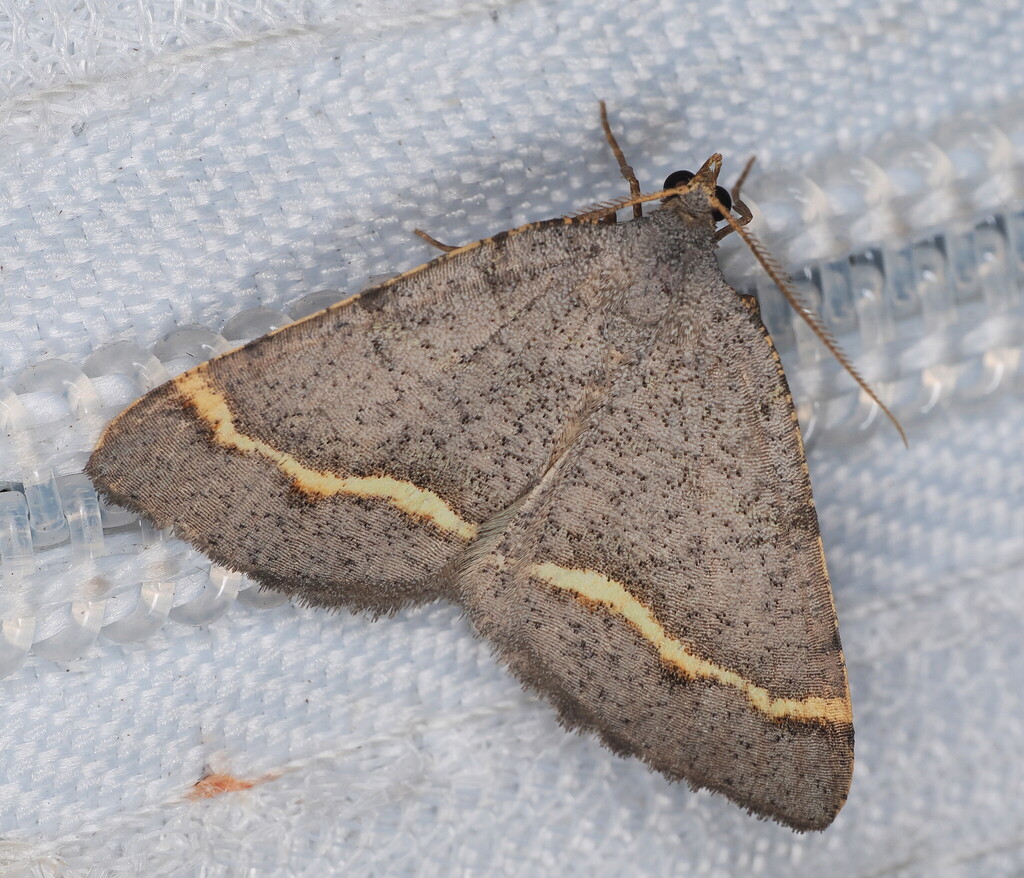
(c) Rosario Douglas, some rights reserved (CC BY) · licence
Family: Geometridae · Class: Insecta · Order: Lepidoptera
Macaria austrinata is a California animal in the Geometridae family.
Macaria austrinata is a geometrid moth in the family Geometridae, subfamily Ennominae. This species belongs to a complex group of closely related moths that can be challenging to distinguish without detailed morphological examination. Adult moths display the typical geometrid body plan with relatively broad wings and a slender abdomen. The forewings and hindwings exhibit patterns of brown and gray coloration with subtle banding and markings characteristic of the genus Macaria. Sexual dimorphism may be present, as is common in many geometrid species, though specific details of size and wing pattern differences between males and females have not been well documented for this species. Macaria austrinata occurs in California from Los Angeles and Ventura counties southward to Baja California. The northern portion of this range overlaps with the closely related Macaria guenearia, which can complicate field identification in areas where both species co-occur. This distribution pattern suggests the species may be adapted to the Mediterranean climate conditions and vegetation communities of coastal and inland southern California. The specific habitat requirements and ecological preferences of Macaria austrinata have not been comprehensively studied. Like other members of the genus Macaria, this species likely inhabits areas with suitable host plants for larval development. Geometrid moths typically prefer habitats that support their caterpillar food plants, which often include various shrubs and trees. The species' range in southern California suggests it may be associated with chaparral, coastal sage scrub, or oak woodland vegetation communities, though specific plant associations remain undocumented. The life cycle and behavioral ecology of Macaria austrinata follow the typical geometrid pattern of complete metamorphosis. Adults likely emerge during specific seasonal periods, though flight times and activity patterns have not been recorded in detail. Caterpillars, commonly called inchworms or loopers, move in the characteristic geometrid fashion by extending the front portion of their body forward and then drawing the rear segments up to meet the front, creating a loop. Larval host plants for this species have not been identified, representing a significant gap in knowledge about the species' ecology. Adult moths are presumably nocturnal, like most geometrids, and may be attracted to artificial lights during their flight period. Macaria austrinata does not appear on federal or state endangered species lists, and its conservation status has not been formally assessed. The species' distribution in rapidly developing areas of southern California may make it vulnerable to habitat loss from urbanization and land conversion. However, without detailed population data or habitat requirements, it is difficult to evaluate specific conservation needs. The overlapping distribution with Macaria guenearia in the northern portion of its range adds complexity to field surveys and population monitoring efforts. Further research is needed to understand the species' ecology, population trends, and potential conservation concerns. Scientific documentation for this species remains limited, and we welcome contributions of verified field observations, photographs, or ecological data to enhance this species account.
Classification
Class: Insecta · Order: Lepidoptera · Family: Geometridae
Frequently asked questions
How is Macaria austrinata classified?
Macaria austrinata belongs to class Insecta, order Lepidoptera, family Geometridae.
What family does Macaria austrinata belong to?
Macaria austrinata is in the Geometridae family.
What is Macaria austrinata?
Macaria austrinata is a geometrid moth in the family Geometridae, subfamily Ennominae.
Is Macaria austrinata found in California?
Yes. Macaria austrinata is recorded in California in The California Species Project's catalogue.
Related species
Other California species in the same genus, family, or bioregion.
Data from The California Species Project — 14,000+ California species with verified data from CNPS, CDFW, USFWS, and more.