Macaria marcescaria
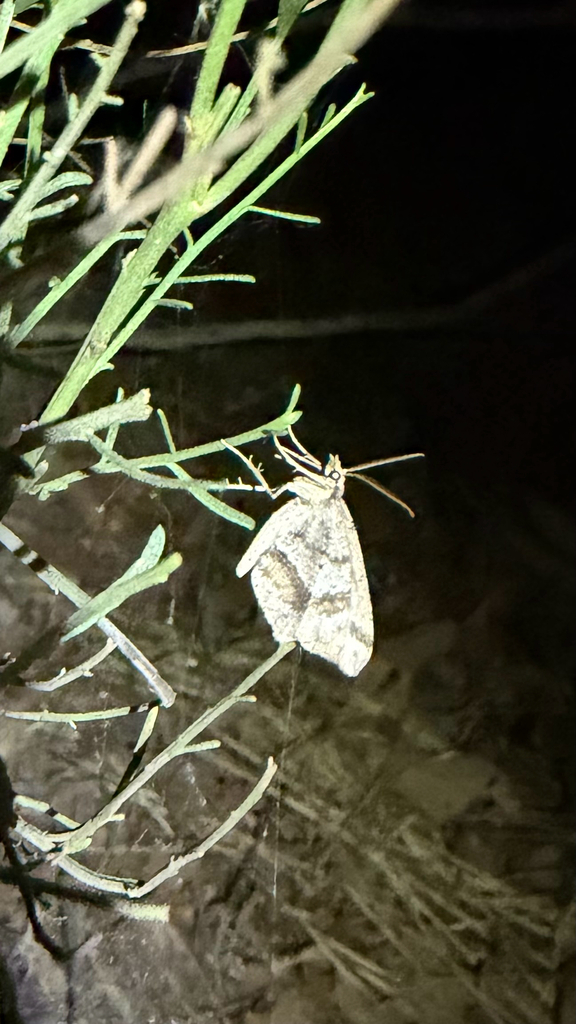
(c) Rachel Allingham, some rights reserved (CC BY) · licence
Family: Geometridae · Class: Insecta · Order: Lepidoptera
Macaria marcescaria is a California animal in the Geometridae family.
Macaria marcescaria is a geometrid moth in the family Geometridae, subfamily Ennominae. Adults have a wingspan of approximately 3.3 cm (1.3 inches). The species exhibits the typical angular wing shape characteristic of geometrid moths, with forewings and hindwings displaying earth-toned coloration that provides effective camouflage when resting on bark or vegetation. Like other members of the genus Macaria, this species likely shows sexual dimorphism in wing patterns and antenna structure, with males possessing more feathery antennae for detecting female pheromones. The species ranges from Oregon south through California to Baja California, Mexico (Butterflies and Moths of North America). In California, verified sightings have been documented in Monterey County and San Luis Obispo County, with observations recorded between 2012 and 2022. The distribution appears to follow coastal and near-coastal regions, suggesting adaptation to Mediterranean climate conditions characteristic of these areas. Macaria marcescaria inhabits areas where its primary host plant, coyotebush (Baccharis pilularis), occurs naturally (Butterflies and Moths of North America). Coyotebush is a widespread shrub in coastal scrub, chaparral, and oak woodland habitats throughout California's coastal ranges and foothills. This association suggests the moth occupies diverse habitat types including coastal bluffs, canyon bottoms, disturbed areas, and woodland edges where coyotebush establishes dense colonies. The species likely occurs from sea level to moderate elevations in foothill regions. Like other geometrid moths, larvae are inchworms or loopers that feed externally on host plant foliage. The caterpillars of M. marcescaria specifically utilize coyotebush, a member of the sunflower family (Asteraceae). Adult flight periods appear to span summer and early fall months based on observation dates ranging from July through November. Adults are likely nocturnal, attracted to artificial lights during evening hours. Mating probably occurs through chemical communication, with females releasing pheromones to attract males. Eggs are deposited on or near host plants, and larvae undergo several molts before pupating, possibly overwintering in the pupal stage. Currently, Macaria marcescaria holds no federal or state conservation listing status. NatureServe assigns the species a global rank of G4G5, indicating the species is apparently secure to secure globally (NatureServe Explorer). No specific conservation concerns have been identified, though like many specialized herbivorous insects, the species' stability depends on maintaining healthy populations of its host plant. Coyotebush remains abundant throughout much of the species' range, occurring in both natural and disturbed habitats. The moth's ability to utilize this widespread and adaptable shrub likely contributes to its apparently stable conservation status. However, detailed population monitoring and ecological studies remain limited for this species.
Classification
Class: Insecta · Order: Lepidoptera · Family: Geometridae
Frequently asked questions
How is Macaria marcescaria classified?
Macaria marcescaria belongs to class Insecta, order Lepidoptera, family Geometridae.
What family does Macaria marcescaria belong to?
Macaria marcescaria is in the Geometridae family.
What is Macaria marcescaria?
Macaria marcescaria is a geometrid moth in the family Geometridae, subfamily Ennominae.
Is Macaria marcescaria found in California?
Yes. Macaria marcescaria is recorded in California in The California Species Project's catalogue.
Related species
Other California species in the same genus, family, or bioregion.
Data from The California Species Project — 14,000+ California species with verified data from CNPS, CDFW, USFWS, and more.