Macaria signaria
Pale-marked Angle
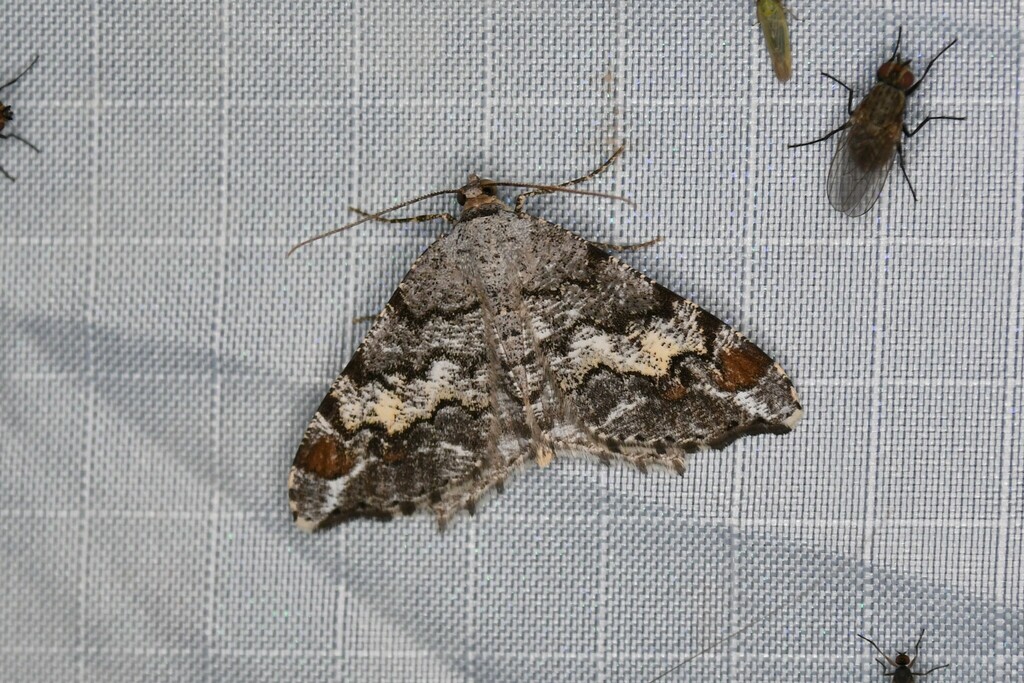
(c) Tristan Jobin, some rights reserved (CC BY) · licence
Family: Geometridae · Class: Insecta · Order: Lepidoptera
Macaria signaria (Pale-marked Angle) is a California animal in the Geometridae family.
The Pale-marked Angle is a geometrid moth in the family Geometridae, subfamily Ennominae. Adults typically measure 20-30 mm in wingspan, with forewings displaying a pale ground color marked by distinctive dark lines and bands that create the characteristic angular wing pattern typical of the genus Macaria. The forewings feature prominent transverse lines and often show subtle mottling or scaling that varies among individuals. The hindwings are generally paler with less distinct markings. Macaria signaria has a broad distribution across North America, extending from southern Canada through much of the United States. The species occurs widely across the western United States, including California, and extends eastward through the Great Plains and into eastern North America. According to NatureServe, the species maintains a global conservation status of G5, indicating it is secure globally with no immediate conservation concerns (NatureServe Explorer). Records from lepidopteran surveys document the species from diverse locations including Alaska, Washington, Oregon, Idaho, and other western states. The Pale-marked Angle inhabits a variety of forested and woodland environments, particularly areas supporting its larval host plants. The species shows preference for mixed deciduous and coniferous forests, woodland edges, and areas with diverse tree communities. Elevational range varies considerably across its distribution, from near sea level in coastal areas to montane forests at higher elevations. Adults are typically encountered from late spring through summer months, with peak flight periods varying by latitude and local climate conditions. Larvae feed on various deciduous trees and shrubs, though specific host plant relationships require further documentation for many populations. The caterpillars are typical geometrid loopers, moving in the characteristic arching motion while feeding on foliage. Adults are primarily nocturnal and are attracted to artificial lights, making them regular subjects for moth surveys and citizen science projects. Flight periods typically span several months during the growing season, with timing influenced by local temperature and photoperiod conditions. The Pale-marked Angle currently holds no federal or state conservation listing status and appears to maintain stable populations across most of its range. The species' broad geographic distribution and apparent habitat flexibility contribute to its secure conservation status. However, like many forest-associated moths, local populations may face pressures from habitat fragmentation, forest management practices, and climate change effects on forest composition. The species was included on Arkansas's Species of Greatest Conservation Need list in 2006, indicating some regional conservation interest, though this designation reflects uncertainty about population status rather than documented decline (BugGuide). Long-term monitoring through citizen science platforms and professional surveys continues to provide valuable population trend data for this widespread North American moth species.
Classification
Class: Insecta · Order: Lepidoptera · Family: Geometridae
Frequently asked questions
How is Macaria signaria classified?
Macaria signaria belongs to class Insecta, order Lepidoptera, family Geometridae.
What family does Macaria signaria belong to?
Macaria signaria is in the Geometridae family.
What is Macaria signaria?
The Pale-marked Angle is a geometrid moth in the family Geometridae, subfamily Ennominae.
Is Macaria signaria found in California?
Yes. Macaria signaria is recorded in California in The California Species Project's catalogue.
Related species
Other California species in the same genus, family, or bioregion.
Data from The California Species Project — 14,000+ California species with verified data from CNPS, CDFW, USFWS, and more.