Macaria unipunctaria
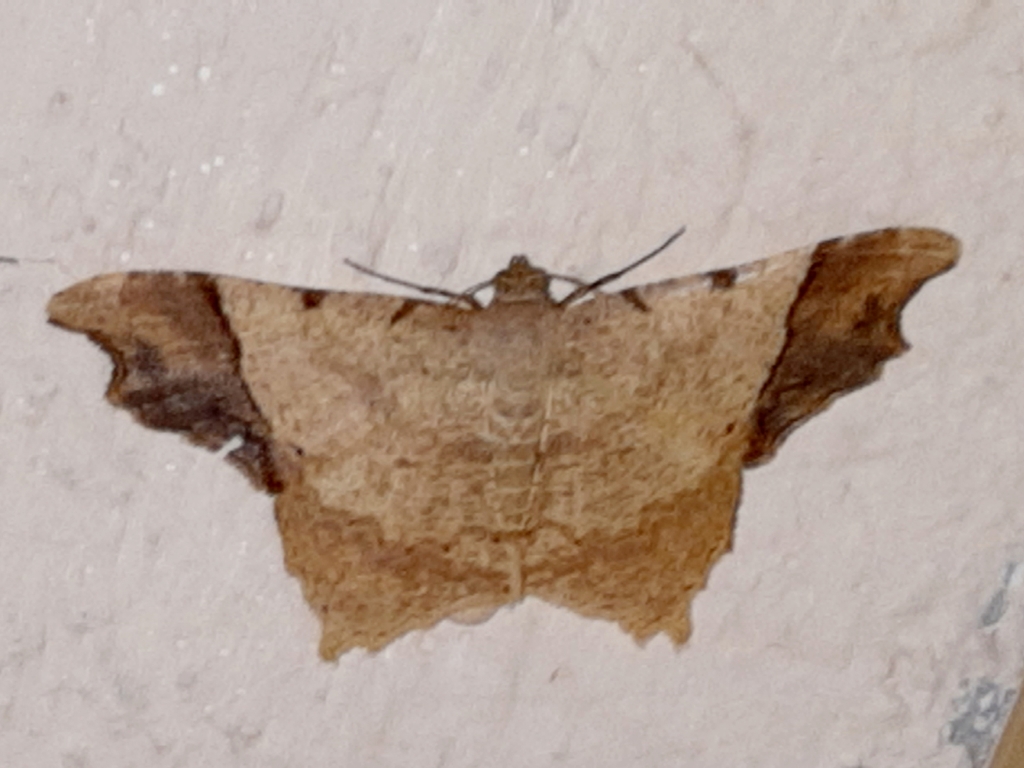
(c) Arthur de Jesús Chavarría Pérez, some rights reserved (CC BY) · licence
Family: Geometridae · Class: Insecta · Order: Lepidoptera
Macaria unipunctaria is a California animal in the Geometridae family.
Macaria unipunctaria, commonly known as the One-spotted Angle moth, is a small geometrid moth belonging to the family Geometridae. Adults typically measure 20-25 mm (0.8-1.0 inches) in wingspan. The forewings are pale gray to brownish-gray with subtle darker cross-lines and a distinctive single dark spot (discal spot) that gives the species its common name. The hindwings are lighter in coloration with faint markings. Like other geometrids, the wings are held horizontally when at rest, creating the characteristic triangular silhouette that earned this group the name "angle moths." Macaria unipunctaria occurs across much of North America, with records from southern Canada south to Mexico. In California, the species has been documented from various counties, though specific distribution data within the state requires further documentation. The species appears to have a broad elevational range, occurring from sea level to montane environments, though precise elevation limits in California are not well-established. This moth inhabits diverse forested environments where its host plants occur. The larvae feed on various members of the rose family (Rosaceae), particularly wild cherry species (Prunus) and related shrubs. Adults are typically found in woodland edges, clearings, and areas with mixed vegetation that support the larval host plants. The species shows preference for areas with adequate moisture and partial shade. Macaria unipunctaria is univoltine in most of its range, producing one generation per year. Adults are active during late spring and early summer, typically from May through July, depending on local climate conditions. The species is nocturnal, with adults attracted to artificial lights. Females deposit eggs on or near host plant foliage. The larvae are typical geometrid caterpillars, often called "inchworms" or "loopers" due to their characteristic method of locomotion. They progress by bringing their rear legs forward to meet their front legs, creating a loop with their body. Larvae feed on the foliage of host plants during summer months, pupating in the soil or leaf litter to overwinter. Currently, Macaria unipunctaria has no federal or state conservation listing status. The species appears to be relatively stable across much of its range, though like many forest-associated Lepidoptera, it may face pressure from habitat fragmentation and forest management practices. Climate change could affect the species through alterations to forest composition and the distribution of host plants. The species' broad host plant range and wide distribution suggest some resilience to environmental changes, though localized populations may be vulnerable to habitat loss. More comprehensive surveys are needed to better understand the species' status and distribution within California, particularly in areas undergoing rapid development or forest management changes.
Classification
Class: Insecta · Order: Lepidoptera · Family: Geometridae
Frequently asked questions
How is Macaria unipunctaria classified?
Macaria unipunctaria belongs to class Insecta, order Lepidoptera, family Geometridae.
What family does Macaria unipunctaria belong to?
Macaria unipunctaria is in the Geometridae family.
What is Macaria unipunctaria?
Macaria unipunctaria, commonly known as the One-spotted Angle moth, is a small geometrid moth belonging to the family Geometridae.
Is Macaria unipunctaria found in California?
Yes. Macaria unipunctaria is recorded in California in The California Species Project's catalogue.
Related species
Other California species in the same genus, family, or bioregion.
Data from The California Species Project — 14,000+ California species with verified data from CNPS, CDFW, USFWS, and more.