Magallana gigas
Pacific Oyster
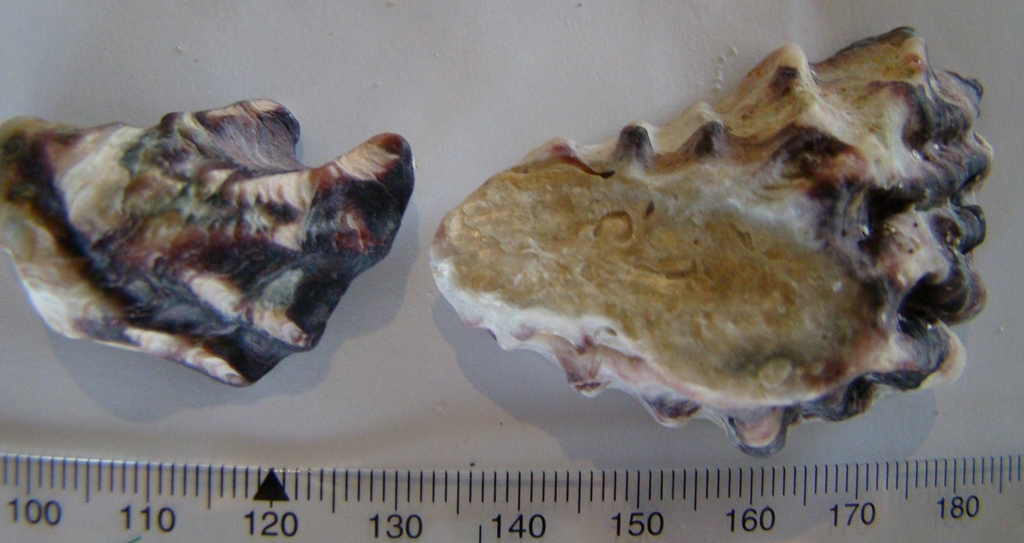
(c) Lisa Bennett, some rights reserved (CC BY) · licence
Family: Ostreidae · Class: Bivalvia · Order: Ostreida
Magallana gigas (Pacific Oyster) is a California animal in the Ostreidae family.
The Pacific oyster is a large marine bivalve mollusk native to the western Pacific Ocean but now established in California's coastal waters. Adults typically reach 150-200 mm (6-8 inches) in length, though specimens can grow up to 300 mm (12 inches). The shell is elongated and irregular in shape, with a deep left valve and flatter right valve. Shell coloration ranges from gray to brown or purple, often with radiating ribs and growth lines. The interior displays a white to purple nacre with a distinctive muscle scar. Pacific oysters occur along California's coast from Humboldt Bay to San Diego, with established populations in major estuarine systems. In California, they are found in protected waters including San Francisco Bay, Morro Bay, Elkhorn Slough, and San Dieguito Lagoon. The species has become naturalized in these systems after initial introductions for aquaculture purposes in the early 20th century. This species inhabits intertidal and shallow subtidal zones in estuaries, bays, and lagoons where freshwater mixes with saltwater. Pacific oysters prefer hard substrates including rocks, pilings, shells, and mudflats in areas protected from heavy wave action. They tolerate salinity ranges from 10-28 parts per thousand and can withstand significant temperature fluctuations. The species thrives in brackish environments where nutrient-rich waters support abundant phytoplankton. Pacific oysters are filter feeders, using their gills to extract phytoplankton, bacteria, and organic particles from the water column. A single adult can filter 20-50 gallons of water per day. They are protandric hermaphrodites, beginning life as males and potentially changing to females as they mature. Spawning occurs from late spring through early fall when water temperatures exceed 20°C (68°F). Females release millions of eggs into the water column where external fertilization occurs. Free-swimming larvae spend 2-3 weeks in the plankton before settling and metamorphosing into juveniles that cement to hard surfaces. Pacific oysters are not listed under federal or state endangered species acts, as they are a non-native species that has established self-sustaining populations in California. While not considered invasive in the traditional sense, their presence has ecological implications for native species. In some locations like Elkhorn Slough, Pacific oysters coexist with the native Olympia oyster (Ostrea lurida), which has experienced severe population declines. The introduced Pacific oysters may compete with native bivalves for space and resources, though they also provide ecosystem services through water filtration and habitat creation for other species. California Department of Fish and Wildlife recognizes Pacific oysters as part of the established marine ecosystem in state marine protected areas including Morro Bay State Marine Reserve and San Dieguito Lagoon State Marine Conservation Area, where they contribute to the invertebrate community alongside native clams, ghost shrimp, and shore crabs.
Classification
Class: Bivalvia · Order: Ostreida · Family: Ostreidae
Frequently asked questions
How is Magallana gigas classified?
Magallana gigas belongs to class Bivalvia, order Ostreida, family Ostreidae.
What family does Magallana gigas belong to?
Magallana gigas is in the Ostreidae family.
What is Magallana gigas?
The Pacific oyster is a large marine bivalve mollusk native to the western Pacific Ocean but now established in California's coastal waters.
Is Magallana gigas found in California?
Yes. Magallana gigas is recorded in California in The California Species Project's catalogue.
Related species
Other California species in the same genus, family, or bioregion.
Data from The California Species Project — 14,000+ California species with verified data from CNPS, CDFW, USFWS, and more.