Malacosoma californica
Western Tent Caterpillar Moth
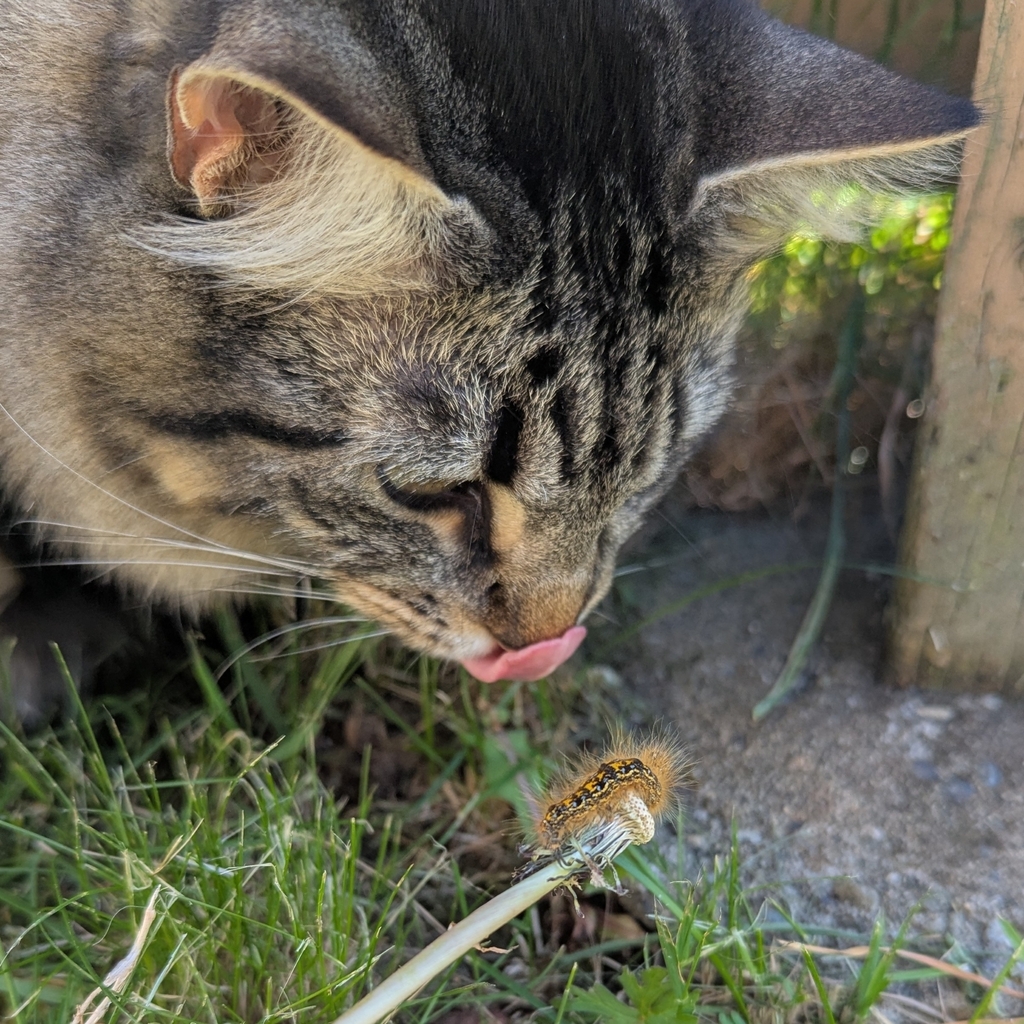
no rights reserved · CC0
Family: Lasiocampidae · Class: Insecta · Order: Lepidoptera
Malacosoma californica (Western Tent Caterpillar Moth) is a California animal in the Lasiocampidae family.
The Western tent caterpillar moth (Malacosoma californica) is a medium-sized moth in the family Lasiocampidae, with adults displaying rusty-brown to reddish-brown forewings marked by two pale diagonal stripes. The wingspan ranges from 25 to 40 mm (1.0 to 1.6 inches). Males are typically smaller and more active than females, with more feathered antennae for detecting female pheromones. This species ranges from southeastern Canada to New York and west to the Pacific Coast, with populations more abundant in western regions. In California, the species occurs throughout much of the state, from coastal areas to montane regions. The distribution extends north into British Columbia and south into Mexico, making it one of the more widespread tent caterpillar species in North America. Western tent caterpillar moths inhabit diverse habitats including deciduous and mixed woodlands, riparian areas, orchards, and urban landscapes where host plants are present. Adults are attracted to lights and are commonly observed from late spring through mid-summer. The species shows considerable ecological adaptability, occurring from sea level to elevations exceeding 2,000 meters in mountainous regions. The larval stage is the most conspicuous phase of this species' life cycle. Caterpillars construct characteristic silk tents in the crotches of tree branches, which serve as communal shelters and molting sites. These tent-building behaviors distinguish M. californica from the closely related forest tent caterpillar (M. disstria), which does not construct tents. Larvae feed primarily on deciduous trees including wild cherry (Prunus species), oak (Quercus species), apple (Malus species), and other members of the Rosaceae family (McFarland 1975). The species exhibits one generation per year, with eggs overwintering on host plant twigs. Caterpillars emerge in early spring when new foliage appears, feed communally for 6-8 weeks, then pupate in cocoons attached to tree bark or nearby vegetation. Adult moths emerge in late spring to early summer, with peak flight periods varying by latitude and elevation. Females deposit egg masses in rings around small twigs, covering them with a protective foam-like substance that hardens over winter. The species demonstrates cyclical population dynamics, with periodic outbreaks occurring approximately every 7-10 years when environmental conditions favor survival and reproduction. The Western tent caterpillar moth is not federally or state-listed as threatened or endangered. Population levels fluctuate naturally, and the species remains common throughout most of its range. While periodic defoliation events can impact individual trees or forest stands, these outbreaks typically subside naturally through predation, parasitism, and disease. The species plays important ecological roles as both herbivore and prey species, supporting diverse communities of parasitoid wasps, flies, and predatory insects. Climate change may affect future distribution patterns and outbreak cycles, though the species' broad host plant range and ecological adaptability suggest continued population stability across most of its current range.
Classification
Class: Insecta · Order: Lepidoptera · Family: Lasiocampidae
Frequently asked questions
How is Malacosoma californica classified?
Malacosoma californica belongs to class Insecta, order Lepidoptera, family Lasiocampidae.
What family does Malacosoma californica belong to?
Malacosoma californica is in the Lasiocampidae family.
What is Malacosoma californica?
The Western tent caterpillar moth (Malacosoma californica) is a medium-sized moth in the family Lasiocampidae, with adults displaying rusty-brown to reddish-brown forewings marked by two pale diagonal stripes.
Is Malacosoma californica found in California?
Yes. Malacosoma californica is recorded in California in The California Species Project's catalogue.
Related species
Other California species in the same genus, family, or bioregion.
Data from The California Species Project — 14,000+ California species with verified data from CNPS, CDFW, USFWS, and more.