Malacosoma constricta
Pacific Tent Caterpillar
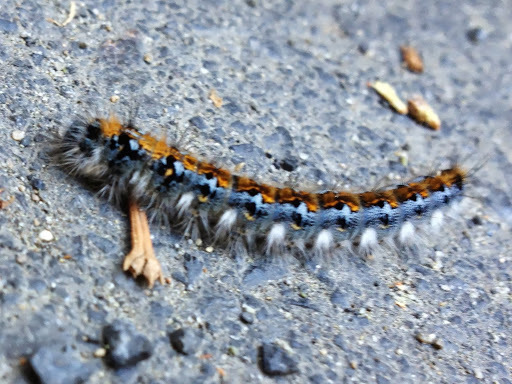
(c) 101595408250610106310, some rights reserved (CC BY) · licence
Family: Lasiocampidae · Class: Insecta · Order: Lepidoptera
Malacosoma constricta (Pacific Tent Caterpillar) is a California animal in the Lasiocampidae family.
The Pacific tent caterpillar (Malacosoma constricta) is a moth species in the family Lasiocampidae endemic to western North America. Adult moths have brown to reddish-brown forewings with darker bands and pale hindwings. The caterpillars are social larvae that construct distinctive silk tents in the branches of their host trees, giving the species its common name. Malacosoma constricta occurs in California, Oregon, and Washington (iNaturalist). In California, the species is divided into two subspecies with distinct distributions: M. c. austrinum ranges from Santa Barbara County southward, while M. c. constrictum occurs from Los Angeles County northward (iNaturalist). This distribution pattern suggests adaptation to different climatic conditions across the state's latitudinal gradient. Pacific tent caterpillars are exclusively associated with oak trees (Quercus species) throughout their range (iNaturalist). The species inhabits oak woodlands, mixed oak forests, and oak-dominated chaparral communities. These habitats range from coastal areas to interior valleys and foothills where native oaks are present. The caterpillars show high host specificity, feeding only on various oak species rather than the broader range of host plants utilized by related tent caterpillar species. The species exhibits typical tent caterpillar behavior, with eggs laid in masses around small branches in late summer. Caterpillars emerge in spring and immediately begin constructing communal silk tents in branch forks. These tents serve as shelter during periods of inactivity and provide protection from predators and weather. The larvae are gregarious, leaving the tent together to feed on oak foliage before returning to the shelter. This social behavior continues through several molts until pupation occurs in individual cocoons. Adults emerge in summer to mate and complete the annual cycle. The species can occasionally reach outbreak densities that result in significant defoliation of oak trees. Such outbreaks can impact other wildlife that depends on oak habitats. Research has documented cases where tent caterpillar defoliation caused nest failures in Blue-gray Gnatcatchers (Polioptila caerulea) due to loss of arthropod prey following removal of foliage (Birds of the World). However, oaks typically recover from defoliation events, and periodic outbreaks appear to be part of the natural population dynamics. Malacosoma constricta does not have any special conservation status and is considered a common species throughout its range. The species benefits from the widespread distribution of oak woodlands in California, though habitat conversion and oak removal in some areas may locally affect populations. Climate change could potentially alter the timing of emergence and host plant phenology, but current populations appear stable. The species plays an ecological role as both an herbivore of oaks and as prey for various birds, spiders, and parasitic insects that help regulate population levels.
Classification
Class: Insecta · Order: Lepidoptera · Family: Lasiocampidae
Frequently asked questions
How is Malacosoma constricta classified?
Malacosoma constricta belongs to class Insecta, order Lepidoptera, family Lasiocampidae.
What family does Malacosoma constricta belong to?
Malacosoma constricta is in the Lasiocampidae family.
What is Malacosoma constricta?
The Pacific tent caterpillar (Malacosoma constricta) is a moth species in the family Lasiocampidae endemic to western North America.
Is Malacosoma constricta found in California?
Yes. Malacosoma constricta is recorded in California in The California Species Project's catalogue.
Related species
Other California species in the same genus, family, or bioregion.
Data from The California Species Project — 14,000+ California species with verified data from CNPS, CDFW, USFWS, and more.