Malacosoma constrictum
Pacific Tent Caterpillar Moth
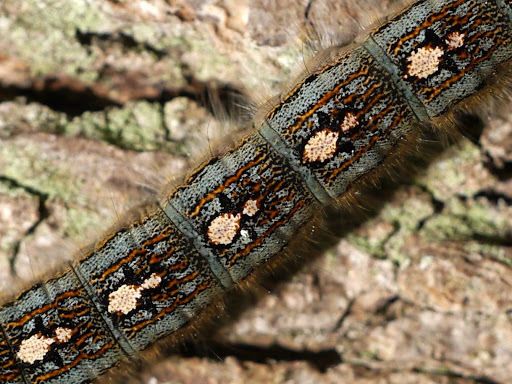
(c) Matt Muir, some rights reserved (CC BY) · licence
Family: Lasiocampidae · Class: Insecta · Order: Lepidoptera
Malacosoma constrictum (Pacific Tent Caterpillar Moth) is a California animal in the Lasiocampidae family.
The Pacific tent caterpillar moth (Malacosoma constrictum) is a medium-sized moth in the family Lasiocampidae, distinguished by its robust, hairy body and mottled brown forewings. Adults have a wingspan of 25 to 40 mm (1.0 to 1.6 inches), with females typically larger than males. The forewings display variable brown, tan, and gray coloration with darker transverse lines and pale spots. Males possess feathery antennae and a more slender abdomen compared to females. The hindwings are uniformly pale brown to tan. Adult moths are covered in dense, woolly scales that give them a fuzzy appearance. Malacosoma constrictum ranges along the Pacific Coast from British Columbia south to Baja California, with populations extending inland through mountainous regions of California, Oregon, and Washington. In California, the species occurs in coastal counties from Del Norte to San Diego, as well as in the Sierra Nevada, Cascade Range, and Transverse Ranges. The distribution follows suitable host plant availability and appropriate climate conditions. This species inhabits diverse woodland and forest ecosystems from sea level to approximately 2,400 meters (7,900 feet) elevation. Pacific tent caterpillars are most commonly found in riparian areas, oak woodlands, mixed coniferous forests, and chaparral communities. The larvae require deciduous trees and shrubs for feeding and tent construction, particularly favoring areas with morning sun exposure for thermoregulation. Pacific tent caterpillars are gregarious during the larval stage, constructing characteristic silk tents in branch crotches of host trees. Primary host plants include oak species (Quercus spp.), willows (Salix spp.), cherry and plum trees (Prunus spp.), apple (Malus spp.), and occasionally other deciduous trees. Larvae emerge in early spring, typically March through May, coinciding with bud break of host plants. The caterpillars feed collectively, leaving the tent during the day to forage and returning to molt and rest. Development through five instars takes 6 to 8 weeks. Mature larvae are 50 to 65 mm (2.0 to 2.6 inches) long, displaying blue and black coloration with orange spots and white stripes. Pupation occurs in individual cocoons attached to bark, fence posts, or other protected surfaces. Adults emerge in late summer, typically July through September, and mate shortly after emergence. Females deposit egg masses of 150 to 300 eggs around small twigs, where they overwinter. Malacosoma constrictum populations experience natural cyclical fluctuations, with outbreak years occurring approximately every 8 to 10 years followed by population crashes. The species is not currently listed under state or federal endangered species legislation. Primary ecological threats include habitat loss from urban development, altered fire regimes, and climate change affecting host plant phenology. Natural enemies include parasitoid wasps, flies, birds, and viral pathogens that help regulate population levels. While periodic outbreaks can cause temporary defoliation of host trees, the species plays an important role in forest ecosystems as both herbivore and prey species.
Classification
Class: Insecta · Order: Lepidoptera · Family: Lasiocampidae
Frequently asked questions
How is Malacosoma constrictum classified?
Malacosoma constrictum belongs to class Insecta, order Lepidoptera, family Lasiocampidae.
What family does Malacosoma constrictum belong to?
Malacosoma constrictum is in the Lasiocampidae family.
What is Malacosoma constrictum?
The Pacific tent caterpillar moth (Malacosoma constrictum) is a medium-sized moth in the family Lasiocampidae, distinguished by its robust, hairy body and mottled brown forewings.
Is Malacosoma constrictum found in California?
Yes. Malacosoma constrictum is recorded in California in The California Species Project's catalogue.
Related species
Other California species in the same genus, family, or bioregion.
Data from The California Species Project — 14,000+ California species with verified data from CNPS, CDFW, USFWS, and more.