Malacosoma disstria
Forest Tent Caterpillar Moth
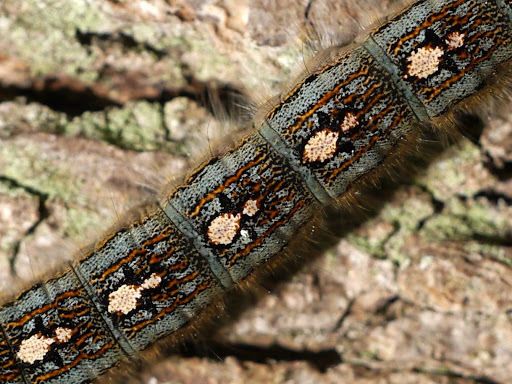
(c) Matt Muir, some rights reserved (CC BY) · licence
Family: Lasiocampidae · Class: Insecta · Order: Lepidoptera
Malacosoma disstria (Forest Tent Caterpillar Moth) is a California animal in the Lasiocampidae family.
The Forest Tent Caterpillar Moth (Malacosoma disstria) is a medium-sized moth in the family Lasiocampidae, widely distributed across North America including California. Adults have a wingspan of 25 to 40 mm (1.0 to 1.6 inches), with males typically smaller than females. The forewings are brown to tan with two darker diagonal lines running from the wing base to the outer margin. Males possess feathery, bipectinate antennae, while females have narrower, less branched antennae. The hindwings are lighter in coloration, often pale brown or cream-colored. The species occurs throughout much of North America, from southern Canada to northern Mexico. In California, Forest Tent Caterpillar Moths are found in forested regions across the state, from the Coast Ranges to the Sierra Nevada, typically at elevations below 2,400 meters (7,900 feet). Populations are established in both northern and central California counties where suitable host trees are present. Forest Tent Caterpillar Moths inhabit deciduous and mixed forests, woodland edges, and riparian corridors. The species is closely associated with broadleaf trees, particularly favoring aspen, oak, cherry, birch, and maple species. In California, they commonly utilize coast live oak (Quercus agrifolia), interior live oak (Q. wislizeni), and various willow species (Salix spp.). Adults are attracted to artificial lights and can be found in suburban areas with ornamental trees. The species exhibits a univoltine life cycle, producing one generation per year. Adults emerge in mid to late summer, typically from June through August, with peak flight activity occurring at night. Females deposit egg masses of 150 to 350 eggs in bands around small twigs, covering them with a protective foam-like substance called spumaline. Eggs overwinter and hatch the following spring, usually in April or May. Larvae are gregarious feeders that construct silk mats on tree trunks and branches but do not build traditional tents like their close relative, the Eastern Tent Caterpillar. Mature caterpillars reach 50 to 65 mm (2.0 to 2.6 inches) in length and are characterized by blue spots along their sides and a series of white diamond-shaped markings down the back. Pupation occurs in cocoons spun in leaf litter or bark crevices. Forest Tent Caterpillar populations are cyclical, with outbreaks occurring approximately every 10 to 15 years when environmental conditions favor reproduction and survival. During outbreak years, defoliation can be extensive, though healthy trees typically recover by producing new leaves. The species faces natural regulation through parasitoid wasps, viral diseases, and predation by birds. Climate change may affect population dynamics by altering the timing of egg hatch relative to host plant phenology. Currently, the Forest Tent Caterpillar Moth is not listed under any conservation status in California or federally, as populations remain stable across most of its range.
Classification
Class: Insecta · Order: Lepidoptera · Family: Lasiocampidae
Frequently asked questions
How is Malacosoma disstria classified?
Malacosoma disstria belongs to class Insecta, order Lepidoptera, family Lasiocampidae.
What family does Malacosoma disstria belong to?
Malacosoma disstria is in the Lasiocampidae family.
What is Malacosoma disstria?
The Forest Tent Caterpillar Moth (Malacosoma disstria) is a medium-sized moth in the family Lasiocampidae, widely distributed across North America including California.
Is Malacosoma disstria found in California?
Yes. Malacosoma disstria is recorded in California in The California Species Project's catalogue.
Related species
Other California species in the same genus, family, or bioregion.
Data from The California Species Project — 14,000+ California species with verified data from CNPS, CDFW, USFWS, and more.