Mallophora fautrix
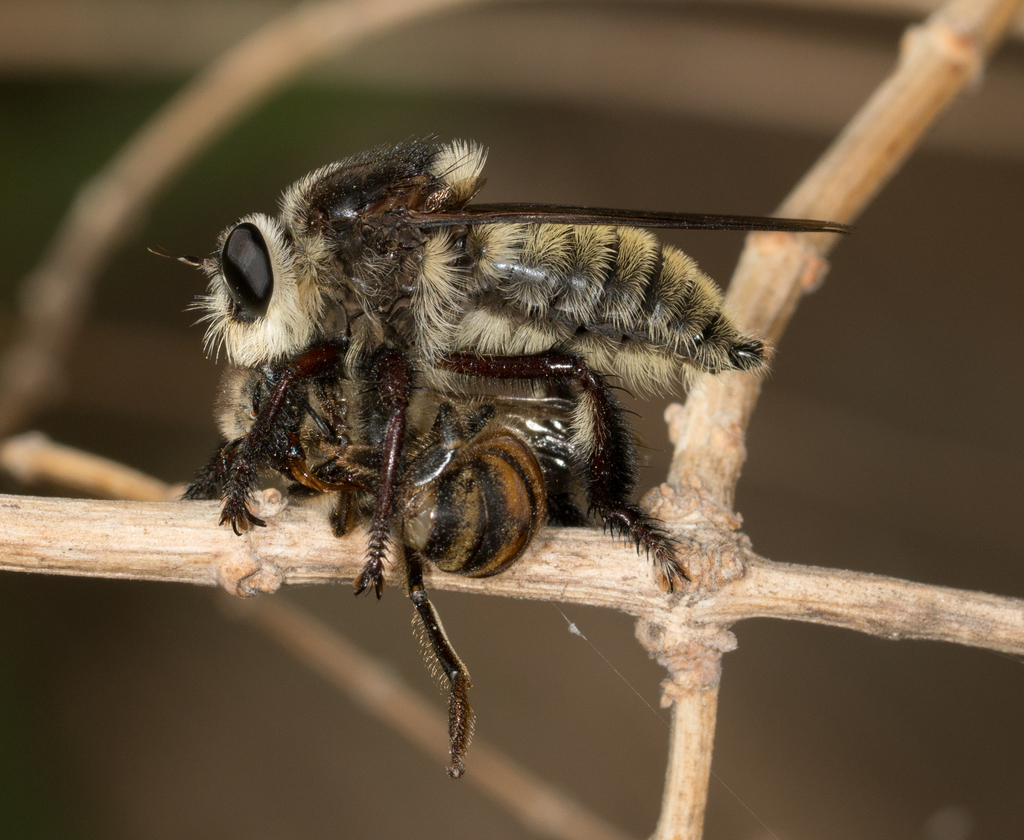
no rights reserved · CC0
Family: Asilidae · Class: Insecta · Order: Diptera
Mallophora fautrix is a California animal in the Asilidae family.
Mallophora fautrix is a robber fly species in the family Asilidae, commonly known as a bee killer. This medium-sized predatory fly measures approximately 15-25 mm in length and belongs to the genus Mallophora, whose name derives from the Greek meaning 'wool-bearing,' referring to the dense bristles covering these flies (BugGuide). The species exhibits the characteristic robust build of robber flies, with a prominent proboscis adapted for piercing prey and strong legs for grasping victims during aerial attacks. Mallophora fautrix has a distinctive distribution pattern across the southwestern United States, ranging from California through Texas and Utah, and extending into Mexico (BugGuide). Notably, this species represents the only member of the genus Mallophora found in California, making it taxonomically significant within the state's dipteran fauna. Historical records document its presence in southern California coastal areas, including documented occurrences at Ballona Wetlands and LAX area dune systems (Mattoni 1991). The species inhabits diverse habitats across its range, with California populations associated with coastal dune systems and scrubland environments. The species has been documented in areas undergoing habitat restoration, suggesting some adaptability to modified landscapes. However, specific microhabitat requirements and elevation preferences remain poorly documented in the scientific literature. As a member of the robber fly family, Mallophora fautrix functions as an active aerial predator, capturing other insects in flight. True to its common name as a bee killer, the species likely preys upon various flying insects including bees, wasps, and other dipterans. Adult robber flies are ambush predators that perch on prominent locations and launch rapid attacks on passing prey. The species exhibits typical asilid hunting behavior, using its strong proboscis to pierce prey and inject enzymes that liquefy internal tissues for consumption. Specific details regarding seasonal activity patterns, mating behavior, and larval ecology for this species have not been well documented in available literature. No federal or state conservation status has been assigned to Mallophora fautrix, and population trends remain largely unknown due to limited systematic survey efforts. However, given its apparent restriction to specific habitat types in California and the documented historical occurrence in areas now heavily developed, the species may face localized threats from habitat loss and fragmentation. The documented presence at Ballona Wetlands suggests the species may benefit from habitat restoration efforts in coastal areas. The lack of recent distributional data and ecological studies represents a significant knowledge gap for this California endemic population. Detailed ecological studies of this species are lacking. The above information synthesizes available data from taxonomic databases and limited habitat surveys. Enhanced survey efforts and systematic ecological research would improve understanding of this species' conservation needs and ecological role within California's diverse arthropod communities.
Classification
Class: Insecta · Order: Diptera · Family: Asilidae
Frequently asked questions
How is Mallophora fautrix classified?
Mallophora fautrix belongs to class Insecta, order Diptera, family Asilidae.
What family does Mallophora fautrix belong to?
Mallophora fautrix is in the Asilidae family.
What is Mallophora fautrix?
Mallophora fautrix is a robber fly species in the family Asilidae, commonly known as a bee killer.
Is Mallophora fautrix found in California?
Yes. Mallophora fautrix is recorded in California in The California Species Project's catalogue.
Related species
Other California species in the same genus, family, or bioregion.
Data from The California Species Project — 14,000+ California species with verified data from CNPS, CDFW, USFWS, and more.