Manduca rustica
Rustic sphinx
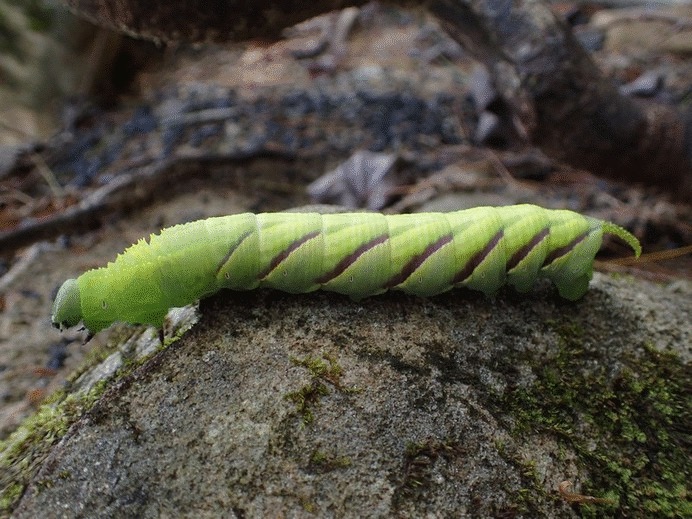
(c) Evan M. Raskin, some rights reserved (CC BY) · licence
Family: Sphingidae · Class: Insecta · Order: Lepidoptera
Manduca rustica (Rustic sphinx) is a California animal in the Sphingidae family.
The rustic sphinx is a large moth in the hawkmoth family Sphingidae, with a wingspan typically ranging from 95 to 130 mm (3.7 to 5.1 inches). Adults display mottled gray-brown forewings with intricate patterns of wavy lines and darker markings that provide effective camouflage against tree bark. The hindwings are pale gray to brownish with darker banding. The robust body is covered in dense, grayish scales, and the species exhibits the characteristic long proboscis typical of sphinx moths, adapted for feeding on nectar from deep-throated flowers. The rustic sphinx has an extensive range spanning from Virginia south to Florida, extending west through Arkansas, Texas, southern New Mexico, Arizona, and southern California. The species occurs throughout Central America and South America, reaching as far south as Uruguay. Occasional vagrant individuals have been recorded as far north as Maine, Massachusetts, and New York, likely representing dispersing adults carried by favorable wind patterns. This species inhabits a variety of environments from sea level to moderate elevations, typically associated with areas where host plants occur. In California, populations are found in riparian zones, urban gardens, and natural areas that support jasmine species and other members of the olive family. The moth occupies both native plant communities and disturbed habitats, including suburban landscapes where ornamental jasmine is cultivated. Rustic sphinx caterpillars feed on several plant families, demonstrating notable host plant diversity. Primary larval hosts include fringe tree (Chionanthus virginicus) and jasmine species (Jasminum) in the olive family Oleaceae, bushy matgrass (Lippia alba) in the vervain family Verbenaceae, knockaway (Ehretia anacua) in the borage family Boraginaceae, and Bignonia species in the Bignoniaceae. The large, green caterpillars reach lengths of approximately 100 mm and display the characteristic horn at the posterior end typical of sphinx moth larvae. Adults are active primarily at dusk and night, visiting flowers of various species for nectar. Flight periods vary by latitude, with multiple broods occurring annually in warmer regions. In California, adults may be active from spring through fall depending on local conditions and host plant phenology. The rustic sphinx is not federally or state-listed and appears to maintain stable populations across much of its range. The species' broad host plant range and ability to utilize both native and introduced plants, particularly ornamental jasmine, likely contribute to its persistence in modified landscapes. However, like many Lepidoptera, populations may face localized pressures from habitat loss, pesticide use, and light pollution that can disrupt nocturnal behavior patterns. The moth's wide geographic distribution and multiple host plant families suggest resilience to environmental changes, though specific population trends have not been comprehensively studied throughout its range.
Classification
Class: Insecta · Order: Lepidoptera · Family: Sphingidae
Frequently asked questions
How is Manduca rustica classified?
Manduca rustica belongs to class Insecta, order Lepidoptera, family Sphingidae.
What family does Manduca rustica belong to?
Manduca rustica is in the Sphingidae family.
What is Manduca rustica?
The rustic sphinx is a large moth in the hawkmoth family Sphingidae, with a wingspan typically ranging from 95 to 130 mm (3.7 to 5.1 inches).
Is Manduca rustica found in California?
Yes. Manduca rustica is recorded in California in The California Species Project's catalogue.
Related species
Other California species in the same genus, family, or bioregion.
Data from The California Species Project — 14,000+ California species with verified data from CNPS, CDFW, USFWS, and more.