Manduca sexta
Carolina sphinx
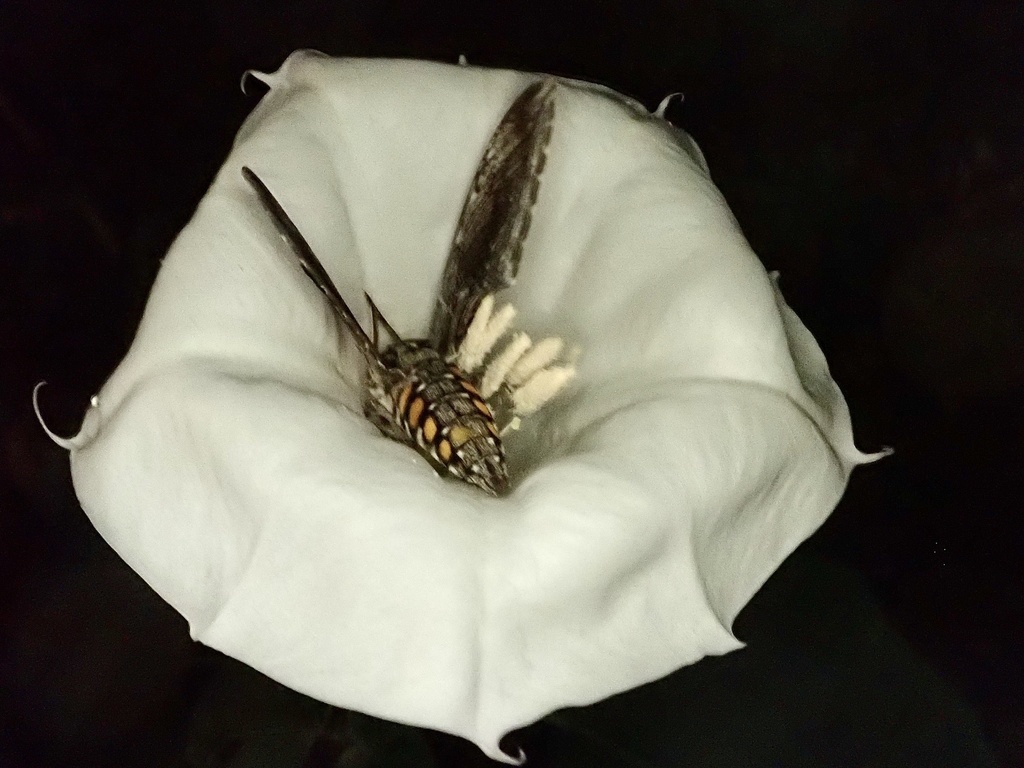
(c) Clifton Ladd, C.W.B., some rights reserved (CC BY) · licence
Family: Sphingidae · Class: Insecta · Order: Lepidoptera
Manduca sexta (Carolina sphinx) is a California animal in the Sphingidae family.
The Carolina sphinx is a large moth in the family Sphingidae, commonly known as hawk moths or sphinx moths. Adults have a wingspan of 90 to 120 mm (3.5 to 4.7 inches) and display distinctive gray forewings with darker zigzag patterns and white lines. The hindwings are gray with darker banding. The body is robust and tapered, characteristic of sphinx moths, with a wingspan that enables rapid, hovering flight. The species exhibits sexual dimorphism, with males having slightly narrower wings and more prominent antennae than females. The Carolina sphinx ranges from Massachusetts west across southern Michigan to Minnesota, central Colorado, and northern California, extending south to Florida, the Gulf Coast, Texas, New Mexico, Arizona, and southern California. In California, the species occurs primarily in the southern regions and Central Valley, where suitable host plants are abundant. The distribution has expanded with agricultural development, particularly in areas where solanaceous crops are cultivated. This species inhabits agricultural areas, gardens, fields, and disturbed habitats where host plants in the nightshade family (Solanaceae) are present. Carolina sphinx moths are found from sea level to approximately 2,000 meters (6,500 feet) elevation. Adults prefer areas with access to nectar sources, including gardens with flowering plants such as petunias, tobacco, and four o'clocks. The species adapts well to human-modified landscapes and urban environments. Carolina sphinx moths are crepuscular and nocturnal, most active during evening hours when they feed on nectar from deep-throated flowers. Adults hover while feeding, using their long proboscis to access nectar. The species produces two to three generations per year in warmer climates, with continuous breeding possible in subtropical regions. Females deposit large, spherical, pale green eggs singly on host plant leaves. Larvae, commonly called tobacco hornworms or tomato hornworms, are large green caterpillars reaching 70 to 100 mm (2.8 to 3.9 inches) in length. They possess a characteristic horn-like projection on the eighth abdominal segment and diagonal white stripes along their sides. Host plants include potato, tobacco, tomato, and other plants in the nightshade family (Solanaceae). Larvae feed on leaves and can cause significant damage to agricultural crops, particularly tomatoes and tobacco. The species overwinters as pupae in underground chambers, emerging as adults when temperatures warm in spring. The Carolina sphinx is not listed under federal or state endangered species legislation and maintains stable populations throughout its range. The species benefits from agricultural practices that provide abundant host plants, though it is sometimes considered an agricultural pest due to larval feeding damage on crops. Population trends appear stable, with the species showing adaptability to various habitats and climate conditions. No specific conservation measures are currently needed for this widespread and common species.
Classification
Class: Insecta · Order: Lepidoptera · Family: Sphingidae
Frequently asked questions
How is Manduca sexta classified?
Manduca sexta belongs to class Insecta, order Lepidoptera, family Sphingidae.
What family does Manduca sexta belong to?
Manduca sexta is in the Sphingidae family.
What is Manduca sexta?
The Carolina sphinx is a large moth in the family Sphingidae, commonly known as hawk moths or sphinx moths.
Is Manduca sexta found in California?
Yes. Manduca sexta is recorded in California in The California Species Project's catalogue.
Related species
Other California species in the same genus, family, or bioregion.
Data from The California Species Project — 14,000+ California species with verified data from CNPS, CDFW, USFWS, and more.