Mareca americana
American Wigeon
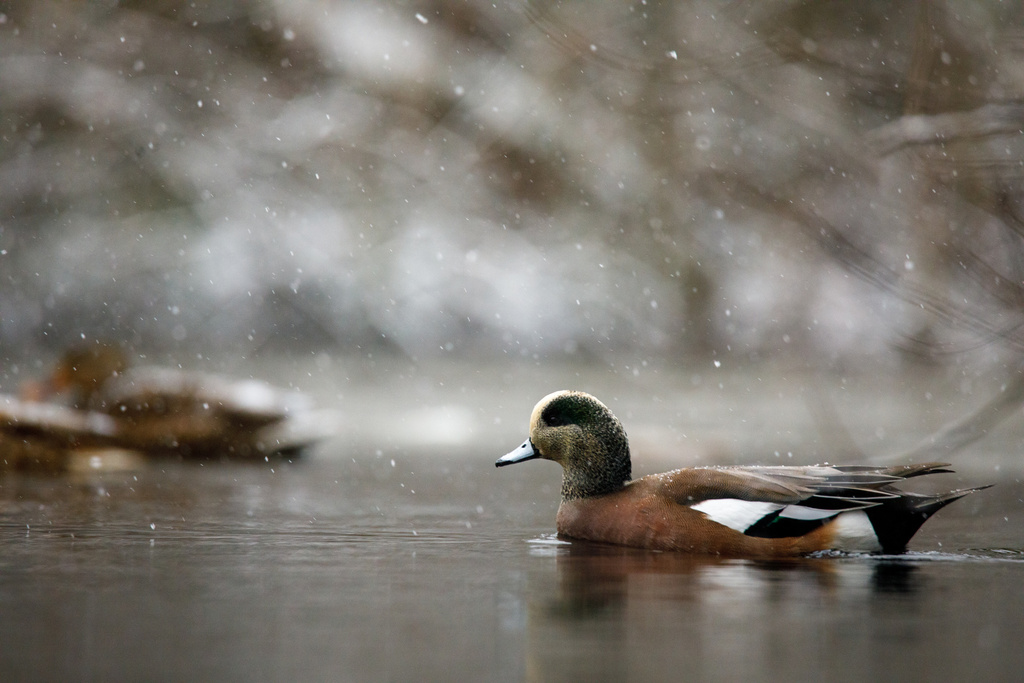
(c) Charles Van Arsdall, some rights reserved (CC BY) · licence
Family: Anatidae · Class: Aves · Order: Anseriformes
Mareca americana (American Wigeon) is a California animal in the Anatidae family.
The American Wigeon is a medium-sized dabbling duck with distinctive coloration and feeding behaviors. Adult males measure 42 to 59 centimeters (16.5 to 23.2 inches) in length with a wingspan of 76 to 91 centimeters (30 to 36 inches), weighing 544 to 1,330 grams (1.2 to 2.9 pounds). Breeding males display a white crown stripe contrasting with an iridescent green patch extending from the eye to the back of the head, earning them the colloquial name "baldpate." The breast and sides are pinkish-brown, while the back appears grayish with fine black barring. Females are more subdued, with mottled brown plumage and a grayish head. Both sexes show white belly patches and blue-gray bills with black tips. American Wigeon breed across Alaska, western and central Canada, and the northern United States, with the core breeding range centered in the Prairie Pothole Region. In California, the species is primarily a common winter resident and migrant from September through April. Major wintering areas include the Central Valley, San Francisco Bay, coastal estuaries, and southern California wetlands. Smaller numbers occur year-round in suitable habitat, particularly in the northeastern counties. The species occupies diverse wetland habitats including shallow freshwater marshes, flooded agricultural fields, seasonal wetlands, estuaries, and brackish lagoons. During winter in California, American Wigeon frequent rice fields, managed wetlands, and shallow ponds with abundant submerged aquatic vegetation. They prefer areas with water depths of 15 to 46 centimeters (6 to 18 inches) that allow surface feeding and dabbling. American Wigeon exhibit unique foraging behavior among North American ducks, often feeding by grazing on land near water bodies and stealing food from diving ducks such as Canvasback and Redhead. Their diet consists primarily of leaves, stems, and seeds of aquatic plants including pondweeds, widgeon grass, and algae. During breeding season, females consume more protein-rich invertebrates including midges, snails, and crustaceans. The species typically feeds during early morning and late afternoon. Nesting occurs from May through July, with females selecting sites in dense grassland or shrubland within 200 meters of water. Clutch size ranges from 6 to 12 eggs, with an average of 9. Incubation lasts 23 to 25 days, performed solely by the female. Ducklings fledge at 37 to 48 days of age. The American Wigeon is not federally or state listed and maintains stable continental populations estimated at approximately 2.8 million breeding birds according to waterfowl surveys. However, the species faces ongoing challenges from wetland loss, drought cycles affecting Prairie Pothole breeding areas, and climate change impacts on migration timing and habitat availability. In California, conservation efforts focus on maintaining seasonal flooding in agricultural areas and protecting key wintering habitats through programs such as the North American Waterfowl Management Plan partnerships.
Classification
Class: Aves · Order: Anseriformes · Family: Anatidae
Frequently asked questions
How is Mareca americana classified?
Mareca americana belongs to class Aves, order Anseriformes, family Anatidae.
What family does Mareca americana belong to?
Mareca americana is in the Anatidae family.
What is Mareca americana?
The American Wigeon is a medium-sized dabbling duck with distinctive coloration and feeding behaviors.
Is Mareca americana found in California?
Yes. Mareca americana is recorded in California in The California Species Project's catalogue.
Related species
Other California species in the same genus, family, or bioregion.
Data from The California Species Project — 14,000+ California species with verified data from CNPS, CDFW, USFWS, and more.