Mareca falcata
Falcated Duck
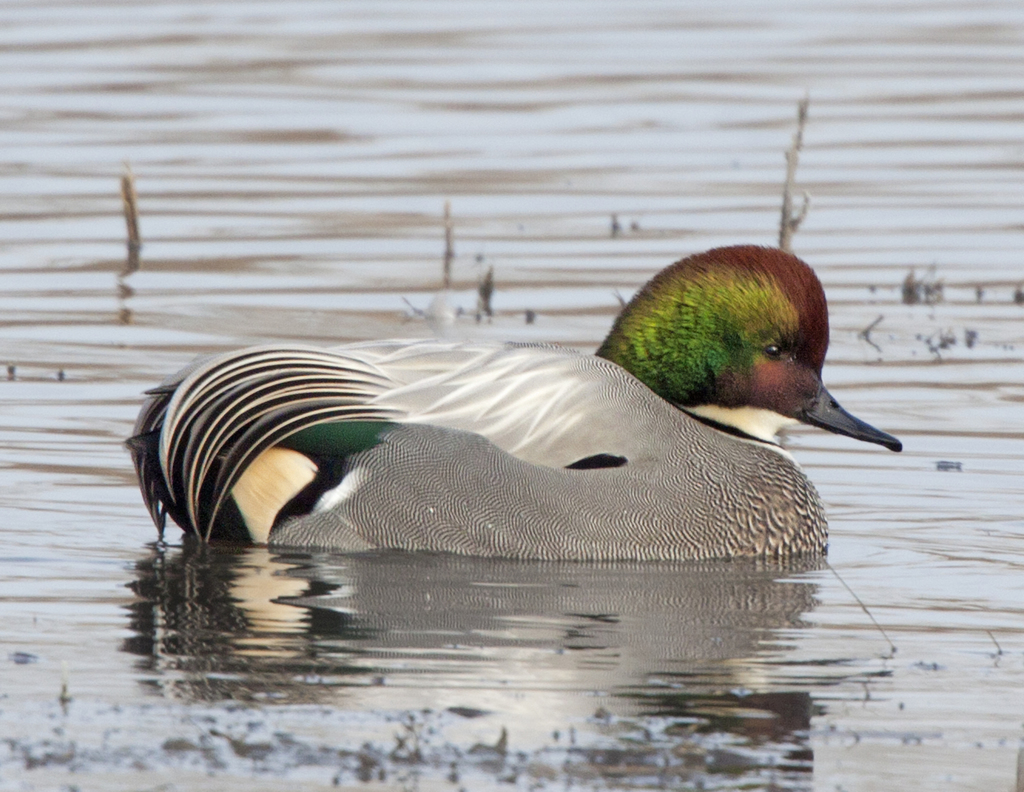
(c) nmoorhatch, some rights reserved (CC BY) · licence
Family: Anatidae · Class: Aves · Order: Anseriformes
Mareca falcata (Falcated Duck) is a California animal in the Anatidae family.
The Falcated Duck is a medium-sized dabbling duck measuring 48-54 cm (19-21 inches) in length with a wingspan of 78-82 cm (31-32 inches). Adult males in breeding plumage display distinctive iridescent green head coloring with a bronze-purple sheen, a white stripe extending from above the eye to the nape, and a prominent white breast patch. The species' most characteristic feature is the elongated, sickle-shaped tertial feathers that curve over the back, giving rise to its common name. Males also exhibit a black undertail with white flanks marked by vertical black stripes. Females and non-breeding males appear more subdued, with mottled brown plumage, though they retain the species' characteristic body proportions and bill shape. The Falcated Duck breeds across eastern Asia, from southeastern Russia through Mongolia, northeastern China, and the Korean Peninsula to northern Japan. The species is a rare visitor to western North America, including California, where it appears as an uncommon vagrant primarily during fall and winter months. Most California records occur along the coast and in the Central Valley, with sightings documented from Humboldt County south to San Diego County. The species typically arrives in North America between September and March, with peak occurrence from November through January. In its native range, Falcated Ducks inhabit shallow freshwater wetlands, including lakes, ponds, marshes, and slow-moving rivers with abundant emergent vegetation. During migration and winter, they utilize coastal estuaries, tidal marshes, and flooded agricultural fields. In California, vagrant individuals are most commonly observed in freshwater ponds, sewage treatment facilities, and coastal lagoons, often associating with flocks of other dabbling ducks, particularly American Wigeon and Northern Pintail. Falcated Ducks are primarily herbivorous, feeding on aquatic vegetation, seeds, and algae through dabbling and up-ending behaviors typical of surface-feeding ducks. Their diet includes pondweeds, sedges, and rice in agricultural areas. Breeding occurs from May through July in their native range, with females constructing nests in dense vegetation near water. Clutch size ranges from 6-10 eggs, with an incubation period of approximately 24-25 days. The species exhibits strong pair bonds during the breeding season, with males performing elaborate courtship displays that emphasize their distinctive plumage features. The Falcated Duck is not listed under the U.S. Endangered Species Act and has no special conservation status in California, as it is not a breeding resident. According to BirdLife International, the species is classified as Least Concern globally, with stable populations estimated at 150,000-1,000,000 individuals. However, like many waterfowl species, Falcated Ducks face threats from habitat loss due to wetland drainage and agricultural conversion throughout their breeding range. Climate change may also affect migration patterns and the frequency of vagrant occurrences in North America. In California, the species benefits from wetland conservation efforts that support diverse waterfowl communities.
Classification
Class: Aves · Order: Anseriformes · Family: Anatidae
Frequently asked questions
How is Mareca falcata classified?
Mareca falcata belongs to class Aves, order Anseriformes, family Anatidae.
What family does Mareca falcata belong to?
Mareca falcata is in the Anatidae family.
What is Mareca falcata?
The Falcated Duck is a medium-sized dabbling duck measuring 48-54 cm (19-21 inches) in length with a wingspan of 78-82 cm (31-32 inches).
Is Mareca falcata found in California?
Yes. Mareca falcata is recorded in California in The California Species Project's catalogue.
Related species
Other California species in the same genus, family, or bioregion.
Data from The California Species Project — 14,000+ California species with verified data from CNPS, CDFW, USFWS, and more.