Mareca penelope
Eurasian Wigeon
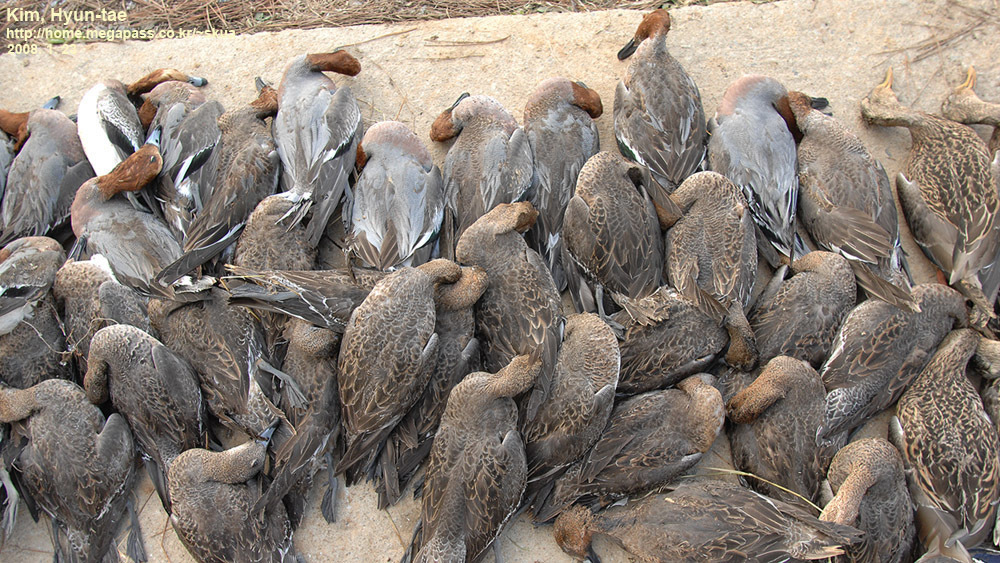
(c) Kim, Hyun-tae, some rights reserved (CC BY) · licence
Family: Anatidae · Class: Aves · Order: Anseriformes
Mareca penelope (Eurasian Wigeon) is a California animal in the Anatidae family.
The Eurasian Wigeon is a medium-sized dabbling duck measuring 45 to 56 cm (18 to 22 inches) in length with a wingspan of 75 to 86 cm (30 to 34 inches). Adult males in breeding plumage display a distinctive chestnut head with a cream-colored crown stripe, earning them the nickname "baldpate." The breast is pinkish-buff, the back and flanks are gray with fine black barring, and the undertail coverts are black. A prominent white shoulder patch is visible in flight and at rest. Females and eclipse males are brownish overall with a rounded head profile and lack the male's distinctive head pattern. Both sexes have a gray-blue bill with a black tip and dark legs. The Eurasian Wigeon breeds across northern Eurasia from Iceland and the British Isles east through Siberia to the Chukchi Peninsula. The species winters in western and southern Europe, Africa, and southern Asia. In North America, Eurasian Wigeons are irregular visitors, with most records concentrated along the Pacific Coast from Alaska to California. In California, this species occurs primarily as a rare but regular winter visitor and passage migrant from October through April, with peak abundance from December through February. Eurasian Wigeons utilize similar habitats to their closely related American Wigeon counterpart, preferring shallow freshwater and brackish wetlands including marshes, ponds, lakes, and flooded agricultural fields. During winter in California, they are most frequently observed in coastal wetlands, estuaries, and inland valleys. The species shows a preference for areas with abundant submerged aquatic vegetation and adjacent short-grass areas for terrestrial foraging. This species is primarily herbivorous, feeding on aquatic plants, algae, and grasses. Eurasian Wigeons are both dabbling feeders and grazers, often foraging on land in short-grass areas adjacent to water. They frequently associate with diving ducks, particularly American Coots and Canvasbacks, taking advantage of vegetation brought to the surface by these species. Breeding occurs on the breeding grounds in northern Eurasia, where females construct ground nests near water and lay 7 to 9 creamy-white eggs. The incubation period lasts 24 to 25 days. The Eurasian Wigeon is not federally or state listed in California, as it is not a breeding resident. The species is classified as Least Concern globally by the International Union for Conservation of Nature, with stable populations across most of its range. In California, occurrence patterns appear consistent with historical records, though the species remains uncommon. Climate change may affect wintering distributions and migration timing. The primary challenge for field identification is distinguishing this species from the similar American Wigeon, particularly females and immature birds, requiring careful attention to head shape, bill coloration, and plumage details.
Classification
Class: Aves · Order: Anseriformes · Family: Anatidae
Frequently asked questions
How is Mareca penelope classified?
Mareca penelope belongs to class Aves, order Anseriformes, family Anatidae.
What family does Mareca penelope belong to?
Mareca penelope is in the Anatidae family.
What is Mareca penelope?
The Eurasian Wigeon is a medium-sized dabbling duck measuring 45 to 56 cm (18 to 22 inches) in length with a wingspan of 75 to 86 cm (30 to 34 inches).
Is Mareca penelope found in California?
Yes. Mareca penelope is recorded in California in The California Species Project's catalogue.
Related species
Other California species in the same genus, family, or bioregion.
Data from The California Species Project — 14,000+ California species with verified data from CNPS, CDFW, USFWS, and more.