Margaritifera falcata
Western Pearlshell
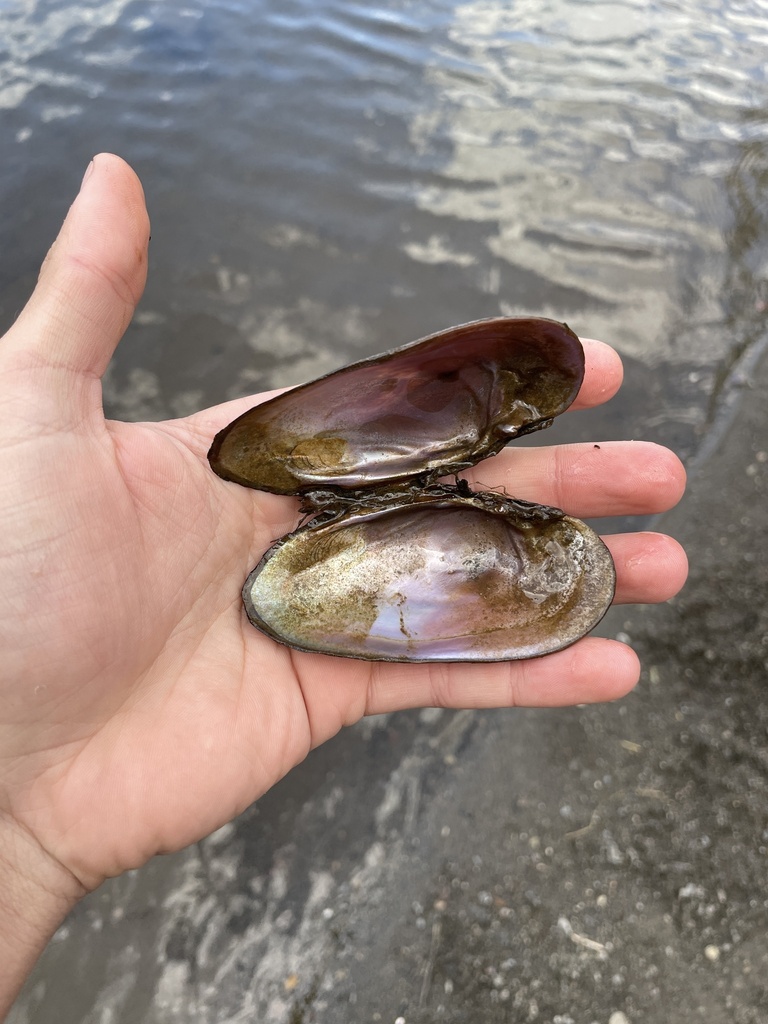
(c) Sam Turner, some rights reserved (CC BY) · licence
Family: Margaritiferidae · Class: Bivalvia · Order: Unionoida
Conservation status: G3G4 S1S2
Margaritifera falcata (Western Pearlshell) is a California animal in the Margaritiferidae family.
The western pearlshell mussel is a large freshwater bivalve with an elongate shell reaching up to 15 centimeters (6 inches) in length. The shell exhibits a broadly curved dorsal margin and slightly concave ventral margin. Juveniles display light brown periostracum that darkens to dark brown or black with age, lacking shell rays but showing prominent growth lines. The nacre ranges from purple to salmon-colored or pink, though it fades to white over time. The anterior adductor muscle scar appears sharply defined while the posterior scar is less distinct, and tiny faint pits may be visible on the central nacre surface. Margaritifera falcata has the broadest distribution of western North American freshwater mussel species, occurring from California north to British Columbia and southern Alaska, extending inland to western Montana, Wyoming, and Utah (USFWS 2025). However, distribution and abundance have declined significantly across this range, with populations in large rivers and stream aggregations becoming extirpated in many areas. California populations have experienced particular declines, contributing to the species' current state rank of S1S2. The species inhabits small streams and large rivers that support salmonid populations, showing a strong association with cold, clean flowing waters. Western pearlshells are typically found in areas with stable substrates where they can burrow partially into sediment. They often occur in densely populated aggregations consisting of thousands of individuals in suitable habitat, though such concentrations have become increasingly rare. Western pearlshells are obligate parasites during their larval stage, with glochidia measuring less than 0.15 millimeters in length that must attach to fish hosts to complete development (Spring Rivers 2007). Research indicates that Pacific salmon and trout species serve as primary hosts, with the larvae attaching to gill tissues for several weeks before metamorphosing and dropping to the substrate. Adults are filter feeders that process water through their gills, removing particles and recycling nutrients back to the ecosystem through biodeposits. This filtering activity significantly affects stream biodiversity by providing enhanced food resources for benthic macroinvertebrates and supporting faster growth rates in Pacific lamprey larvae near mussel beds. The species exhibits exceptional longevity, with individuals documented to exceed 100 years of age. Although not federally listed, the western pearlshell faces significant conservation challenges reflected in its Global/State Rank of G3G4 S1S2, indicating the species is vulnerable to extirpation. Primary threats include water diversion projects for irrigation, power generation, and municipal supply that alter flow regimes and reduce habitat quality. Dam construction has eliminated many miles of free-flowing rivers and disrupted native fish communities essential for mussel reproduction. Additional threats include channel modification from dredging and mining, sedimentation from land use practices, contamination, livestock grazing in riparian areas, and introduction of non-native fish species. Die-offs and substantial population declines have been reported across multiple drainages, with unexplained mortality events documented in Washington between 2014 and 2018. The species' dependence on salmonid host fish makes it particularly vulnerable to factors affecting salmon and trout populations throughout the Pacific Northwest.
Classification
Class: Bivalvia · Order: Unionoida · Family: Margaritiferidae
Conservation status
G3G4 S1S2
Frequently asked questions
How is Margaritifera falcata classified?
Margaritifera falcata belongs to class Bivalvia, order Unionoida, family Margaritiferidae.
What family does Margaritifera falcata belong to?
Margaritifera falcata is in the Margaritiferidae family.
Is Margaritifera falcata protected or of conservation concern?
Margaritifera falcata carries the following status: G3G4 S1S2.
What is Margaritifera falcata?
The western pearlshell mussel is a large freshwater bivalve with an elongate shell reaching up to 15 centimeters (6 inches) in length.
Is Margaritifera falcata found in California?
Yes. Margaritifera falcata is recorded in California in The California Species Project's catalogue.
More California species
This species has no close relatives in our California data — here are other species to explore.
Data from The California Species Project — 14,000+ California species with verified data from CNPS, CDFW, USFWS, and more.