Marmara arbutiella
Madrone Skin Miner
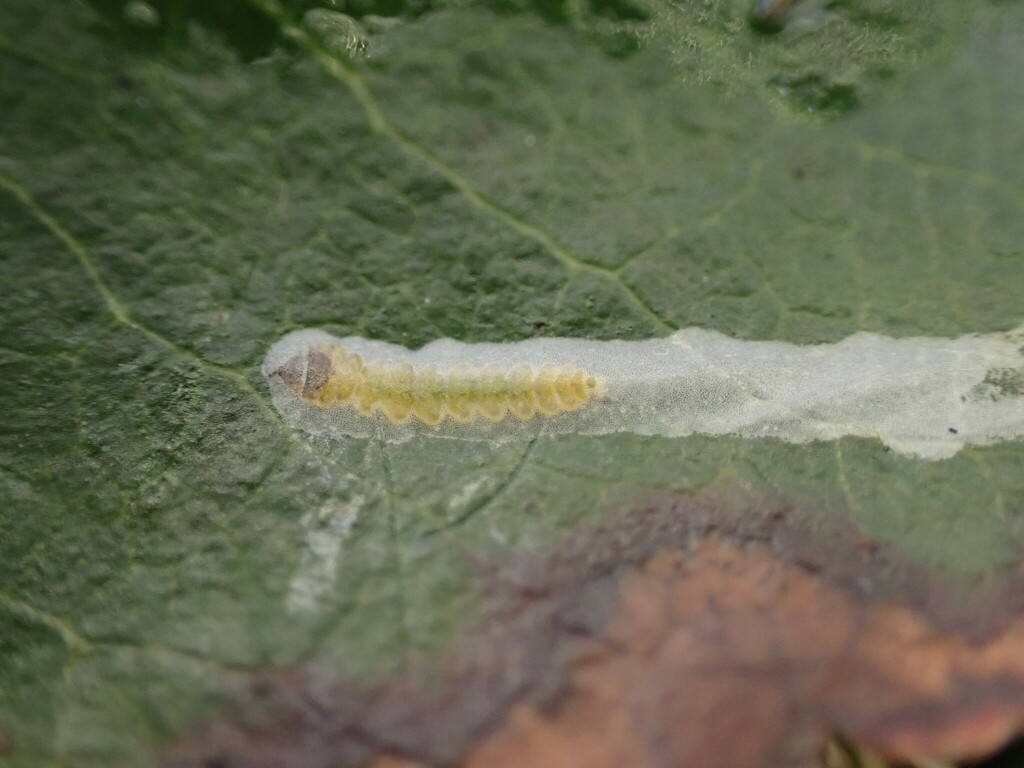
(c) Aiva Noringseth, some rights reserved (CC BY) · licence
Family: Gracillariidae · Class: Insecta · Order: Lepidoptera
Marmara arbutiella (Madrone Skin Miner) is a California animal in the Gracillariidae family.
The Madrone Skin Miner (Marmara arbutiella) is a small moth in the family Gracillariidae whose larvae create distinctive serpentine mines in the leaves of Pacific madrone trees. As leaf miners, the larvae are extremely modified with flattened heads and mandibles adapted for feeding on plant sap just beneath the leaf cuticle (CNPS 2002). The mining activity creates very long, convoluted tracks that gradually enlarge as the larva develops, forming characteristic patterns visible on the leaf surface. This species occurs throughout the range of its primary host plant, Pacific madrone (Arbutus menziesii), along the Pacific Coast from British Columbia to California. In California, the species is found in areas where madrone trees grow, including coastal forests, mixed evergreen woodlands, and chaparral communities. Pacific madrone typically occurs from sea level to approximately 1,500 meters (4,900 feet) elevation, establishing the general altitudinal range for this moth species. The Madrone Skin Miner inhabits mature Pacific madrone forests and mixed woodland communities where its host trees are present. These environments often include associated vegetation such as tanoak, big leaf maple, white alder, and various fern species. The moth requires healthy madrone trees with suitable leaf tissue for larval development and mining activities. Adult moths are likely present during the growing season when new madrone foliage is available for oviposition. Like other Gracillariidae species, the Madrone Skin Miner exhibits a specialized life cycle closely tied to its host plant. Adult females deposit eggs on madrone leaves, and the resulting larvae tunnel between the upper and lower leaf surfaces, feeding on cellular contents and creating the characteristic serpentine mines. The larval stage represents the primary feeding period, during which the insect obtains all nutrients necessary for development. The mining behavior distinguishes this species from external leaf feeders and represents a specialized ecological adaptation that reduces exposure to predators and environmental stresses. No formal conservation status has been assigned to Marmara arbutiella, and the species is considered apparently secure globally (NatureServe 2025). However, the moth's dependence on Pacific madrone trees means its distribution and abundance are intrinsically linked to the health and distribution of madrone forests. Threats to madrone ecosystems, including habitat fragmentation, disease pressure such as sudden oak death syndrome, and climate change impacts on forest composition, could potentially affect local populations of this specialized herbivore. The species serves as an indicator of madrone forest health and represents part of the complex arthropod community associated with California's native tree species. Conservation of intact madrone woodlands benefits not only this moth species but the entire suite of organisms dependent on these distinctive forest ecosystems.
Classification
Class: Insecta · Order: Lepidoptera · Family: Gracillariidae
Frequently asked questions
How is Marmara arbutiella classified?
Marmara arbutiella belongs to class Insecta, order Lepidoptera, family Gracillariidae.
What family does Marmara arbutiella belong to?
Marmara arbutiella is in the Gracillariidae family.
What is Marmara arbutiella?
The Madrone Skin Miner (Marmara arbutiella) is a small moth in the family Gracillariidae whose larvae create distinctive serpentine mines in the leaves of Pacific madrone trees.
Is Marmara arbutiella found in California?
Yes. Marmara arbutiella is recorded in California in The California Species Project's catalogue.
Related species
Other California species in the same genus, family, or bioregion.
Data from The California Species Project — 14,000+ California species with verified data from CNPS, CDFW, USFWS, and more.