Martes caurina
Pacific Marten
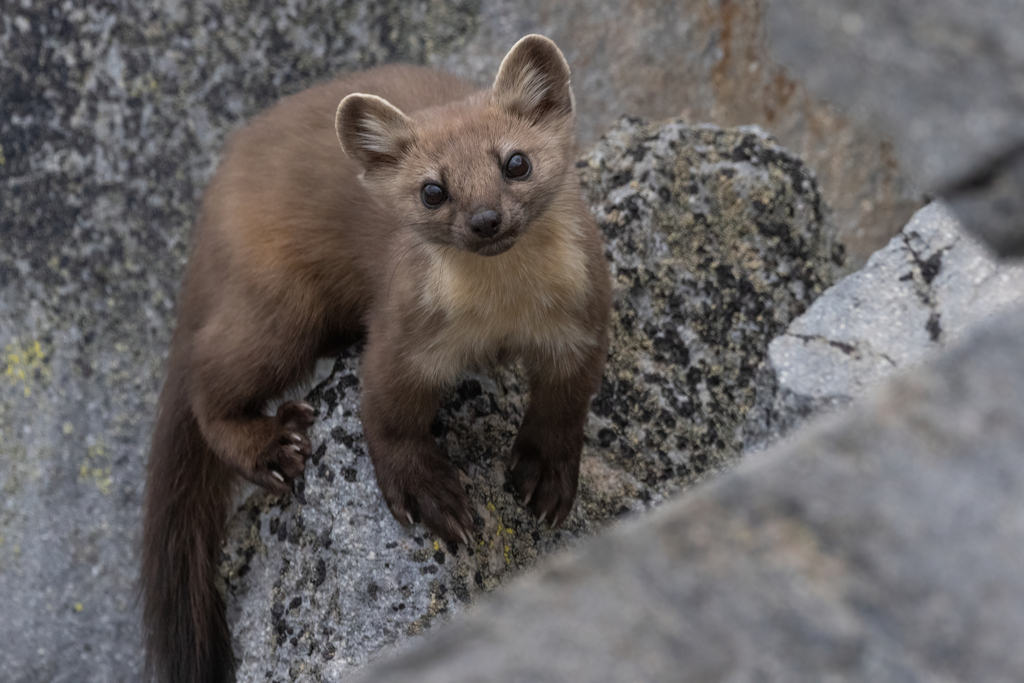
(c) Sam Eberhard, some rights reserved (CC BY) · licence
Family: Mustelidae · Class: Mammalia · Order: Carnivora
Conservation status: G4G5 S3
Martes caurina (Pacific Marten) is a California animal in the Mustelidae family.
The Pacific marten is a medium-sized carnivorous mammal in the weasel family, measuring 32 to 40 cm (12.6 to 15.7 inches) in body length with an additional 15 to 23 cm (5.9 to 9.1 inches) of tail. Adults typically weigh 0.5 to 1.5 kg (1.1 to 3.3 pounds), with males generally larger than females. The species displays dense, soft fur that ranges from yellowish-brown to dark brown, often with a distinctive orange to yellow throat patch called a bib. The tail is bushy and dark-tipped, while the ears are prominent and triangular. Pacific martens have semi-retractable claws adapted for climbing, and their feet are proportionally large with furred pads that aid in traversing snow. Historically, Pacific martens ranged throughout the coniferous forests of the Pacific Coast from Alaska to central California. In California, the species once occurred in the Sierra Nevada, Cascade Range, and coastal mountains. Current distribution is significantly reduced, with populations persisting primarily in the northern Sierra Nevada and southern Cascade Range. Small, isolated populations may remain in the Coast Range, though recent surveys have documented few individuals in these areas. Pacific martens inhabit mature and old-growth coniferous forests, typically at elevations between 900 and 2,400 meters (2,950 to 7,870 feet). They require forest stands with complex structural diversity, including large trees, snags, and downed logs that provide denning sites and foraging opportunities. The species shows strong associations with forests containing Douglas fir, true firs, and ponderosa pine. Martens utilize multiple habitat types throughout their home range, which can span 0.5 to 15 square kilometers depending on prey availability and habitat quality. Pacific martens are primarily nocturnal and crepuscular, though they may be active during daylight hours in winter. Their diet consists mainly of small mammals, particularly voles, mice, and squirrels, but also includes birds, insects, berries, and carrion. Breeding occurs during summer, with delayed implantation resulting in births the following spring after an effective gestation of 27 days. Females typically produce litters of one to five kits in tree cavities or rock crevices. The species is semi-arboreal, spending considerable time foraging and traveling through forest canopies, though they also hunt extensively on the ground. The Pacific marten holds a state ranking of S3 in California, indicating the species is vulnerable to extirpation. Primary threats include habitat loss and fragmentation from logging, fire suppression leading to altered forest structure, and climate change affecting montane forest ecosystems. The species' dependence on mature forest conditions makes it particularly sensitive to forest management practices. Trapping was historically a significant threat but is now regulated. Current conservation efforts focus on maintaining and restoring appropriate forest habitat through ecosystem management approaches that promote structural complexity in coniferous forests.
Classification
Class: Mammalia · Order: Carnivora · Family: Mustelidae
Conservation status
G4G5 S3
Frequently asked questions
How is Martes caurina classified?
Martes caurina belongs to class Mammalia, order Carnivora, family Mustelidae.
What family does Martes caurina belong to?
Martes caurina is in the Mustelidae family.
Is Martes caurina protected or of conservation concern?
Martes caurina carries the following status: G4G5 S3.
What is Martes caurina?
The Pacific marten is a medium-sized carnivorous mammal in the weasel family, measuring 32 to 40 cm (12.6 to 15.7 inches) in body length with an additional 15 to 23 cm (5.9 to 9.1 inches) of tail.
Is Martes caurina found in California?
Yes. Martes caurina is recorded in California in The California Species Project's catalogue.
Related species
Other California species in the same genus, family, or bioregion.
Data from The California Species Project — 14,000+ California species with verified data from CNPS, CDFW, USFWS, and more.