Martes caurina humboldtensis
Humboldt Marten
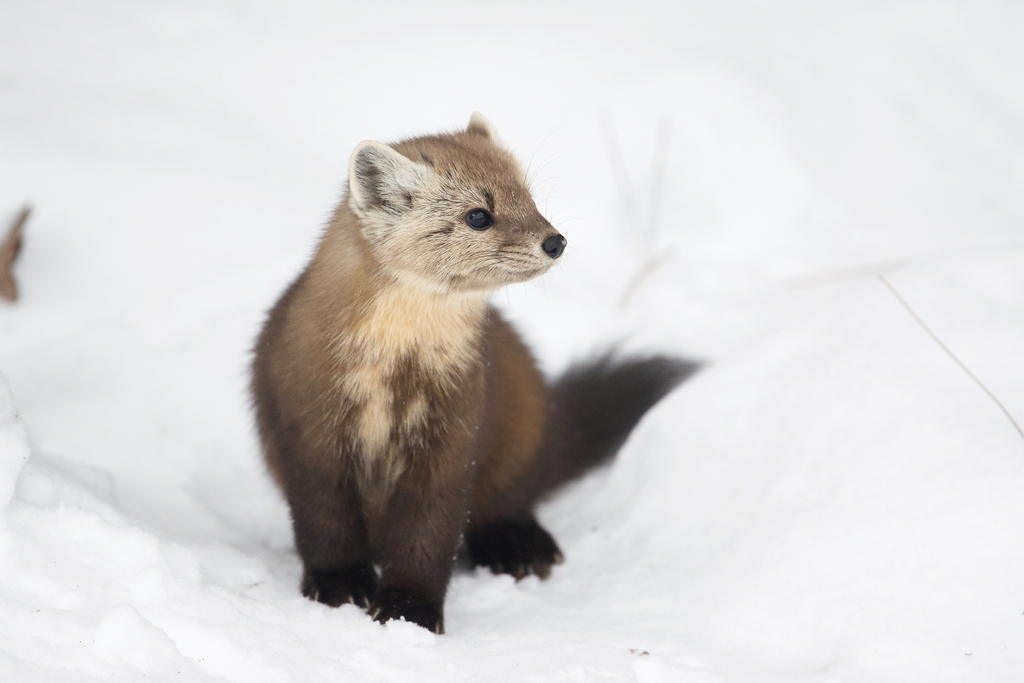
(c) Owen Strickland, some rights reserved (CC BY) · licence
Family: Mustelidae · Class: Mammalia · Order: Carnivora
Conservation status: Threatened · G4G5T1 S1
Martes caurina humboldtensis (Humboldt Marten) is a California animal in the Mustelidae family.
The Humboldt marten is a medium-sized carnivore in the mustelid family, endemic to northwestern California and western Oregon. Adults measure approximately 60 to 70 cm (24 to 28 inches) in total length, including a bushy tail that comprises roughly 40% of body length. Body weight ranges from 0.7 to 1.5 kg (1.5 to 3.3 pounds), with males typically larger than females. The species exhibits dense, soft fur that varies from yellowish-brown to dark brown, often with a distinctive orange to yellow throat patch. The ears are prominent and rounded, and the feet are large and well-furred, providing traction on snow and rough bark. Historically, the Humboldt marten occupied coastal forests from the Oregon-California border south to the San Francisco Bay Area. The species has lost over 90% of its historical range and currently exists in only four small, isolated populations in northern coastal California and southern coastal Oregon (USFWS 2024). These remnant populations occur in Humboldt and Del Norte counties in California and in Curry and Coos counties in Oregon. According to the U.S. Fish and Wildlife Service, fewer than 400 individuals remain across all populations (USFWS 2024). The Humboldt marten inhabits mature and old-growth coniferous forests, particularly those dominated by Douglas fir, redwood, and Sitka spruce. The species shows strong preference for forests with complex canopy structure, large-diameter trees, and abundant coarse woody debris. Suitable habitat typically occurs below 300 meters (1,000 feet) elevation in the fog belt of coastal mountains. Dense canopy cover appears critical, as the species avoids extensive areas of young forest less than 70 years old (Eriksson et al. 2019). Humboldt martens are primarily arboreal and nocturnal, though they may be active during daylight hours. They are skilled climbers, using their semi-retractable claws to navigate through forest canopies. The diet consists primarily of small mammals, particularly voles, squirrels, and woodrats, supplemented by birds, insects, and occasionally fruits. Breeding occurs in mid-summer, with delayed implantation resulting in births the following spring. Females typically produce 2 to 4 kits per litter in tree cavities or other elevated den sites. Home ranges are large relative to body size, often exceeding 1,000 hectares for adult males. The coastal distinct population segment of the Pacific marten, which includes the Humboldt marten, was listed as federally threatened in 2018 and as state endangered in California. Critical habitat encompassing 1,213,752 acres was designated in 2024 across northwestern California and southwestern Oregon (USFWS 2024). Primary threats include habitat loss from timber harvest, habitat fragmentation that isolates populations, vehicle strikes, and predation by larger carnivores. The species was historically decimated by unregulated trapping and extensive logging of coastal forests. Current recovery efforts focus on habitat restoration, population monitoring, and maintaining connectivity between isolated populations through landscape-scale conservation planning.
Classification
Class: Mammalia · Order: Carnivora · Family: Mustelidae
Conservation status
Threatened · G4G5T1 S1
Frequently asked questions
How is Martes caurina humboldtensis classified?
Martes caurina humboldtensis belongs to class Mammalia, order Carnivora, family Mustelidae.
What family does Martes caurina humboldtensis belong to?
Martes caurina humboldtensis is in the Mustelidae family.
Is Martes caurina humboldtensis protected or of conservation concern?
Martes caurina humboldtensis carries the following status: Threatened · G4G5T1 S1.
What is Martes caurina humboldtensis?
The Humboldt marten is a medium-sized carnivore in the mustelid family, endemic to northwestern California and western Oregon.
Is Martes caurina humboldtensis found in California?
Yes. Martes caurina humboldtensis is recorded in California in The California Species Project's catalogue.
Related species
Other California species in the same genus, family, or bioregion.
Data from The California Species Project — 14,000+ California species with verified data from CNPS, CDFW, USFWS, and more.