Martes caurina sierrae
Sierra Marten
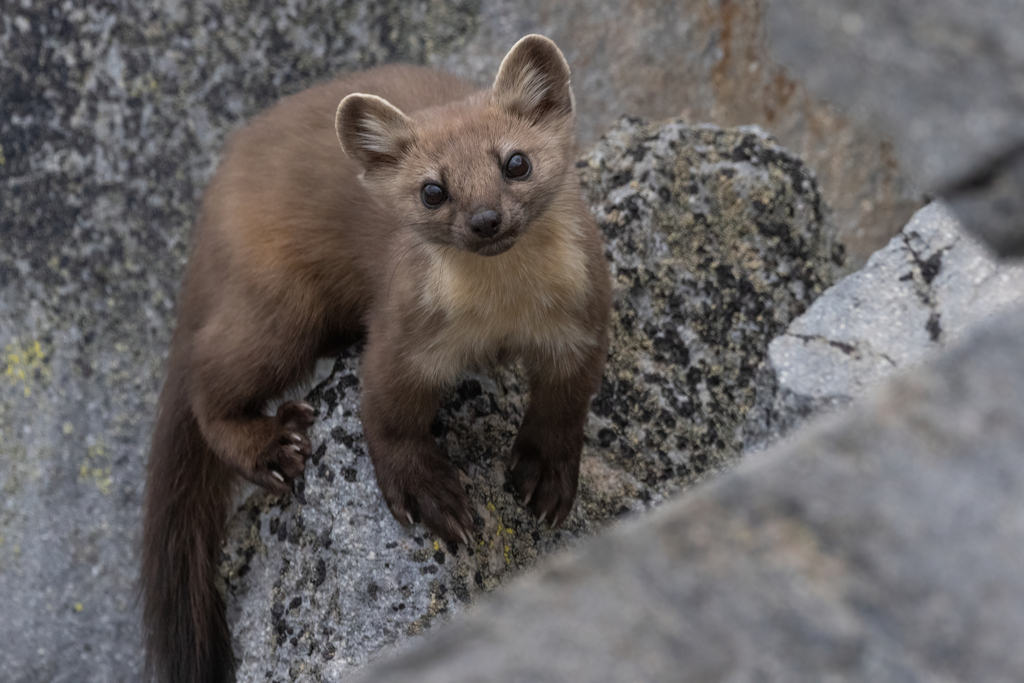
(c) Sam Eberhard, some rights reserved (CC BY) · licence
Family: Mustelidae · Class: Mammalia · Order: Carnivora
Conservation status: G4G5T3 S3
Martes caurina sierrae (Sierra Marten) is a California animal in the Mustelidae family.
The Sierra marten is a medium-sized carnivore in the mustelid family, representing a subspecies of the Pacific marten (Martes caurina sierrae). Adults typically measure 35-65 cm (14-26 inches) in body length with a bushy tail adding an additional 15-23 cm (6-9 inches). Males are generally larger than females, weighing 0.9-1.5 kg (2-3.3 pounds) compared to females at 0.5-0.9 kg (1.1-2 pounds). The species exhibits dense, soft fur ranging from yellowish-brown to dark brown, with a distinctive yellowish to orange throat patch that varies in size and coloration. Compared to the coastal subspecies, Sierra martens often display a more orange-yellow throat patch and slightly different pelage characteristics. Historically, Sierra martens occurred throughout the montane forests of the Sierra Nevada and southern Cascade ranges in California. The current range has contracted significantly and is now limited to scattered populations in the Sierra Nevada mountains of central and northern California, with some populations extending into the southern Cascade Range. According to USFWS assessments, the subspecies occurs primarily in the interior mountains of northwestern California and the Sierra Nevada Mountains (USFWS 2018). Sierra martens inhabit mature and old-growth coniferous forests, typically at elevations between 1,200-2,700 meters (4,000-9,000 feet). They show strong preference for forests with dense canopy cover, large trees, and abundant coarse woody debris. Primary habitat includes mixed-conifer forests dominated by Douglas-fir, white fir, red fir, and lodgepole pine. The species requires complex forest structure with multiple canopy layers, snags for denning, and fallen logs for foraging and cover. Snow depth and persistence influence habitat suitability, as deep snow can limit access to prey. Sierra martens are primarily arboreal but also forage extensively on the ground. They are opportunistic carnivores with a diet consisting mainly of small mammals including voles, mice, squirrels, and pikas, supplemented by birds, insects, and occasionally fruits. Breeding occurs once annually, typically in late summer, with delayed implantation resulting in birth of 2-4 kits in spring following a total gestation of approximately 270 days. Females establish dens in tree cavities, witches' brooms, or other protected sites in mature trees. Home ranges vary considerably with habitat quality and prey availability, typically ranging from 0.5-15 square kilometers. The Sierra marten faces significant conservation challenges due to habitat loss and fragmentation from timber harvest, fire suppression altering natural fire regimes, and climate change affecting montane forest ecosystems. Current threats include continuing effects of habitat loss from clear-cutting and vegetation management practices (NatureServe 2025). The subspecies has a global rank of G4G5T3 S3, indicating it is vulnerable to moderately vulnerable globally. Population estimates suggest substantial decline from historical numbers, with current populations fragmented across suitable habitat patches. Climate change poses an emerging threat through potential shifts in forest composition and snow patterns that may affect prey availability and denning habitat.
Classification
Class: Mammalia · Order: Carnivora · Family: Mustelidae
Conservation status
G4G5T3 S3
Frequently asked questions
How is Martes caurina sierrae classified?
Martes caurina sierrae belongs to class Mammalia, order Carnivora, family Mustelidae.
What family does Martes caurina sierrae belong to?
Martes caurina sierrae is in the Mustelidae family.
Is Martes caurina sierrae protected or of conservation concern?
Martes caurina sierrae carries the following status: G4G5T3 S3.
What is Martes caurina sierrae?
The Sierra marten is a medium-sized carnivore in the mustelid family, representing a subspecies of the Pacific marten (Martes caurina sierrae).
Is Martes caurina sierrae found in California?
Yes. Martes caurina sierrae is recorded in California in The California Species Project's catalogue.
Related species
Other California species in the same genus, family, or bioregion.
Data from The California Species Project — 14,000+ California species with verified data from CNPS, CDFW, USFWS, and more.