Masticophis flagellum
Coachwhip
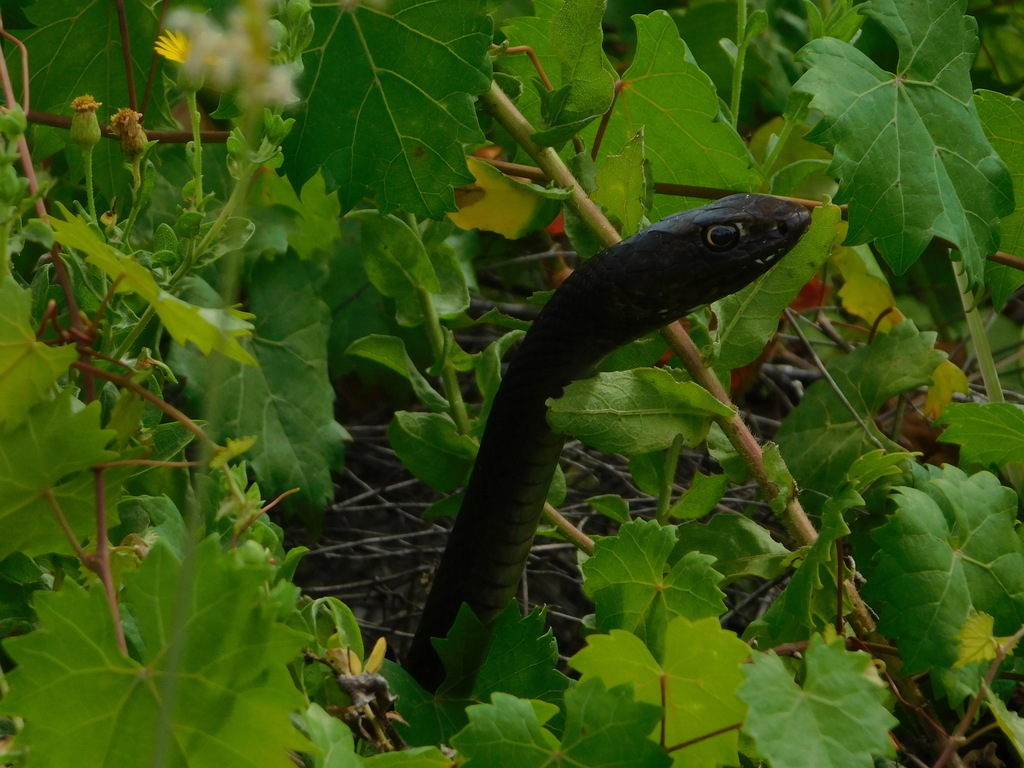
no rights reserved · CC0
Family: Colubridae · Class: Reptilia · Order: Squamata
Masticophis flagellum (Coachwhip) is a California animal in the Colubridae family.
The coachwhip (Masticophis flagellum) is a large, slender colubrid snake characterized by its distinctive coloration pattern and considerable length. Adults typically measure 0.9 to 1.8 meters (3 to 6 feet) in total length, with exceptional individuals reaching up to 2.6 meters (8.5 feet), making it one of the longest snakes in North America. The species exhibits significant color variation, with the anterior portion of the body typically dark brown or black, gradually lightening to tan, yellow, or pinkish-brown toward the tail. This gradient coloration pattern gives the species its common name, resembling the braided appearance of a coachman's whip. The scales are smooth, and the head is relatively small and distinct from the neck. Juveniles display more pronounced banding patterns that fade with age. The coachwhip occurs throughout much of the western and southwestern United States, with its range extending into California's desert regions and Central Valley. In California, the species is found primarily in the Mojave and Sonoran desert regions of southern California, the San Joaquin Valley, and portions of the Coast Range. Populations occur from sea level to approximately 2,100 meters (6,900 feet) elevation, though they are most common below 1,500 meters (4,900 feet). This species inhabits a variety of arid and semi-arid environments, including desert scrub, chaparral, grasslands, and open woodlands. Coachwhips prefer areas with scattered vegetation that provides both basking sites and cover, including creosote bush communities, Joshua tree woodlands, and oak savannas. They utilize rodent burrows, rock crevices, and dense vegetation for shelter and thermoregulation. The species shows strong preferences for areas with firm substrate and moderate vegetation density. Coachwhips are primarily diurnal and highly active foragers, actively pursuing prey rather than ambushing. Their diet consists mainly of lizards, small snakes, rodents, and birds, with larger individuals capable of consuming rabbits and ground squirrels. They are known for their exceptional speed, reaching speeds up to 6.4 kilometers per hour (4 miles per hour) when pursuing prey or escaping predators. Mating occurs in spring, typically from April to June. Females deposit 4 to 20 eggs in sandy soil or loose substrate during late spring or early summer, with eggs hatching after 45 to 60 days of incubation. The coachwhip is not federally or state listed and appears to maintain stable populations throughout most of its California range. However, habitat loss and fragmentation from urban development and agricultural conversion pose localized threats, particularly in the Central Valley and southern California. Road mortality represents an additional threat due to the species' terrestrial habits and tendency to cross roads while foraging. Climate change may affect the species through altered precipitation patterns and increased temperatures in desert habitats.
Classification
Class: Reptilia · Order: Squamata · Family: Colubridae
Frequently asked questions
How is Masticophis flagellum classified?
Masticophis flagellum belongs to class Reptilia, order Squamata, family Colubridae.
What family does Masticophis flagellum belong to?
Masticophis flagellum is in the Colubridae family.
What is Masticophis flagellum?
The coachwhip (Masticophis flagellum) is a large, slender colubrid snake characterized by its distinctive coloration pattern and considerable length.
Is Masticophis flagellum found in California?
Yes. Masticophis flagellum is recorded in California in The California Species Project's catalogue.
Related species
Other California species in the same genus, family, or bioregion.
Data from The California Species Project — 14,000+ California species with verified data from CNPS, CDFW, USFWS, and more.