Masticophis flagellum ruddocki
San Joaquin Coachwhip
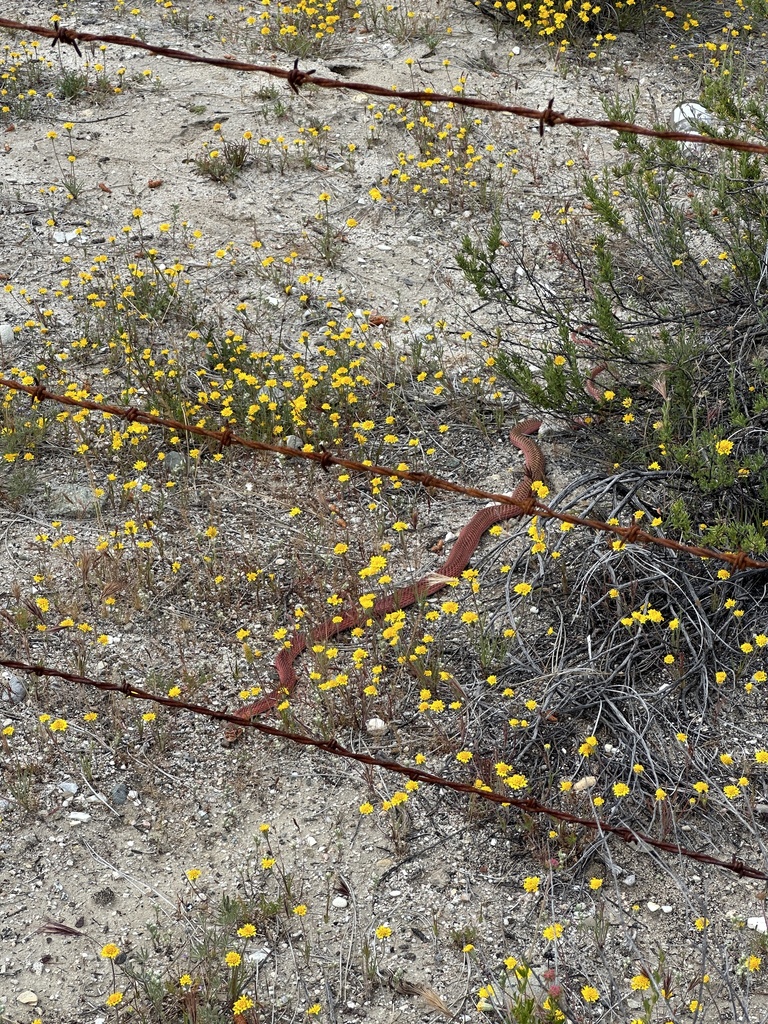
(c) Matt Berger, some rights reserved (CC BY) · licence
Family: Colubridae · Class: Reptilia · Order: Squamata
Conservation status: G5T2T3 S3
Masticophis flagellum ruddocki (San Joaquin Coachwhip) is a California animal in the Colubridae family.
The San Joaquin coachwhip is a subspecies of coachwhip snake endemic to California's Central Valley and adjacent foothills. Adults typically reach lengths of 90 to 150 cm (35 to 59 inches), with some individuals exceeding 180 cm (71 inches). The species exhibits the characteristic coachwhip body plan: a relatively thick anterior portion tapering to a thin, whip-like tail. Coloration varies from light brown to pinkish or reddish-brown dorsally, with lighter ventral surfaces. The scales have a braided appearance, particularly evident on the posterior portion of the body, giving the snake its common name. Juveniles display distinct crossbands that fade with age. Historically, the San Joaquin coachwhip ranged throughout the San Joaquin Valley floor and surrounding foothills from Kern County north to approximately Stanislaus County. Current distribution is severely fragmented, with most remaining populations confined to the western edge of the San Joaquin Valley and adjacent foothill areas. The subspecies has been extirpated from much of its historical range due to habitat conversion. Small, isolated populations persist in Fresno, Kings, Tulare, and Kern counties, with scattered occurrences in Merced and Stanislaus counties. This subspecies inhabits open, dry, treeless areas with sparse vegetation cover, including valley grassland, alkali scrub, and saltbush scrub communities. According to California Herps, the species avoids dense vegetation where it cannot move quickly, preferring areas that allow rapid escape from predators. Elevation ranges from near sea level to approximately 760 meters (2,500 feet) in foothill areas. The snake shows strong preference for areas with scattered shrubs, rock outcrops, and mammal burrows that provide refuge sites. San Joaquin coachwhips are diurnal and highly active foragers, using their exceptional speed to pursue prey across open terrain. Diet consists primarily of lizards, small mammals, birds, and other snakes, which they subdue through constriction rather than venom. Mating occurs in spring, with females laying clutches of 4 to 20 eggs in loose soil or sand during late spring to early summer. Eggs incubate for approximately 60 to 75 days, with hatchlings emerging in late summer. The species demonstrates strong site fidelity, with individuals often returning to the same refuge sites. The California Department of Fish and Wildlife designates the San Joaquin coachwhip as a Species of Special Concern due to significant population declines and habitat loss. The subspecies receives no federal protection despite its precarious status. Primary threats include continued agricultural conversion, urban development, and habitat fragmentation that isolates remaining populations. Intensive agriculture has eliminated an estimated 95% of original Central Valley grassland habitat. Additional threats include road mortality, predation by domestic cats, and potential hybridization with other coachwhip subspecies at range boundaries. Conservation efforts focus on habitat protection within existing preserves and restoration of grassland corridors to connect fragmented populations.
Classification
Class: Reptilia · Order: Squamata · Family: Colubridae
Conservation status
G5T2T3 S3
Frequently asked questions
How is Masticophis flagellum ruddocki classified?
Masticophis flagellum ruddocki belongs to class Reptilia, order Squamata, family Colubridae.
What family does Masticophis flagellum ruddocki belong to?
Masticophis flagellum ruddocki is in the Colubridae family.
Is Masticophis flagellum ruddocki protected or of conservation concern?
Masticophis flagellum ruddocki carries the following status: G5T2T3 S3.
What is Masticophis flagellum ruddocki?
The San Joaquin coachwhip is a subspecies of coachwhip snake endemic to California's Central Valley and adjacent foothills.
Is Masticophis flagellum ruddocki found in California?
Yes. Masticophis flagellum ruddocki is recorded in California in The California Species Project's catalogue.
Related species
Other California species in the same genus, family, or bioregion.
Data from The California Species Project — 14,000+ California species with verified data from CNPS, CDFW, USFWS, and more.