Masticophis lateralis euryxanthus
Alameda whipsnake
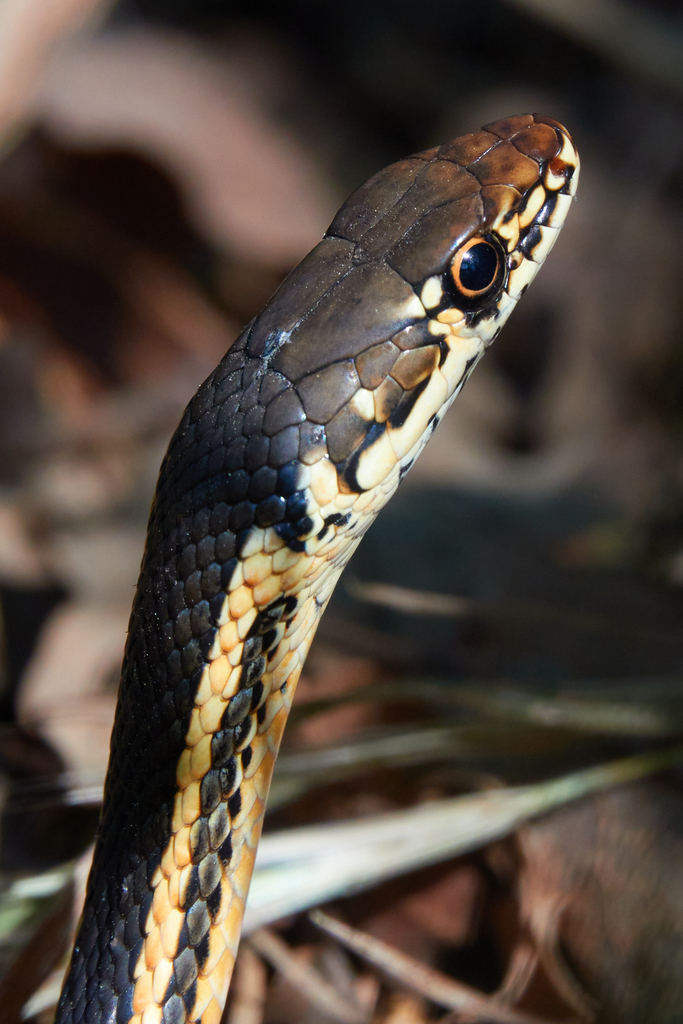
(c) Ken-ichi Ueda, some rights reserved (CC BY) · licence
Family: Colubridae · Class: Reptilia · Order: Squamata
Conservation status: ST · Threatened · G4T2 S2
Masticophis lateralis euryxanthus (Alameda whipsnake) is a California animal in the Colubridae family.
The Alameda whipsnake is a slender, fast-moving serpent endemic to the inner Coast Ranges of central California. Adults typically measure 0.9 to 1.5 meters (3 to 5 feet) in length, with a streamlined body adapted for rapid movement through dense vegetation. The species is distinguished by its distinctive coloration pattern: a dark brown to black dorsal surface with prominent yellow or cream-colored stripes running longitudinally along each side of the body. The ventral surface is pale yellow to cream. The head is relatively small and distinct from the neck, with large eyes that provide excellent vision for hunting. Historically, the Alameda whipsnake occurred throughout the inner Coast Ranges of the San Francisco Bay Area. Currently, the species is known to occur in five populations distributed across Contra Costa County, most of Alameda County, and small portions of northern Santa Clara and western San Joaquin counties (USFWS). The species' range has been significantly reduced from historical levels due to habitat loss and fragmentation. Alameda whipsnakes inhabit mixed chaparral, coastal scrub, annual grassland, and oak woodland habitats within the California inner Coast Range. Rock outcrops and talus slopes are critical habitat components, providing shelter, thermoregulation sites, and hunting grounds. The species typically occurs at elevations ranging from sea level to approximately 490 meters (1,600 feet). Open grasslands interspersed with shrub cover and rocky areas represent optimal habitat conditions. The snakes require a mosaic of habitat types to meet their various life history needs throughout the year. This diurnal species is most active during warm, sunny days from March through October. Alameda whipsnakes are accomplished predators, feeding primarily on lizards, particularly western fence lizards and alligator lizards, though they also consume small mammals, birds, and bird eggs. Their hunting strategy involves rapid pursuit and constriction of prey. Mating occurs in spring, typically from April through June, with females laying clutches of 3 to 12 eggs in underground burrows or beneath rocks during late spring and early summer. Juveniles emerge in late summer and early fall. The species exhibits strong site fidelity, often returning to the same rock outcrops for shelter and thermoregulation. The Alameda whipsnake was federally listed as threatened on December 5, 1997, and is also state-listed as threatened in California. Critical habitat was designated on August 23, 2005, encompassing approximately 196,637 acres across the species' range. Primary threats include habitat loss and fragmentation due to urban development, road construction, recreational activities, and invasive plant species that alter native plant communities. Fire suppression has led to increased shrub density in some areas, potentially reducing suitable habitat. Climate change poses emerging threats through altered precipitation patterns and increased wildfire frequency. Conservation efforts focus on habitat protection, restoration of degraded areas, and maintaining connectivity between population segments to facilitate genetic exchange.
Classification
Class: Reptilia · Order: Squamata · Family: Colubridae
Conservation status
ST · Threatened · G4T2 S2
Frequently asked questions
How is Masticophis lateralis euryxanthus classified?
Masticophis lateralis euryxanthus belongs to class Reptilia, order Squamata, family Colubridae.
What family does Masticophis lateralis euryxanthus belong to?
Masticophis lateralis euryxanthus is in the Colubridae family.
Is Masticophis lateralis euryxanthus protected or of conservation concern?
Masticophis lateralis euryxanthus carries the following status: ST · Threatened · G4T2 S2.
What is Masticophis lateralis euryxanthus?
The Alameda whipsnake is a slender, fast-moving serpent endemic to the inner Coast Ranges of central California.
Is Masticophis lateralis euryxanthus found in California?
Yes. Masticophis lateralis euryxanthus is recorded in California in The California Species Project's catalogue.
Related species
Other California species in the same genus, family, or bioregion.
Data from The California Species Project — 14,000+ California species with verified data from CNPS, CDFW, USFWS, and more.