Meda fulgida
Spikedace
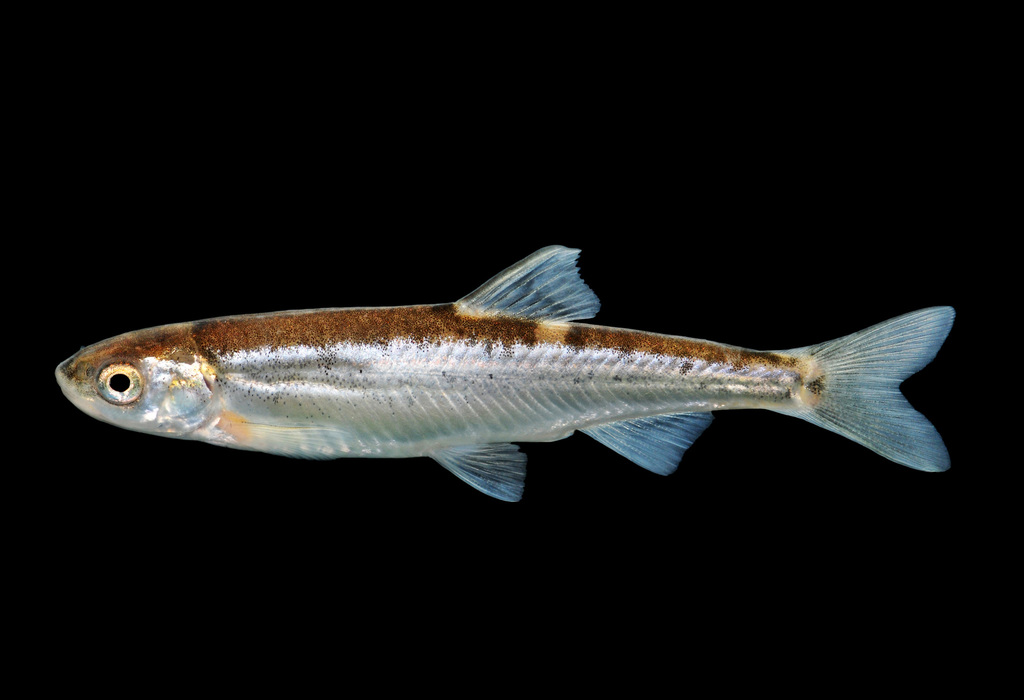
(c) Tom Kennedy, some rights reserved (CC BY) · licence
Family: Unknown · Class: Unknown · Order: Unknown
Conservation status: Endangered
Meda fulgida (Spikedace) is a California animal in the Unknown family.
The spikedace is a small cyprinid fish endemic to the Gila River basin of Arizona and New Mexico. Adults typically measure 60 to 100 mm (2.4 to 3.9 inches) in total length, with a streamlined, fusiform body adapted for life in flowing water. The species exhibits a silvery coloration with a distinctive pattern of scales that gives it its common name. Males develop breeding tubercles during spawning season, and the species can be distinguished from similar cyprinids by its specific fin ray counts and body proportions. Historically, spikedace were distributed throughout much of the Gila River basin, including the mainstem Gila River upstream of Phoenix and major tributaries including the Verde, Agua Fria, Salt, San Pedro, and San Francisco River subbasins in Arizona, extending into the Gila Wilderness area of New Mexico. The species was once common in headwater streams draining the Mogollon Rim and White Mountains. Current distribution is severely fragmented, with populations now restricted to upstream portions of their historical range in geographically isolated stream segments. Spikedace inhabit flowing water with slow to moderate velocities over sand, gravel, and cobble substrates. They show a strong preference for specific microhabitats, particularly shear zones where rapid flow borders slower flow areas. These transition zones provide optimal feeding opportunities and refuge from predators. The species requires clean, well-oxygenated water with minimal siltation and appears sensitive to habitat modifications that alter natural flow regimes. Spikedace are drift-feeding insectivores, with dietary preferences changing ontogenetically. Post-larval individuals consume small, soft-bodied invertebrates, while adults feed primarily on drifting terrestrial and aquatic insects. Spawning typically occurs in spring when water temperatures and flow conditions are favorable. Adults move to suitable spawning areas with appropriate substrate composition, where females deposit adhesive eggs on clean gravel and cobble. The U.S. Fish and Wildlife Service listed the spikedace as threatened on July 1, 1986, and later reclassified it as endangered. Critical habitat was designated on February 23, 2012, encompassing eight units across river subbasins including the Verde River, Salt River, San Pedro, Bonita Creek, Eagle Creek, San Francisco River, Blue River, and Gila River subbasins. The species has experienced dramatic population declines due to habitat destruction from damming, channel alteration, water diversions, and groundwater pumping. Competition and predation by non-native aquatic species represent ongoing primary threats. Many current populations are small and isolated, making them vulnerable to local extirpation. Recovery efforts focus on habitat restoration, non-native species control, and maintaining adequate stream flows to support remaining populations. The species' survival depends on protecting existing habitat and restoring connectivity between fragmented populations throughout its historical range.
Classification
Class: Unknown · Order: Unknown · Family: Unknown
Conservation status
Endangered
Frequently asked questions
How is Meda fulgida classified?
Meda fulgida belongs to class Unknown, order Unknown, family Unknown.
What family does Meda fulgida belong to?
Meda fulgida is in the Unknown family.
Is Meda fulgida protected or of conservation concern?
Meda fulgida carries the following status: Endangered.
What is Meda fulgida?
The spikedace is a small cyprinid fish endemic to the Gila River basin of Arizona and New Mexico.
Is Meda fulgida found in California?
Yes. Meda fulgida is recorded in California in The California Species Project's catalogue.
Related species
Other California species in the same genus, family, or bioregion.
Data from The California Species Project — 14,000+ California species with verified data from CNPS, CDFW, USFWS, and more.