Megabalanus californicus
California Barnacle
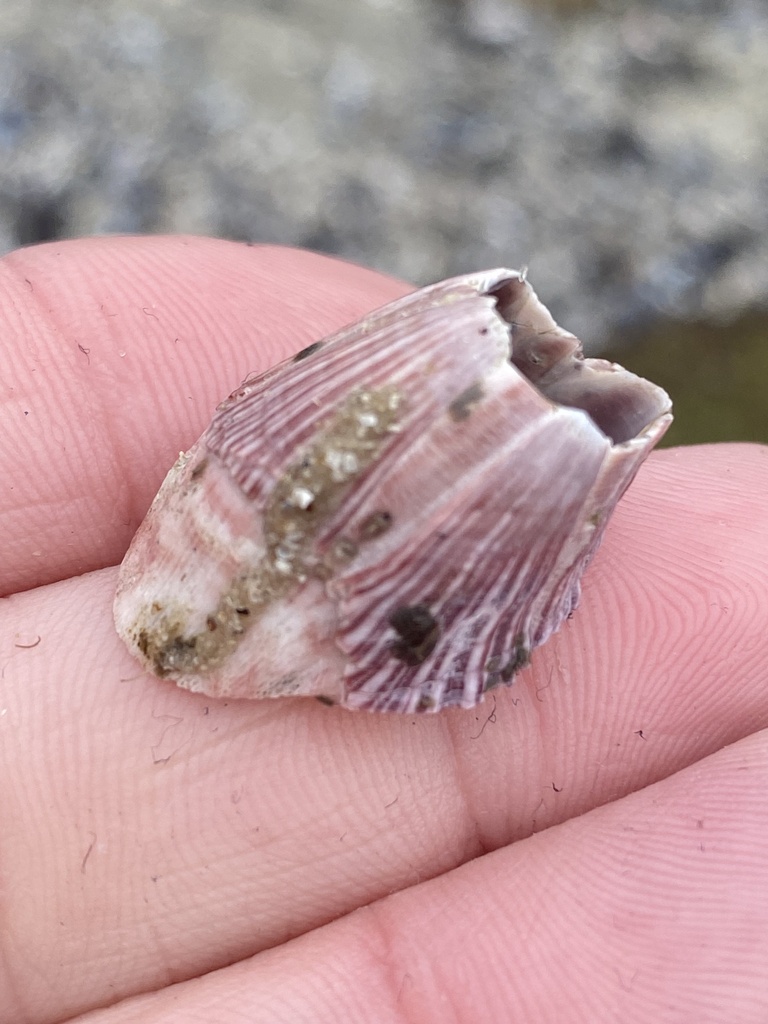
(c) Rebecca Johnson, some rights reserved (CC BY) · licence
Family: Balanidae · Class: Thecostraca · Order: Sessilia
Megabalanus californicus (California Barnacle) is a California animal in the Balanidae family.
The California barnacle (Megabalanus californicus) is a large sessile marine crustacean in the family Balanidae. Adults develop substantial calcareous shells composed of six triangular plates that form a cone-shaped structure, typically measuring 50-75 mm (2.0-3.0 inches) in basal diameter and reaching heights of 40-60 mm (1.6-2.4 inches). The shell plates are white to grayish-white with distinct growth ridges, and the operculum consists of four movable plates that can close tightly when the animal retracts. This species occurs along the Pacific coast from central California to Baja California, Mexico. In California, populations are documented from Monterey Bay southward to the Mexican border, with particularly dense concentrations in Southern California waters. The species inhabits both open coast and semi-protected bay environments, typically in areas with moderate to strong wave action. California barnacles attach permanently to hard substrates in the intertidal and shallow subtidal zones, typically from mean low water to depths of approximately 20 meters (66 feet). They colonize natural rock surfaces, pier pilings, jetties, and other artificial structures. The species shows preference for areas with good water circulation and adequate plankton supply. Adults can tolerate brief periods of aerial exposure during extreme low tides but are primarily subtidal in distribution. As filter feeders, California barnacles extend their feathery cirri through the opercular opening to capture zooplankton, phytoplankton, and organic detritus from the water column. Feeding activity increases with water movement, as stronger currents bring more food particles within reach. The species exhibits typical barnacle reproductive behavior, functioning as simultaneous hermaphrodites. Individuals cross-fertilize with nearby barnacles through extended reproductive organs. Spawning typically occurs during warmer months, with larvae undergoing several planktonic stages before settling and metamorphosing into juvenile barnacles. Reproductive success depends heavily on larval settlement patterns and substrate availability. The cyprid larval stage actively selects settlement sites, often preferring areas near existing barnacle populations. Settlement density can significantly impact individual growth rates and reproductive output through intraspecific competition for space and food resources. No specific conservation status has been assigned to Megabalanus californicus, and the species does not appear on federal or state threatened species lists. Populations appear stable throughout most of the species' range, though local variations may occur due to coastal development, water quality changes, and climate-related oceanographic shifts. The species' ability to colonize artificial structures may provide some resilience to habitat loss from coastal development. However, like other marine invertebrates, California barnacles may face challenges from ocean acidification, which can affect shell formation and structural integrity. Long-term monitoring data for population trends are limited, making it difficult to assess potential impacts from environmental changes or human activities on overall population stability.
Classification
Class: Thecostraca · Order: Sessilia · Family: Balanidae
Frequently asked questions
How is Megabalanus californicus classified?
Megabalanus californicus belongs to class Thecostraca, order Sessilia, family Balanidae.
What family does Megabalanus californicus belong to?
Megabalanus californicus is in the Balanidae family.
What is Megabalanus californicus?
The California barnacle (Megabalanus californicus) is a large sessile marine crustacean in the family Balanidae.
Is Megabalanus californicus found in California?
Yes. Megabalanus californicus is recorded in California in The California Species Project's catalogue.
Related species
Other California species in the same genus, family, or bioregion.
Data from The California Species Project — 14,000+ California species with verified data from CNPS, CDFW, USFWS, and more.