Megaceryle alcyon
Belted Kingfisher
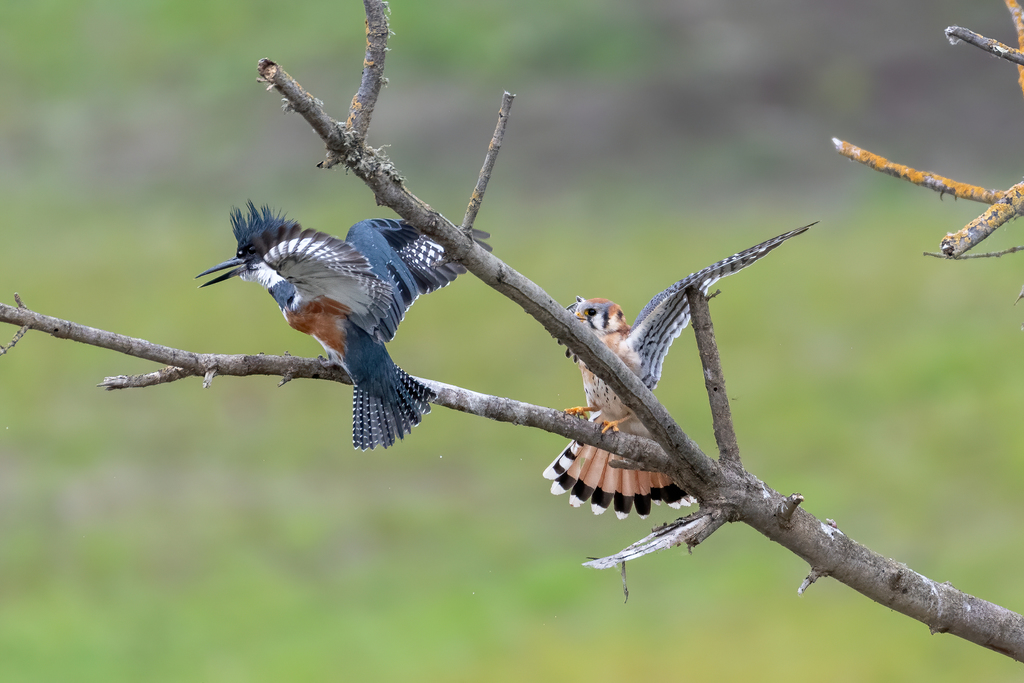
(c) Jonathan Eisen, some rights reserved (CC BY) · licence
Family: Alcedinidae · Class: Aves · Order: Coraciiformes
Megaceryle alcyon (Belted Kingfisher) is a California animal in the Alcedinidae family.
The Belted Kingfisher is a medium-sized bird measuring 28 to 35 cm (11 to 14 inches) in length with a wingspan of 48 to 58 cm (19 to 23 inches). Adults weigh between 113 to 178 grams (4.0 to 6.3 ounces). The species exhibits reverse sexual dimorphism, with females being more colorful than males. Both sexes have a distinctive blue-gray crest, white collar, and blue-gray upperparts. Males display a single blue-gray breast band across white underparts, while females have an additional rufous breast band below the blue-gray band and rufous flanks. The bill is long, straight, and dagger-like, measuring 4 to 5 cm in length, with a dark upper mandible and lighter lower mandible. The tail is relatively short with white spots on blue-gray feathers. Belted Kingfishers have one of the largest breeding ranges of any North American kingfisher, extending from central Alaska and northern Canada south to the southern United States. In California, they breed throughout most of the state, from the northern coastal regions and Central Valley south to the Mexican border. They are year-round residents in much of their California range, though northern populations may migrate south during winter months. The species occurs from sea level to elevations of approximately 2,400 meters (7,900 feet) in mountain areas. This species inhabits areas near water bodies including rivers, streams, lakes, ponds, estuaries, and coastal areas. They require vertical banks or cliffs for nesting, typically 1 to 4 meters high, composed of sand, clay, or soft earth. Preferred fishing areas include clear, shallow waters with adequate fish populations. Belted Kingfishers excavate burrows 0.9 to 2.4 meters (3 to 8 feet) deep in riverbanks, road cuts, or gravel pits, ending in a chamber where eggs are laid. Belted Kingfishers are primarily piscivorous, with fish comprising 80 to 90 percent of their diet. They hunt by diving from perches 3 to 10 meters above water, plunging headfirst to capture prey. Common prey includes small fish such as minnows, sticklebacks, and trout fry, typically 7 to 14 cm in length. They also consume crustaceans, amphibians, reptiles, insects, and occasionally small mammals and birds. Breeding occurs from April through July, with females laying 5 to 8 glossy white eggs in the burrow chamber. Incubation lasts 22 to 24 days, shared by both parents. Young fledge after 27 to 35 days but may return to the burrow for several additional days. The Belted Kingfisher is not federally or state-listed and maintains stable populations across most of its range. According to the North American Breeding Bird Survey, populations have remained relatively stable since 1966, with slight regional variations. The species benefits from beaver activity, which creates suitable habitat through pond formation and bank erosion. Primary threats include habitat loss from channelization of waterways, bank stabilization projects, and water pollution that reduces fish populations. Climate change may affect northern breeding populations through altered precipitation patterns and stream flow regimes.
Classification
Class: Aves · Order: Coraciiformes · Family: Alcedinidae
Frequently asked questions
How is Megaceryle alcyon classified?
Megaceryle alcyon belongs to class Aves, order Coraciiformes, family Alcedinidae.
What family does Megaceryle alcyon belong to?
Megaceryle alcyon is in the Alcedinidae family.
What is Megaceryle alcyon?
The Belted Kingfisher is a medium-sized bird measuring 28 to 35 cm (11 to 14 inches) in length with a wingspan of 48 to 58 cm (19 to 23 inches).
Is Megaceryle alcyon found in California?
Yes. Megaceryle alcyon is recorded in California in The California Species Project's catalogue.
More California species
This species has no close relatives in our California data — here are other species to explore.
Data from The California Species Project — 14,000+ California species with verified data from CNPS, CDFW, USFWS, and more.