Megachile angelarum
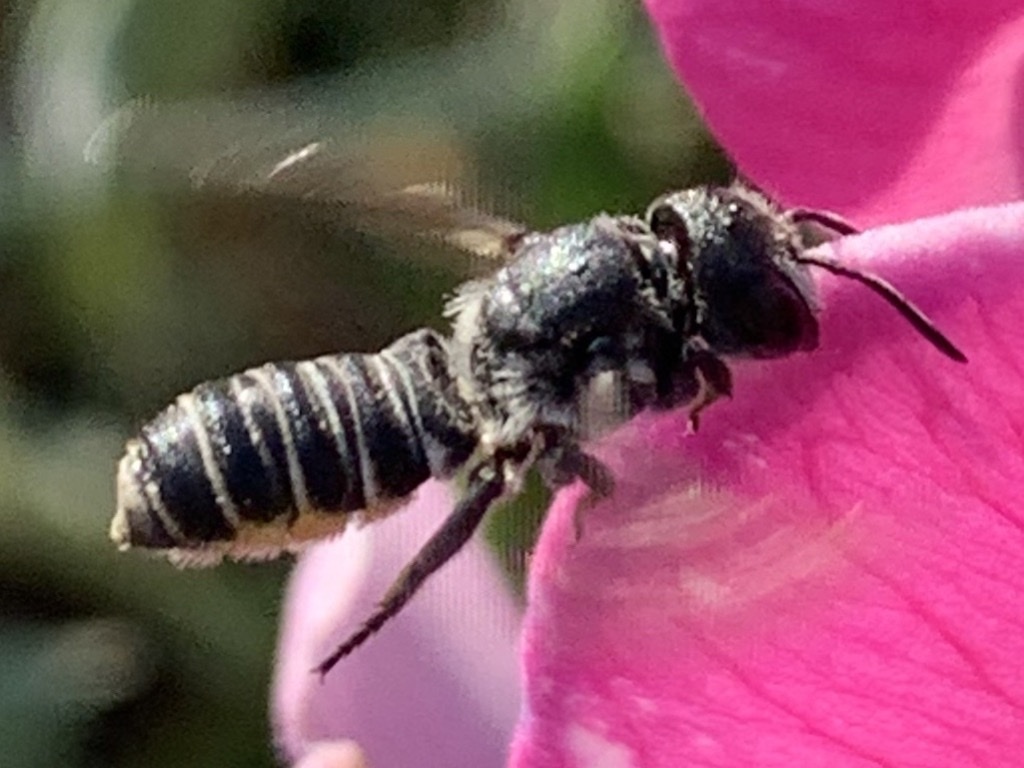
(c) eebee, some rights reserved (CC BY) · licence
Family: Megachilidae · Class: Insecta · Order: Hymenoptera
Megachile angelarum is a California animal in the Megachilidae family.
Megachile angelarum is a solitary bee in the leafcutter and resin bee genus Megachile, subfamily Megachilinae. This species belongs to the subgenus Chelostomoides and was first described by Cockerell in 1902. Females measure 10-11 mm in length, while males are slightly smaller at 8-9 mm (BugGuide). The species exhibits typical megachilid morphology with a robust body structure adapted for collecting and transporting nest-building materials. Megachile angelarum occurs across western North America, with a documented range extending from southern British Columbia south to Tijuana, Mexico, with scattered records elsewhere (NatureServe 2019). This distribution encompasses much of the western United States, including California, where the species can be found in suitable habitats throughout the state. The broad latitudinal range suggests considerable ecological adaptability across different climatic zones. The species inhabits diverse western ecosystems, though specific habitat preferences have not been comprehensively documented in the scientific literature. Like other members of the subgenus Chelostomoides, M. angelarum likely occurs in areas with adequate nesting sites and floral resources. Many Megachile species utilize existing cavities in wood, stems, or other natural substrates for nest construction, suggesting this species may require habitats with appropriate nesting infrastructure. As a member of the Megachilidae family, M. angelarum exhibits solitary nesting behavior typical of leafcutter and resin bees. Females construct individual nests and provision them with pollen and nectar for developing larvae. The species likely collects plant resins or other materials to construct nest partitions and closures, a characteristic behavior of the subgenus Chelostomoides. Specific host plant relationships and foraging preferences remain poorly documented in available literature. Flight periods and reproductive timing have not been well characterized for this species. Regarding conservation status, NatureServe assigned M. angelarum a global rank of G3G4, indicating the species is either vulnerable to extirpation (G3) or apparently secure (G4) across its range (NatureServe 2019). This ranking was last reviewed in December 2019. The species does not appear on federal or state endangered species lists. However, like many native bee species, M. angelarum may face threats from habitat loss, pesticide use, climate change, and competition from introduced species. The relatively broad geographic distribution may provide some resilience against localized threats. Detailed ecological studies of M. angelarum remain limited despite its widespread western distribution. The species represents one of numerous native bee taxa requiring additional research to understand population trends, habitat requirements, and conservation needs. Current knowledge gaps include specific nesting biology, host plant relationships, seasonal activity patterns, and population status across the species' range.
Classification
Class: Insecta · Order: Hymenoptera · Family: Megachilidae
Frequently asked questions
How is Megachile angelarum classified?
Megachile angelarum belongs to class Insecta, order Hymenoptera, family Megachilidae.
What family does Megachile angelarum belong to?
Megachile angelarum is in the Megachilidae family.
What is Megachile angelarum?
Megachile angelarum is a solitary bee in the leafcutter and resin bee genus Megachile, subfamily Megachilinae.
Is Megachile angelarum found in California?
Yes. Megachile angelarum is recorded in California in The California Species Project's catalogue.
Related species
Other California species in the same genus, family, or bioregion.
Data from The California Species Project — 14,000+ California species with verified data from CNPS, CDFW, USFWS, and more.