Megachile fidelis
Horn-faced Leafcutter Bee
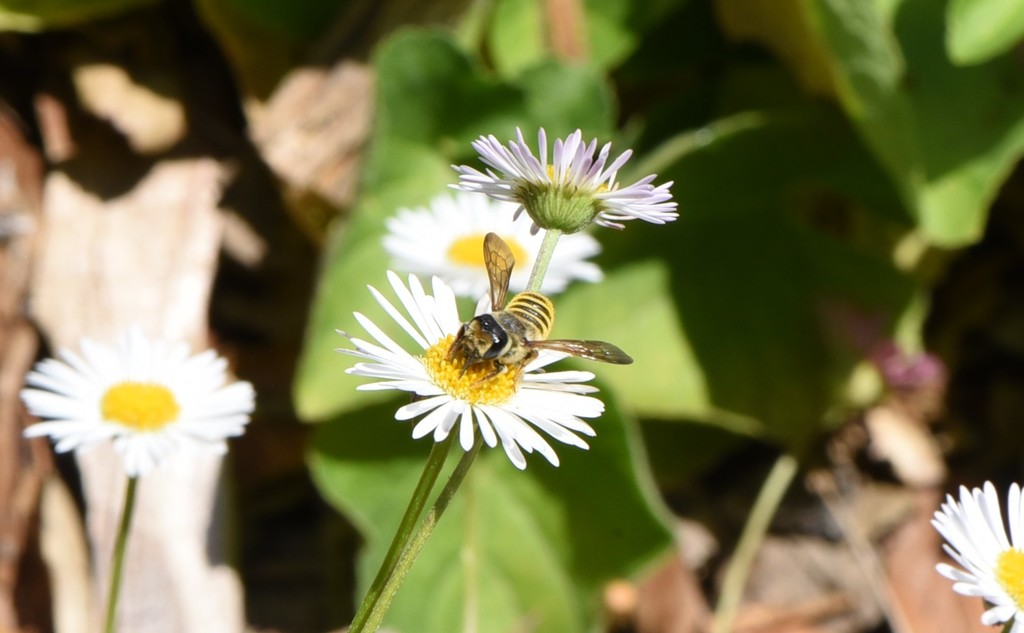
(c) Kylie Etter, some rights reserved (CC BY) · licence
Family: Megachilidae · Class: Insecta · Order: Hymenoptera
Megachile fidelis (Horn-faced Leafcutter Bee) is a California animal in the Megachilidae family.
The Horn-faced Leafcutter Bee is a solitary bee species in the family Megachilidae, distinguished by the characteristic leafcutting behavior that gives this group its common name. Like other leafcutter bees, M. fidelis carries pollen on specialized hairs (scopa) located on the underside of its abdomen rather than on its hind legs, a key identifying feature of the megachilid family (Xerces Society 2018). Megachile fidelis has a wide distribution across North America, with populations considered secure due to its extensive range and presumed large population size (NatureServe 2025). The species occurs across diverse habitats throughout much of the continental United States, demonstrating the adaptability typical of many leafcutter bee species. This species inhabits a variety of open and semi-open habitats characteristic of leafcutter bees generally, including shrublands, prairies, gardens, and forest openings. Dense forests with reduced understories appear to be poor habitats for leafcutter bees, as these environments lack suitable nesting sites and floral resources (NatureServe 2016). Suitable habitat requires the presence of dead wood, logs, or other materials containing beetle tunnels and similar cavities where females can establish nests, as well as appropriate vegetation for leaf collection and nectar sources. Female Horn-faced Leafcutter Bees construct their nests in pre-existing cavities, typically beetle tunnels in dead wood or similar hollow spaces. Following the typical megachilid pattern, females cut circular or oval pieces from leaves and flower petals to line their nest cells and create partitions between individual brood cells. Each cell is provisioned with a ball of pollen and nectar before a single egg is deposited. The larva develops within this sealed cell, consuming the provided food stores before pupating and eventually emerging as an adult. As pollinators, leafcutter bees including M. fidelis play important ecological roles in plant reproduction. Leafcutter bees are documented as key pollinators of native plants in various ecosystems, including coastal dunes in California (NatureServe 2016). Their foraging activities on diverse flowering plants contribute to both wild plant community maintenance and agricultural crop pollination, though their specific host plant preferences and pollination effectiveness remain largely undocumented for many species. The conservation status of Megachile fidelis reflects its widespread distribution and stable populations. The species currently holds no federal or state conservation listings, and NatureServe ranks it as secure globally. However, leafcutter bees as a group face potential challenges from habitat loss, particularly the removal of dead wood that provides essential nesting sites, and climate-related stressors. In southwestern regions, prolonged droughts may be detrimental to species with smaller ranges, though the extent to which leafcutter bees can survive extended dry periods through diapause remains poorly understood (NatureServe 2016). The species' apparent adaptability to various habitat types and broad distribution suggest relative resilience to current environmental pressures.
Classification
Class: Insecta · Order: Hymenoptera · Family: Megachilidae
Frequently asked questions
How is Megachile fidelis classified?
Megachile fidelis belongs to class Insecta, order Hymenoptera, family Megachilidae.
What family does Megachile fidelis belong to?
Megachile fidelis is in the Megachilidae family.
What is Megachile fidelis?
The Horn-faced Leafcutter Bee is a solitary bee species in the family Megachilidae, distinguished by the characteristic leafcutting behavior that gives this group its common name.
Is Megachile fidelis found in California?
Yes. Megachile fidelis is recorded in California in The California Species Project's catalogue.
Related species
Other California species in the same genus, family, or bioregion.
Data from The California Species Project — 14,000+ California species with verified data from CNPS, CDFW, USFWS, and more.