Megachile parallela
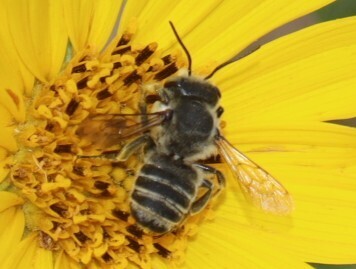
(c) Rich Sommer, some rights reserved (CC BY) · licence
Family: Megachilidae · Class: Insecta · Order: Hymenoptera
Megachile parallela is a California animal in the Megachilidae family.
Megachile parallela is a leafcutter bee belonging to the family Megachilidae. This species is part of the subgenus Argyropile and represents one of the more widespread North American leafcutter bees. Adult females typically measure 10-12 mm in length, with robust, dark bodies covered in dense hairs. The species exhibits sexual dimorphism, with females possessing specialized ventral scopa (pollen-carrying hairs) beneath their abdomens, while males are generally smaller and lack these structures. The body coloration ranges from dark brown to black, with lighter-colored hair bands across the abdomen. Megachile parallela has an extensive range across North America, from Canada south to Costa Rica. Within the United States, this species occurs throughout most regions, making it one of the most geographically widespread members of its genus. The species demonstrates broad ecological adaptability, occurring across diverse climatic zones from temperate to subtropical regions. Its wide distribution reflects its ability to utilize various host plants and nesting sites across different ecosystems. This leafcutter bee inhabits diverse habitats including prairie grasslands, woodland edges, suburban gardens, and agricultural areas. The species shows particular association with areas containing abundant flowering plants, especially members of the Asteraceae family (Mitchell 1962). Megachile parallela constructs nests in pre-existing cavities, including hollow plant stems, beetle borings in wood, and artificial nest sites such as drilled blocks (Michener 2007). Females line nest cells with circular leaf pieces cut from various plant species, creating distinctive cylindrical brood cells. Females are active pollinators that collect pollen primarily from composite flowers, including sunflowers, asters, and other members of the Asteraceae family. The species demonstrates oligolectic tendencies, showing preference for specific plant families while maintaining some dietary flexibility (Sheffield et al. 2003). Adults are most active during summer months, with peak activity typically occurring from June through August. Females provision individual nest cells with pollen balls mixed with nectar, laying a single egg per cell (Krombein et al. 1979). The complete life cycle from egg to adult typically requires 6-8 weeks under favorable conditions. Megachile parallela maintains stable populations across most of its range, with no immediate conservation concerns due to its wide distribution and habitat flexibility. However, like many native bee species, populations may face localized pressures from habitat loss, pesticide use, and landscape fragmentation. The species' broad geographic range and ecological adaptability provide some resilience against regional threats. Climate change may affect leafcutter bees through altered flowering phenology and increased overwinter mortality, though direct temperature effects are unlikely given the species' wide latitudinal range. Conservation efforts benefiting this species include maintaining diverse flowering plant communities, reducing pesticide applications during active foraging periods, and preserving nesting habitat through retention of dead wood and plant stems. The species serves as an important pollinator for both wild plants and some agricultural crops within its range.
Classification
Class: Insecta · Order: Hymenoptera · Family: Megachilidae
Frequently asked questions
How is Megachile parallela classified?
Megachile parallela belongs to class Insecta, order Hymenoptera, family Megachilidae.
What family does Megachile parallela belong to?
Megachile parallela is in the Megachilidae family.
What is Megachile parallela?
Megachile parallela is a leafcutter bee belonging to the family Megachilidae.
Is Megachile parallela found in California?
Yes. Megachile parallela is recorded in California in The California Species Project's catalogue.
Related species
Other California species in the same genus, family, or bioregion.
Data from The California Species Project — 14,000+ California species with verified data from CNPS, CDFW, USFWS, and more.